Your deal desk approves six-figure discounts based on a Slack message and a hunch about a rep's optimism.
The request arrives the way it always does: "Need 18% to get this done by quarter-end — competitive pressure." The approver — deal desk lead, RevOps owner, sometimes the CRO themselves — sees a number, a stage, and a one-line justification. What they cannot see is the conversation where the buyer mentioned their budget ceiling in passing, the call where "competitive pressure" turned out to be a single offhand remark, or the QBR where the customer's economic buyer described the project as mission-critical. The people governing price have the least access to the evidence that should govern it.
So deal desks run on proxies — rep narratives, stage labels, quarter-end pressure — and the result is the worst of both worlds: approvals slow enough to frustrate sellers, and decisions blind enough to leak margin. The fix arriving in 2026 is the AI deal desk: approval workflows grounded in what buyers actually said. The interesting part is that the speed-versus-discipline tradeoff everyone assumes turns out to be false — evidence improves both at once.
Deal desks exist to protect pricing integrity while keeping deals moving — two goals in permanent tension when decisions run on secondhand information. Consider what the standard approval packet contains, and what it conceals:
None of this reflects bad faith. The evidence simply lived somewhere the approval workflow couldn't reach: in the deal's conversations. As McKinsey's pricing and growth research has tracked, B2B organizations are moving pricing workflows onto agentic AI rails — yet the governance-heavy approval step has lagged, precisely because automating a blind decision just makes the blindness faster.
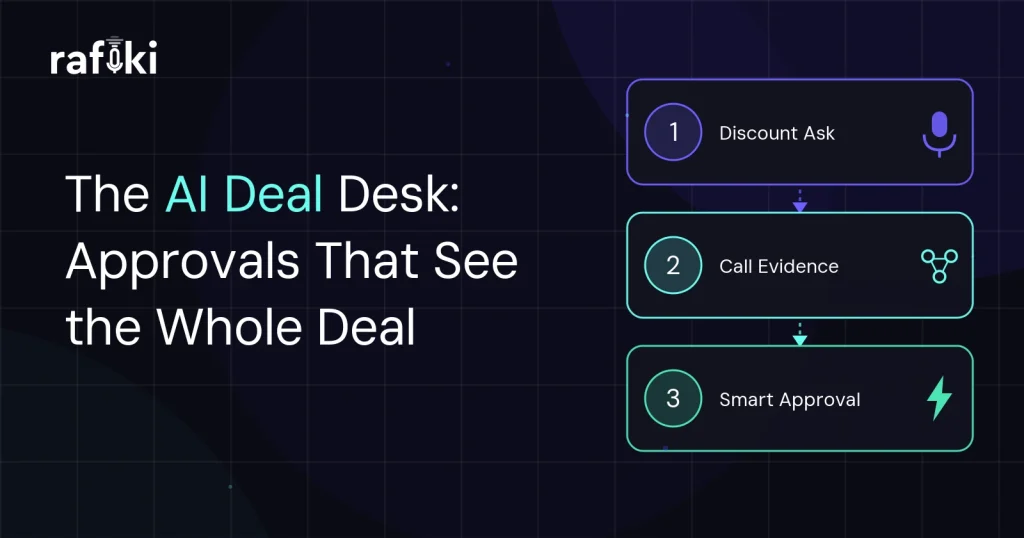
An AI deal desk is an approval workflow in which discount and exception decisions are grounded in the deal's full evidence record — conversation signals, commitment history, engagement data — assembled automatically and attached to every request, with AI handling the evidence and humans retaining the judgment. It is not a pricing bot that approves autonomously; it is the end of approvals-by-anecdote.
The architecture has three layers:
The shift mirrors what we described for board reporting in revenue board reporting: the decision process doesn't change owners — it changes evidence standards.
Grounded approvals work because a handful of conversation-derived signals answer most of what a deal desk actually needs to know:
Did price resistance come from the buyer, and from whom? An economic buyer saying "this is beyond our band" is a real constraint. A technical champion speculating about what finance might say is not. And silence — no price pushback in any call — is the strongest signal of all, because it means the discount request originated on your side of the table.
Was a competitor named? Did the buyer describe an active evaluation, or mention an incumbent in passing? The evidence converts "competitive pressure" from an unfalsifiable claim into a checkable one — which protects the genuine bidding wars as much as it exposes the bluffs.
Quarter-end discounts only make sense against buyer-confirmed timing. If no buyer voice ever agreed to the date, the time-boxed concession is a gift to a timeline that doesn't exist. The record settles it in one query.
A deal with rising stakeholder breadth and buyer-side action items is one where patience has leverage. A deal whose engagement has decayed for six weeks may genuinely need the concession — or may be past saving regardless. Either way, the approver should know which deal they're pricing.
Has the buyer articulated the value case in their own words — the operational pain, the cost of doing nothing? Deals where the customer has spoken the ROI aloud sustain price far better than deals where value lives only in the seller's deck. The strongest pushback on a discount request is often the buyer's own recorded words.
| Question | Blind approval packet | Evidence-grounded packet |
|---|---|---|
| Who raised price? | Unknown — "it's competitive" | Named speaker, quoted moment, or: nobody did |
| Competitor in play? | Rep's assertion | Actual mentions across the call record, in context |
| Is the date real? | CRM close date | Buyer-confirmed timeline, or its absence |
| Deal health | Stage label | Engagement trend, methodology completeness, open objections |
| Precedent | Approver's memory | Similar deals' actual outcomes by segment |
| Decision time | Days of investigation | Minutes of reading |
The right column is not a future-state fantasy — every row is a query against a record that conversation capture already builds. The only structural change is attaching the answers to the request instead of leaving the approver to hunt for them.
Everything above applies with more force to renewals, where the approval question is usually a discount to *retain* rather than to win — and where blind decisions are costlier in both directions. A retention discount granted to a customer whose calls show healthy engagement and spoken value acknowledgment is pure margin donation; a hardline stance with a customer whose QBRs have been quietly deteriorating for two quarters is how "surprise churn" gets manufactured at the negotiating table.
The renewal evidence set looks slightly different from the new-business one:
Teams that ground the renewal desk first often see the faster payback, because retention pricing decisions compound across the entire installed base every quarter.
Deal desks have always traded speed against discipline — tight governance meant slow approvals; fast approvals meant rubber stamps. Evidence dissolves the tradeoff, because the slow part was never the decision. It was the investigation: the Slack threads, the "quick call to understand the deal," the back-and-forth that exists only because the approver couldn't see the deal directly.
With evidence attached at request time:
The cultural effect compounds quietly: when reps know requests are read against the record, requests get better. The deal desk stops being the place where narratives are tested and becomes the place where evidence is priced.
The series rule applies here with extra force, because pricing touches strategy, precedent, and relationships at once. The AI deal desk assembles evidence; it does not:
Rafiki AI is an AI-native revenue intelligence platform whose entire architecture — one conversational source of truth, consumed by autonomous AI agents — is what an evidence-grounded deal desk runs on.
For RevOps leaders who own the approval workflow, the practical change is that the deal desk plugs into the same record the rest of the revenue motion already runs on — no new data entry, no parallel system, with 60+ language coverage so global pricing governance reads every region's deals the same way.
No — and resisting that design is the point. Approval remains a named human's judgment; what changes is the information that judgment runs on. Teams sometimes automate the easiest tier (small discounts, clean evidence, within policy) as a fast lane, but the architecture's value is grounded decisions, not removed deciders. An autonomous approver with blind spots would simply leak margin faster.
Even more directly. In companies where the CRO or a RevOps lead plays deal desk part-time, approvals-by-anecdote consume executive attention the company can't spare, and pricing discipline depends entirely on one person's memory. The evidence layer gives a lightweight approval process the rigor of a staffed desk — it is the deal desk you can run before you can afford one.
It gives the retro a fact base. Most pricing reviews argue from aggregate discount rates and anecdote; an evidence-grounded desk can ask sharper questions: which discounts were buyer-driven versus seller-initiated, how often "competitive pressure" was evidenced versus asserted, and what concessions actually correlated with on-time closes. Those patterns turn the review from a blame exercise into policy refinement — the discount floor, the approval tiers, and the coaching priorities all get adjusted against what conversations show, not what the quarter felt like.
With the record, then one workflow. Capture and structure the conversations first — nothing works without the evidence layer. Then pick the single highest-leak approval path, usually net-new discounts above a threshold, and attach evidence to those requests for a quarter: price-sensitivity provenance, competitive reality, timeline confirmation. The before/after on that one path — approval speed, discount depth, and how request quality changes — builds the case for extending evidence-grounding to renewals, exceptions, and the rest of the pricing surface.
Every discount approval is a bet about what a buyer would actually pay, and for years deal desks have placed that bet on the testimony of the most invested witness available. The discipline problems that follow — margin leak, approval theater, quarter-end gifting — are not character flaws in sellers or approvers. They are what any governance process produces when it cannot see its own subject.
The AI deal desk fixes the visibility, and the rest follows: faster yeses on real constraints, earlier catches on manufactured ones, precedent that accumulates as pattern instead of folklore. Price governance finally gets what every other revenue function is getting from the conversation record — the ability to decide from evidence rather than recollection.
Rafiki AI's autonomous AI agents put the whole deal's evidence behind every approval. Plans start at $19 per seat per month with no seat minimums and no annual commitment. Start your free trial today or book a demo and run your next discount request against what the buyer actually said.
Start for free — no credit card, no seat minimums, no long contracts. Just better sales intelligence.