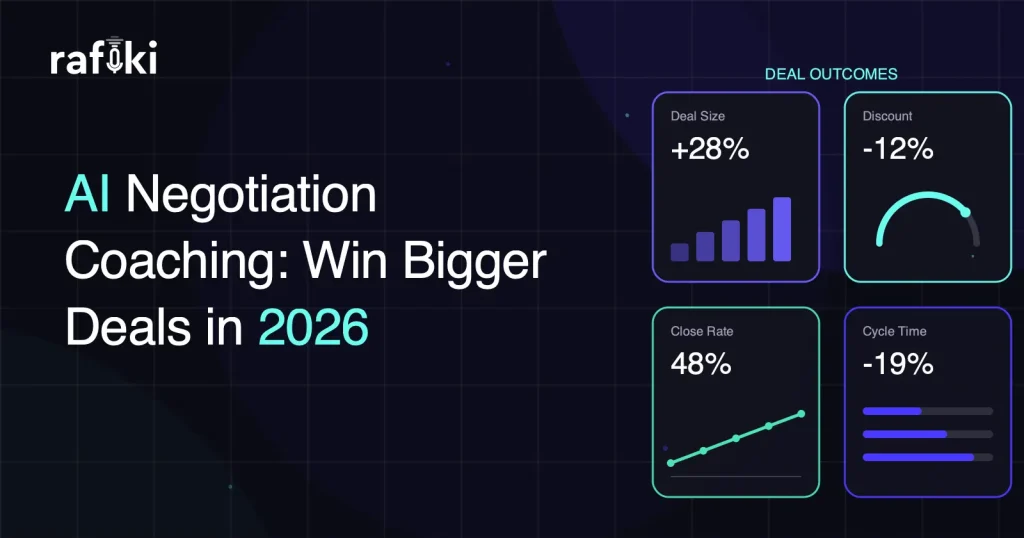
Your reps are losing deals in the final moments of pricing negotiations because nobody catches the subtle buyer signals that reveal which concessions to make and which battles to fight.
The most expensive minutes in B2B sales happen during pricing conversations. A single misread signal, an ill-timed discount, or a failure to recognize genuine budget constraints versus negotiation theater can cost significant margin or kill a deal entirely. Yet most sales teams treat these critical moments as gut-feel exercises, relying on individual rep intuition rather than systematic intelligence.
The stakes continue to rise. Deal cycles are longer, buying committees are larger, and pricing decisions get scrutinized by procurement teams trained to extract maximum concessions. Meanwhile, competition is getting smarter about positioning value propositions and timing pricing moves. The teams that master AI negotiation coaching in 2026 will systematically outmaneuver those still operating on instinct alone.
Traditional sales negotiation training teaches frameworks and tactics, but it cannot prepare reps for the infinite variations of real buyer behavior. Every pricing conversation contains numerous micro-signals about budget authority, competitive pressure, timeline urgency, and value perception. Human brains struggle to process and pattern-match this complexity in real-time, especially under the pressure of a live negotiation.
The result is predictable value leakage across sales organizations:
The fundamental issue is that pricing negotiations are information warfare, and most sales teams are fighting with incomplete intelligence. They cannot see the patterns across similar conversations or identify the subtle linguistic cues that may predict negotiation outcomes.
Human negotiators excel at reading obvious signals and building rapport, but they often miss the data patterns that may influence negotiation outcomes. Every pricing conversation generates multiple layers of intelligence that remain invisible to even experienced reps.
The hidden intelligence includes conversation sentiment shifts, keyword frequency patterns, and timing dynamics:
This intelligence exists in every conversation, but it flows past human consciousness at conversation speed. By the time most reps recognize a pattern, the negotiation moment has passed. The teams that systematically capture and analyze this intelligence can gain decisive advantages in subsequent pricing conversations.
AI negotiation coaching transforms pricing conversations from intuitive exercises into data-driven strategic engagements. Machine learning models can analyze numerous negotiation conversations to identify the linguistic patterns, timing sequences, and contextual factors that may predict successful outcomes.
The AI advantage operates across multiple analytical dimensions simultaneously:
The most sophisticated AI models learn from every pricing conversation across your organization, constantly refining their understanding of what works in your specific market, with your buyer personas, against your competitive set. This creates a continuous learning loop that can make your entire team smarter with every negotiation.
Human negotiators typically focus on one or two obvious signals during pricing discussions. AI systems can simultaneously track numerous variables and identify complex interaction effects that may influence negotiation outcomes. This multi-dimensional analysis reveals negotiation opportunities and risks that remain invisible to traditional approaches.
Effective AI negotiation coaching requires a systematic approach that combines pre-negotiation intelligence, real-time guidance, and post-conversation analysis. This creates a continuous improvement loop that can make every subsequent pricing conversation more effective.
The framework operates through four integrated phases:
This systematic approach ensures that negotiation intelligence compounds over time. Each conversation generates insights that can improve performance in future negotiations, creating a sustainable competitive advantage that grows stronger with scale.
The most valuable negotiation intelligence often exists in the spaces between explicit statements. AI systems excel at identifying these subtle signals and translating them into actionable strategic guidance.
Critical signal categories include budget authenticity, decision-making authority, and competitive pressure indicators:
Advanced AI models can also identify interaction effects between different signal types. For example, urgent timeline pressure combined with specific budget language patterns might indicate a high-probability close opportunity, while similar timeline language with different contextual signals might suggest negotiation theater.
Rafiki's AI-native revenue intelligence platform transforms every pricing conversation into structured negotiation intelligence through its autonomous AI agents. The platform's Smart Call Scoring capability automatically analyzes negotiation conversations against proven frameworks like MEDDIC and BANT, identifying budget authority signals, decision criteria, and competitive dynamics in real-time.
The system's six-agent architecture provides comprehensive negotiation support across the entire sales cycle:
Unlike traditional conversation intelligence tools that require manual analysis, Rafiki's AI sales agents operate autonomously, providing negotiation insights without additional rep workload. The platform's 60+ language support ensures consistent negotiation intelligence across global sales teams, while its no-seat-minimum pricing makes enterprise-grade negotiation coaching accessible to growing teams.
Rafiki's Smart Call Scoring specifically identifies negotiation readiness signals and flags pricing conversation opportunities that might otherwise go unrecognized. This systematic approach ensures that every pricing discussion generates actionable intelligence for future negotiations.
Rafiki's AI agents provide contextual negotiation guidance during live conversations, analyzing buyer responses in real-time and suggesting optimal strategic moves. This capability transforms experienced reps into negotiation experts and accelerates the development of junior team members.
Successful AI negotiation coaching implementation requires a phased approach that builds capabilities systematically while generating early wins to drive adoption across the sales organization.
The implementation follows a structured four-phase rollout:
Each phase builds upon previous capabilities while introducing new levels of sophistication. This approach ensures that teams develop confidence with AI-powered insights before relying on real-time guidance during high-stakes negotiations.
Effective implementation requires specific metrics that track both process adoption and business outcomes. Key performance indicators include conversation intelligence coverage, negotiation win rates, and average deal size progression. Regular optimization based on these metrics ensures continuous improvement in AI coaching effectiveness.
The most complex B2B negotiations involve multiple stakeholders with different priorities, concerns, and decision-making authority. AI systems excel at tracking these multi-dimensional conversations and identifying optimal influence strategies for each participant.
Advanced negotiation intelligence capabilities include stakeholder influence mapping and consensus-building strategy development:
These advanced capabilities become increasingly valuable in enterprise negotiations where success depends on navigating complex organizational dynamics rather than simply presenting compelling value propositions.
The next evolution in AI negotiation coaching involves predictive modeling that anticipates buyer responses to different pricing strategies before conversations occur. These systems will analyze historical negotiation patterns, current deal characteristics, and market dynamics to recommend optimal negotiation sequences.
Predictive capabilities will enable sales teams to approach negotiations with unprecedented strategic sophistication. Rather than reacting to buyer moves, teams will anticipate objections, prepare optimal responses, and sequence their pricing discussions for maximum effectiveness.
The competitive advantages compound as these systems learn from every negotiation across the organization:
Organizations that develop these predictive negotiation capabilities in 2026 will establish sustainable advantages that become increasingly difficult for competitors to match.
AI negotiation coaching represents the evolution from intuitive deal-making to systematic revenue optimization. The teams that master these capabilities in 2026 will consistently outperform those still relying on traditional negotiation approaches, winning larger deals with better margins while building stronger customer relationships.
The window for competitive advantage remains open, but it is closing rapidly as AI-powered negotiation intelligence becomes table stakes in sophisticated B2B sales environments. Organizations must move beyond traditional conversation recording toward comprehensive negotiation intelligence platforms that provide real-time strategic guidance and continuous learning capabilities.
The choice is between systematic intelligence and continued intuition-based approaches. The market will reward those who choose intelligence.
Ready to transform your pricing conversations into systematic revenue wins? Rafiki's AI-native revenue intelligence platform provides enterprise-grade negotiation coaching starting at $19 per seat with no minimums or annual commitments. Start your free trial today or book a demo to see how six autonomous AI agents can revolutionize your team's negotiation performance.
Start for free — no credit card, no seat minimums, no long contracts. Just better sales intelligence.