AI

AI-Driven SDR Ramp: How to Cut Onboarding Time in Half in 2026

Aruna Neervannan
Jan 22, 2026 5 min read
AI-Driven SDR Ramp: How to Cut Onboarding Time in Half in 2026

SDR Ramp Time Is Quietly Destroying Pipeline Velocity. Most companies obsess over:

  • Lead generation
  • Close rates
  • Sales cycles
  • Forecast accuracy

But one of the biggest hidden revenue leaks is SDR ramp time.

A new SDR typically takes:

  • 60–90 days to become productive
  • 4–6 months to reach full quota performance

During that time:

  • Messaging is inconsistent
  • Discovery depth is shallow
  • Objection handling is weak
  • Qualification is incomplete
  • Meetings convert poorly to opportunities

Multiply that across 5–10 new SDR hires, and the revenue impact becomes massive.

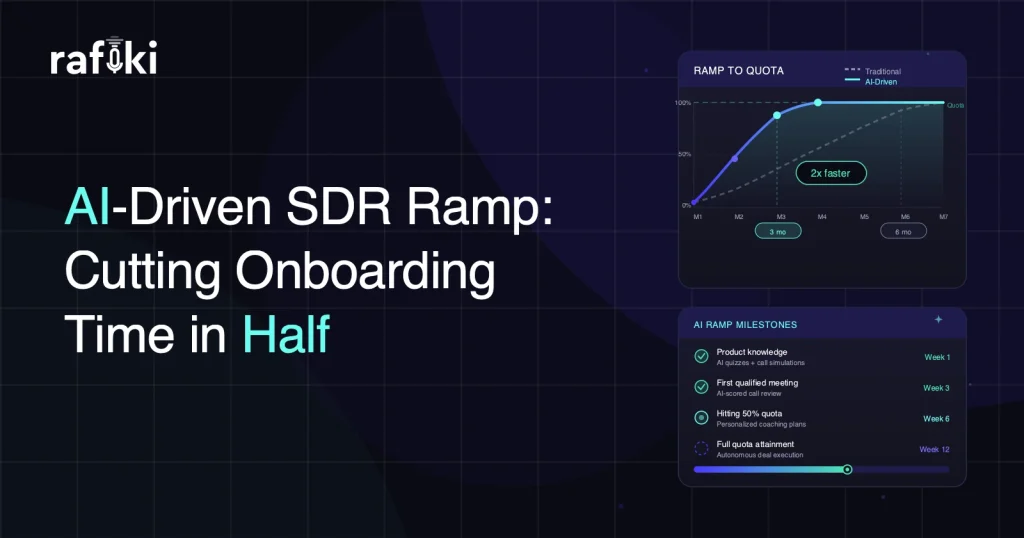
In 2026, high-performing revenue teams are cutting SDR ramp time in half.

Not by adding more training sessions.

But by embedding AI directly into onboarding.

This is where AI-driven SDR ramp — powered by structured conversation intelligence platforms like Rafiki — becomes transformational.


Why Traditional SDR Onboarding Is Slow

Most SDR onboarding follows this model:

Week 1–2:

  • Product training
  • ICP overview
  • Messaging decks

Week 3–4:

  • Shadow calls
  • Script practice
  • Role plays

Month 2:

  • Begin calling live prospects
  • Manager reviews a few calls
  • Feedback given sporadically

Month 3:

  • Performance begins stabilizing

The problem?

Learning is slow because feedback loops are slow.

Managers cannot:

  • Review every call
  • Diagnose subtle qualification gaps
  • Track recurring mistakes across dozens of calls
  • Connect SDR behavior to downstream outcomes

So SDRs learn through trial and error.

AI changes that by shortening feedback cycles dramatically.


What AI-Driven SDR Ramp Actually Means

AI-driven ramp isn’t about replacing onboarding content.

It’s about embedding real-time, structured learning loops into daily execution.

Instead of waiting for weekly feedback, SDRs get:

  • Instant call analysis
  • Structured scoring against methodologies
  • Objection detection
  • Discovery gap identification
  • Benchmark comparison to top performers
  • Suggested improvements for next call

The difference is immediate.

And it depends entirely on high-quality conversation intelligence.


The 4 Accelerators of AI-Driven SDR Ramp

1️⃣ Structured Call Intelligence From Day One

New SDRs don’t need more theory.

They need structured clarity on:

  • What they did right
  • What they missed
  • What top performers do differently

Rafiki captures and analyzes every call and extracts:

  • Topics and subtopics discussed
  • Objections raised
  • Stakeholder signals
  • Qualification completeness (BANT, MEDDIC, SPICED, GAP, etc.)
  • Sentiment trends
  • Next-step clarity

This transforms each live call into a structured learning artifact.

Instead of reviewing 2 calls per week, managers can see trends across 20 calls instantly.


2️⃣ Benchmarking Against Top Performers

One of the most powerful uses of AI in SDR ramp is comparative benchmarking.

New SDRs often ask:

“What does a great discovery call actually sound like?”

With Rafiki, managers can:

  • Identify calls from top-performing SDRs
  • Analyze structured qualification depth
  • Compare objection-handling patterns
  • Benchmark next-step clarity scores
  • Track talk-to-listen balance

Instead of generic advice, new reps see measurable differences.

For example:

Top SDRs:

  • Confirm budget explicitly 78% of the time
  • Identify decision-makers within first call
  • Clarify next steps with specific calendar commitments

New SDR:

  • Budget mentioned but not confirmed
  • Decision-maker inferred, not validated
  • Next step vague

AI surfaces the gap clearly.

That clarity accelerates improvement.


3️⃣ Real-Time Objection Intelligence

New SDRs struggle most with objections:

  • “We already use X.”
  • “Not interested.”
  • “Budget is tight.”
  • “Send me information.”

Without structured tracking, objections feel random.

With AI-driven analysis:

  • Objections are categorized
  • Recurrence patterns are detected
  • Resolution quality is evaluated
  • Managers identify which objections derail meetings most often

Rafiki aggregates objection data across accounts and SDRs, allowing:

  • Targeted objection training
  • Script refinement
  • Best-response libraries built from real conversations

This prevents new SDRs from repeatedly failing in the same way.


4️⃣ Qualification Scoring Before AE Handoff

One of the biggest onboarding failures is poor qualification.

New SDRs often:

  • Book meetings without authority
  • Fail to clarify timeline
  • Avoid budget questions
  • Skip decision process exploration

This leads to low AE conversion.

AI-driven ramp includes qualification scoring.

Rafiki can surface:

  • Missing MEDDIC components
  • Weak SPICED signals
  • Incomplete GAP exploration
  • Vague BANT criteria

Managers can intervene early — before bad habits solidify.


The New SDR Ramp Model (2026)

Instead of 90 days to productivity, AI-enabled teams follow this structure:

Week 1–2: Immersion + AI Shadowing

New SDR reviews:

  • Top-performer calls (structured by Rafiki)
  • Objection trend dashboards
  • Qualification signal examples

Week 3–4: Guided Live Calls

Calls analyzed immediately.
Scorecards auto-generated.
Gap areas highlighted.

Month 2: Behavior Refinement

Managers focus on:

  • Top 2 skill gaps
  • Measurable improvement targets
  • Next-call execution plans

Month 3: Performance Stabilization

Conversion rates begin matching team average.

Ramp time drops by 30–50%.


How Rafiki Powers the AI-Driven Ramp Loop

Rafiki becomes the intelligence backbone of onboarding by:

  • Structuring call intelligence automatically
  • Mapping conversations to methodologies
  • Detecting qualification gaps
  • Categorizing objections
  • Tracking sentiment signals
  • Feeding manager dashboards
  • Enabling performance trend visibility

Instead of onboarding being classroom-heavy, it becomes execution-driven.

Every live conversation becomes structured training data.


The Financial Impact of Cutting Ramp in Half

Let’s quantify.

If an SDR costs $75,000 annually and takes 6 months to reach quota:

That’s 50% productivity loss.

Cut ramp to 3 months, and you:

  • Recover pipeline earlier
  • Increase meeting volume
  • Improve conversion quality
  • Reduce churn risk from poor early experiences
  • Improve SDR morale
  • Lower replacement costs

AI-driven ramp is not just a training improvement.

It’s a revenue multiplier.


Why Static Playbooks No Longer Work

Playbooks assume consistency.

But every conversation is dynamic.

Without conversation intelligence:

  • Managers guess which calls to review
  • Feedback is inconsistent
  • Best practices remain anecdotal
  • Ramp time varies by manager skill

With Rafiki, best practices are extracted from real performance.

Playbooks become data-backed.


The Cultural Shift: From “Figure It Out” to “System-Supported”

Traditional SDR ramp says:

“Shadow calls. Practice scripts. Learn from experience.”

AI-driven ramp says:

“Execute. Get structured feedback. Improve immediately.”

This removes randomness.

New SDRs gain confidence faster because:

  • Mistakes are identified early
  • Gaps are measurable
  • Improvement is visible
  • Coaching is specific

Confidence accelerates productivity.


The Bigger Strategic Advantage

In 2026, competitive advantage in outbound isn’t:

  • More calls
  • Better scripts
  • More tools

It’s faster skill development.

Companies that shorten ramp:

  • Scale outbound faster
  • Adapt messaging quicker
  • Respond to market shifts earlier
  • Outpace competitors in pipeline generation

AI-driven ramp becomes a strategic lever.


Conclusion: Ramp Is No Longer a Waiting Period — It’s an Optimization Phase

For years, SDR ramp was seen as inevitable.

“Everyone takes 3–6 months.”

That assumption is now outdated.

With structured conversation intelligence and AI-driven feedback loops:

  • Skill gaps are identified immediately
  • Objection handling improves rapidly
  • Qualification compliance increases
  • Best practices scale across the team
  • Conversion rates stabilize faster

Rafiki transforms SDR onboarding from passive learning to data-backed execution.

It turns every call into structured pipeline intelligence.

And when onboarding becomes measurable and systematic, ramp time shrinks naturally.

In 2026, the fastest-growing sales teams won’t just hire more SDRs.

They’ll make them productive in half the time.

And AI-driven ramp will be the reason.

Ready to see what
you've been missing?

Start for free — no credit card, no seat minimums, no long contracts. Just better sales intelligence.