Your reps are getting call scores every week, and nothing about how they sell is changing.
Sales leaders have spent the last decade investing in conversation intelligence, scorecards, and weekly one-on-ones. The dashboards look impressive. Managers can rattle off which calls were "good" and which were "bad." Yet ramp times are stubborn, win rates plateau, and the same objection-handling gaps show up in QBR after QBR. The scoring infrastructure is mature. The behavior change is not.
That gap is the single most expensive blind spot in modern revenue organizations. You are paying for a measurement system that produces grades but not growth. Every winnable deal lost to a fumbled discovery question, a missed multi-threading opportunity, or a weak next-step ask is a direct consequence of a coaching loop that never closes. The fix is not more scoring. The fix is AI skill scoring — a system that grades the rep, not just the call, and feeds that signal back into coaching that actually changes behavior.
Most conversation intelligence deployments stop at the call. A rubric scores a single conversation against a checklist — did they confirm budget, did they identify a champion, did they set a clear next step — and the score lives on a dashboard until the next pipeline review. The unit of analysis is the call. But the unit of improvement is the rep.
That mismatch creates predictable failure modes:
Until the data structure shifts from call-centric to rep-centric and skill-centric, coaching remains a ritual rather than a system. You are measuring outputs while pretending to manage inputs.
Open-loop coaching does not just fail to help. It actively burns money. When skill development is not systematic, the costs compound across every quarter you delay — and the coaching loop is where the gap between insight and action across the revenue tech stack is widest.
Consider what an open loop actually costs you:
None of this shows up as a line item. It shows up as a slow erosion of velocity, win rate, and retention that everyone blames on the market. The real culprit is a coaching system that grades but never teaches.
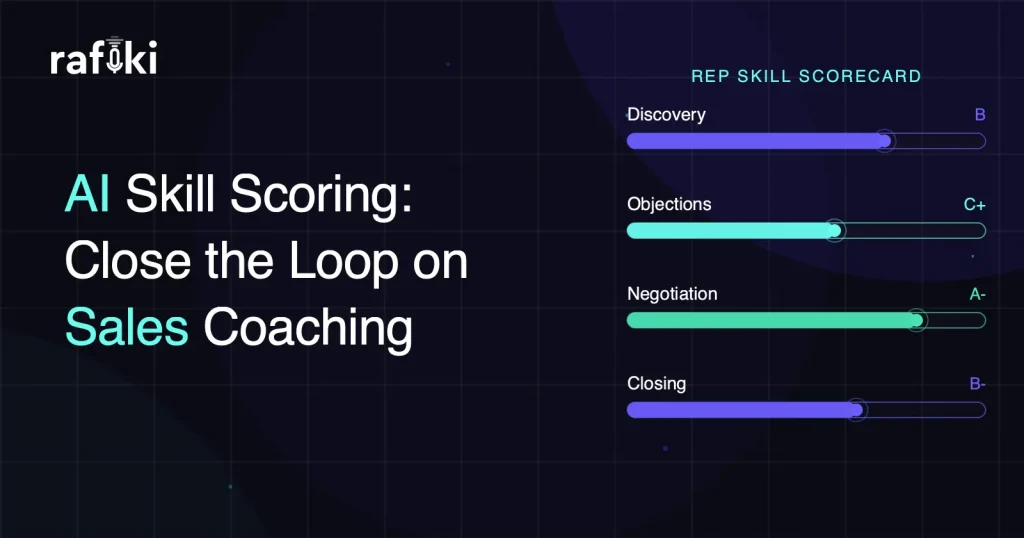
AI skill scoring is the practice of grading reps along persistent, multi-dimensional skill axes — discovery depth, objection handling, multi-threading, pricing confidence, next-step clarity, methodology adherence — by analyzing every call they participate in, then tracking those scores as trend lines over weeks and months. The call score becomes an input. The skill score becomes the management object.
This is a fundamental shift in how revenue organizations operate:
When you operate on skill scores, every one-on-one starts with the same question: "Which two skills are we working on this week, and what evidence do we have that last week's focus is sticking?" That question is impossible to answer with traditional call scoring. It is trivial to answer once the loop is closed.
Closing the loop is not about one feature. It is about wiring four components together so that signal flows continuously from conversation to coaching to behavior change to measurable outcome. Skip any one and the loop breaks.
Every customer-facing conversation — discovery, demo, pricing, renewal, churn save — must be transcribed, scored, and tagged automatically. Sampling is the enemy. If only a small fraction of calls are reviewed, the skill score is statistically noisy and reps quickly learn which calls "count."
Raw call scores get rolled up into persistent skill dimensions per rep. Instead of "Sarah scored well on this call," the system tracks something like "Sarah ranks in the top quartile on discovery, lags on pricing objection handling, and is trending up on multi-threading over the last 30 days."
Skill scores must drive what happens in one-on-ones, enablement assignments, and self-directed practice. The system should tell a manager exactly which two skills to focus on for each rep this week and surface the specific call moments that demonstrate the gap.
The final loop closes when skill scores are tied back to deal outcomes. Which skills predict won deals in your enterprise segment? Which skills are correlated with expansion in your install base? The answer is different for every business, and it changes over time.
Traditional conversation intelligence platforms were architected for a different era. They were built to record, transcribe, and produce call-level scorecards — and they did that job well a decade ago. The architecture assumes a human reviewer in the loop, with AI as a supporting actor. That assumption is now the bottleneck.
Older solutions struggle to close the coaching loop for structural reasons:
The result is a market full of expensive scoring engines that produce dashboards but not behavior change. To close the loop, you need a platform designed AI-first, where skill scoring, coaching workflows, and outcome correlation are native primitives rather than add-on modules. The case for modular, AI-native sales coaching is precisely this: the architecture has to match the ambition.
Rafiki AI is an AI-native revenue intelligence platform built from day one on multi-model AI, with autonomous AI agents — that operate autonomously as a 24/7 revenue team. The platform was designed specifically to collapse the gap between conversation and coaching — to make skill scoring continuous, personalized, and tied to outcomes without requiring an enterprise-scale services engagement.
Here is how the closed loop comes together in practice:
Because Rafiki AI starts at $19/seat/month with no seat minimums and no annual commitment, growing teams get enterprise-grade skill scoring without the enterprise contract. Setup runs about 15 minutes, with native integrations across Salesforce, HubSpot, Zoho, Pipedrive, Freshworks, and Monday.com on the CRM side, Zoom, Microsoft Teams, and Google Meet on the meetings side, and Slack, Aircall, and OpenPhone for messaging and dialing. Transcription covers 60+ languages, so global teams operate on the same scoring framework regardless of region. For frontline managers and sales enablement leaders, that combination is the difference between a coaching program that ships and one that lives forever in a planning deck.
A closed-loop system is only as good as the skills it tracks. Generic taxonomies — "communication," "product knowledge," "closing" — produce generic coaching. The skills that drive your business are more specific, more behavioral, and more measurable.
Strong skill taxonomies share a few characteristics:
Treat the taxonomy as a living artifact. Review it quarterly. The skills that won deals last year are not necessarily the skills that win deals this year, and a system that grades against a stale rubric will quietly train reps for the wrong battle.
Closing the coaching loop is a phased operational change, not a tool installation. The teams that get this right move deliberately through three thirty-day phases.
By day 90, the cultural shift is visible. One-on-ones get shorter and sharper. New hires ramp against a defined skill scorecard instead of a vague "getting up to speed" timeline. Enablement programs get measured against skill movement, not attendance. The loop is closed.
The organizations pulling ahead in 2026 are not the ones with the most call recordings. They are the ones with the tightest feedback loop between conversation, coaching, and outcome. Harvard Business Review has documented that great conversational skill is teachable when feedback is specific and frequent. AI skill scoring is what makes that feedback specific and frequent at scale.
As the loop matures, skill scores become the central operating system of the revenue org:
This is the durable competitive advantage. Pipeline can be bought. Tools can be copied. A revenue org that systematically develops every rep along the skills that win in its market is structurally hard to outrun. The teams that close the loop in 2026 will spend the next several years compounding that advantage while their competitors are still grading individual calls.
Ready to move from call scores to skill scores? Explore the Rafiki AI platform, see how six autonomous AI agents close the coaching loop end-to-end, and start free at $19/seat/month — no seat minimums, no annual commitment, 15-minute setup. Book a demo when you are ready to see closed-loop AI skill scoring on your own calls.
Start for free — no credit card, no seat minimums, no long contracts. Just better sales intelligence.