SDR coaching is the highest-leverage growth lever most teams underuse. If you improve your SDR team’s performance by just 10%, pipeline expands dramatically.
More meetings.
Better-qualified prospects.
Stronger first impressions.
Higher conversion into opportunities.
Yet SDR coaching is often:
In 2026, the highest-performing sales orgs are not coaching SDRs harder.
They’re coaching them smarter — using AI.
Not to replace managers.
But to give managers visibility into what actually drives win rates.
This is where platforms like Rafiki fundamentally change SDR coaching from anecdotal feedback to structured, scalable performance improvement.
Most SDR managers oversee 6–12 reps.
They simply cannot:
So coaching falls back on:
The result?
You optimize activity — not effectiveness.
AI changes this by turning every SDR conversation into structured, analyzable intelligence.
AI coaching isn’t just summarizing calls.
It means:
This requires structured conversation intelligence.
And that’s where Rafiki becomes foundational.
You cannot coach what you cannot measure.
AI allows you to establish SDR performance benchmarks across:
Instead of vague coaching like:
“Ask better questions.”
You measure:
Rafiki analyzes conversations and extracts structured signals across methodologies like:
This allows you to benchmark SDR calls consistently across the team.
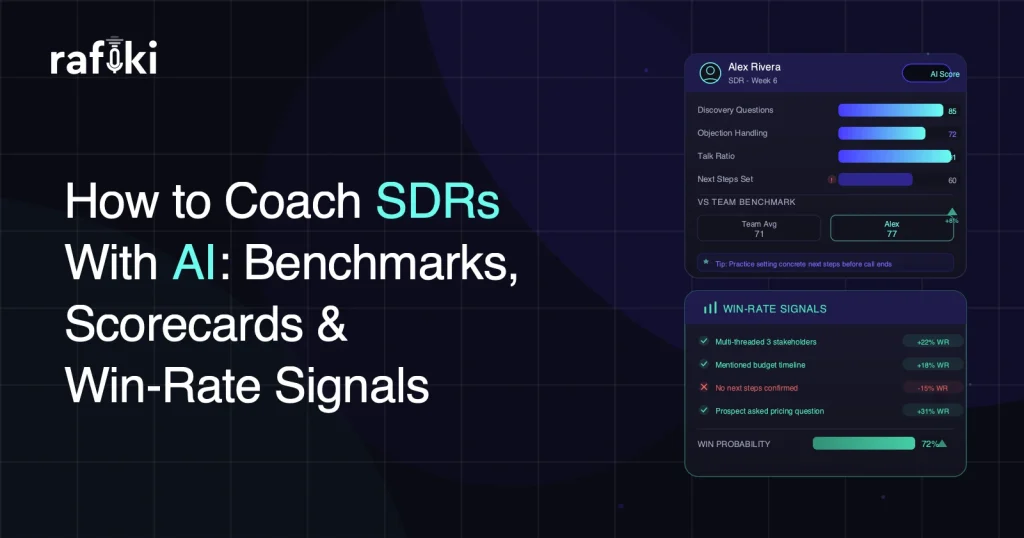
Benchmarks become actionable through scorecards.
An AI SDR scorecard typically evaluates:
Rafiki structures meeting intelligence so managers don’t manually score transcripts.
Instead:
Managers can then validate and refine scores — keeping humans in the loop while scaling visibility.
The biggest mistake in SDR coaching is optimizing behaviors that don’t impact revenue.
AI allows you to correlate SDR behaviors with downstream outcomes:
Because Rafiki structures conversation intelligence across deals, you can:
Coaching then shifts from generic best practices to evidence-backed improvements.
AI-powered SDR coaching changes manager workflow.
Instead of reviewing random calls, managers see:
With Rafiki feeding structured call intelligence into dashboards, managers can:
Coaching becomes systematic.
Not personality-driven.
Many pipeline leaks occur at handoff.
SDRs book meetings that:
AEs then struggle to convert.
With AI:
Rafiki ensures every SDR meeting becomes structured pipeline intelligence — not just a booked calendar event.
This dramatically improves opportunity conversion.
Choose 8–12 measurable behaviors tied to your methodology.
Compare manager scoring vs AI analysis.
Adjust thresholds.
Use Rafiki insights to:
By the end of the quarter, SDR coaching shifts from reactive to proactive.
Organizations implementing AI-based SDR coaching typically see:
Because performance gaps are identified early — not after pipeline collapses.
AI coaching only works if it understands conversations deeply.
Without structured conversation intelligence:
Rafiki provides:
This transforms SDR conversations into actionable coaching intelligence.
Not just transcripts.
In 2023, SDR performance depended heavily on:
In 2026, performance depends on:
The best SDR teams don’t rely on occasional call reviews.
They operate with an always-on coaching engine.
Activity metrics don’t close deals.
Discovery quality does.
Qualification depth does.
Objection handling does.
Next-step rigor does.
AI enables you to measure these consistently.
Rafiki turns every SDR call into structured pipeline intelligence.
It extracts methodology signals.
Feeds coaching dashboards.
Surfaces win-rate correlations.
Identifies patterns across reps.
Guides targeted improvement.
Coaching SDRs with AI isn’t about replacing managers.
It’s about giving them leverage.
In 2026, the SDR teams that scale intelligently — not just energetically — will define pipeline growth.
And structured conversation intelligence is the foundation that makes that possible.
Start for free — no credit card, no seat minimums, no long contracts. Just better sales intelligence.