Your best rep just lost a deal because they kept skipping the discovery phase. Your newest hire has been mispronouncing the product name for three weeks. Your mid-tier AE developed a habit of discounting too early — and nobody caught it until the quarter was already lost.
None of these are catastrophic failures. They're small, fixable problems — the kind a good coaching conversation would resolve in ten minutes. Yet that conversation never happened, because the frontline manager responsible for coaching these reps was already stretched across eight other direct reports, back-to-back pipeline reviews, forecast calls, and a hiring process that never seems to end.
This is the coaching coverage crisis — and it's not a manager problem. It's a math problem, one that no amount of hustle, prioritization, or "coaching culture" can solve without a fundamentally different approach. Put simply, AI sales coaching isn't about replacing the manager. It's about making sure every rep gets feedback on every call, not just the handful a manager has time to review.
The Math That Makes Traditional Sales Coaching Impossible
Let's run the numbers that every sales leader knows intuitively but rarely confronts directly.
A typical frontline manager has 8 to 12 direct reports. Each rep runs somewhere between 15 and 25 customer-facing calls per week — discovery calls, demos, follow-ups, negotiation sessions. In total, that's 120 to 300 calls per week landing on a single manager's desk.
Now consider how that manager's time actually breaks down. Pipeline reviews, forecast meetings, deal strategy sessions, hiring interviews, cross-functional syncs, 1:1s, leadership reporting. Even if they're fortunate enough to carve out 20% of their week for call review and coaching — and that's generous — they can realistically listen to 5 to 10 calls.
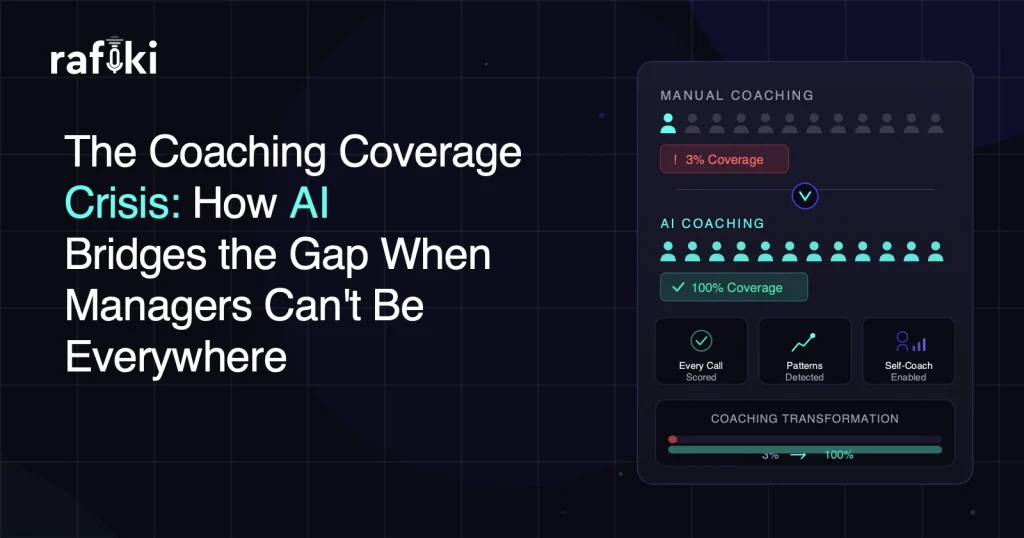
Five to ten calls out of 120 to 300. As a result, you're looking at a coaching coverage rate of roughly 3 to 5 percent.
In practice, that means 95 to 97 percent of coaching moments are invisible. Not because the manager doesn't care. Not because the organization doesn't value coaching. Simply because no human can review 300 calls per week and still do everything else the role demands.
That's not a coaching program. That's a lottery.
The Hidden Cost of Random Call Sampling
When managers can only review a handful of calls, they inevitably rely on sampling. However, that sampling is almost never random in practice — it's shaped by recency bias, gut feeling, and the squeaky-wheel effect.
Here's what typically happens:
- Recency bias dominates — Managers review calls from the last day or two, missing patterns that develop over weeks
- Problem reps get disproportionate attention — The rep who's struggling gets more reviews, while the rep who's quietly developing bad habits flies under the radar
- Top performers get ignored — High performers rarely get coaching because "they're doing fine," missing opportunities to push them from good to great
- Subjective scoring creates inconsistency — What one manager considers a strong discovery call, another rates as mediocre
- Cherry-picking distorts reality — Reps who know which calls their manager might review adjust their behavior on those calls, leaving the rest uncoached
Consequently, the result is a coaching program that feels active but covers almost nothing. Managers believe they're coaching, and reps believe they're being coached. Yet the actual coverage is so thin that critical skill gaps persist for months before anyone notices.
Why This Is a Systems Problem, Not a People Problem
It's tempting to blame managers. "They should prioritize coaching." "They need better time management." "We need to build a coaching culture." After all, CSO Insights research has consistently shown that coaching quality is one of the strongest predictors of quota attainment — managers who deliver effective coaching see significantly higher percentages of their reps hitting quota compared to those who provide ineffective coaching. Still, the gap between "knowing coaching matters" and "actually coaching every rep consistently" isn't a willpower gap. It's a capacity gap.
Consider what we're actually asking frontline managers to do:
- Listen to calls (15-30 minutes each)
- Evaluate against methodology frameworks (MEDDIC, BANT, SPIN, or custom criteria)
- Document observations and scores
- Prepare coaching feedback with specific examples and timestamps
- Deliver that feedback in a 1:1 or coaching session
- Track progress over time to see if behaviors actually change
Even at maximum efficiency, that's 30 to 45 minutes per call reviewed. Multiply by the 120 to 300 calls per week, and you'd need a full-time coaching analyst for every manager. Obviously, no organization can staff that — and no manager can absorb that workload.
The problem isn't effort. Rather, the traditional coaching model was designed for a world where reps had 5 calls a week, not 25. The volume has changed, but the model hasn't.
What Reps Actually Need (and Aren't Getting)
When you ask reps what they want from coaching, the answers are remarkably consistent:
- Consistency — Feedback on every call, not random spot checks
- Specificity — "At minute 12:35 you missed the budget question" beats "You need to work on discovery"
- Patterns, not anecdotes — "Over the last 30 calls, your talk-to-listen ratio has been climbing" matters more than feedback from a single conversation
- Benchmarking — How do they compare to top performers on specific behaviors, not just outcomes?
- Methodology adherence — Are they actually following MEDDIC, or just checking boxes after the call?
- Self-serve access — The ability to review their own performance without waiting for a manager's schedule to open up
Traditional coaching can't deliver any of this at scale. For example, a manager reviewing 5 calls can't identify patterns across 100. Similarly, a manager scoring calls subjectively can't provide consistent benchmarks. And a manager who reviews calls two days later can't give the in-the-moment specificity reps crave.
This gap between what reps need and what the traditional model delivers is where AI sales coaching changes the equation entirely.
AI Sales Coaching: From Random Sampling to Total Coverage
The fundamental shift AI brings to sales coaching isn't better analysis — it's coverage. Every call scored. Every rep evaluated. Every coaching moment captured — not three weeks later, but immediately.
Rafiki's Smart Call Scoring automatically evaluates every customer-facing conversation against your chosen methodology framework. MEDDIC, BANT, SPIN, or fully custom scorecards — every call gets the same rigorous evaluation that a manager would provide, applied consistently across the entire team.
Here's what changes when you move from 3% coverage to 100%:
- Patterns emerge — Instead of isolated call reviews, managers see trends across dozens or hundreds of conversations. A rep who skips competitive positioning on 70% of calls shows a clear pattern that a single review would miss.
- Coaching becomes proactive — Rafiki flags coaching moments with specific timestamps and context before the manager even asks. No more hunting for problems — the problems surface themselves.
- Scoring is consistent — Whether it's the first call of the day or the last call on a Friday, the evaluation criteria don't shift. Every rep is measured against the same standard.
- Speed collapses — Smart Call Summary delivers key moments, objections, and action items within minutes of the call ending. Coaching happens while the conversation is still fresh.
More importantly, this isn't about replacing the manager's judgment. It's about giving the manager something no human can produce alone: a complete picture of every rep's performance across every conversation.
Closing the Coaching Equity Gap
There's a fairness dimension to the coaching coverage crisis that rarely gets discussed. When managers can only review a few calls per week, certain reps inevitably get more attention than others. In some cases, it's the struggling rep who needs intervention. Other times, it's the rep who sits closest to the manager. Or perhaps it's the rep whose deals are in the forecast.
The reps who get left out aren't randomly distributed. They're predictable:
- Mid-tier performers — Not struggling enough to trigger alarm bells, not succeeding enough to be celebrated. The "forgotten middle" receives the least coaching despite having the highest potential for improvement.
- Remote and distributed reps — Out of sight, out of coaching queue. Reps in different time zones or offices consistently receive less feedback.
- New hires after onboarding — Intensive coaching during ramp, then a cliff. Once a rep finishes their formal onboarding program, coaching attention drops dramatically.
In contrast, AI-powered coaching eliminates this inequity by design. Rafiki scores every call for every rep, regardless of tenure, location, or manager availability. As a result, a new SDR in their second week gets the same analytical rigor as a senior AE closing a seven-figure deal. The system doesn't play favorites because it doesn't have any.
The Self-Coaching Revolution
One of the most powerful — and least discussed — benefits of AI sales coaching is what it enables reps to do on their own.
In the traditional model, coaching is a push activity. The manager reviews a call, prepares feedback, and delivers it in a scheduled session. Meanwhile, the rep is passive — they receive coaching only when someone else decides to give it.
With AI-powered scorecards and conversation intelligence, however, coaching becomes a pull activity. Reps can:
- Review their own scores immediately — No waiting for a manager to find time. Call scores and methodology adherence metrics are available within minutes.
- Compare against benchmarks — How does their discovery depth compare to the team's top performers? Where do they over-index and under-index?
- Identify their own patterns — Rafiki's Gen AI Reports surface behavioral trends across weeks and months, letting reps spot their own blind spots.
- Ask specific questions — With Ask Rafiki Anything, reps can query their own performance data. "How often do I address pricing objections in the first call?" "What's my average talk-to-listen ratio on discovery calls?" Real answers from real data.
- Study what great looks like — AI identifies the specific behaviors that differentiate top performers, giving every rep a playbook built from actual winning calls — not theory.
Of course, self-coaching doesn't eliminate the need for manager involvement. But it means reps arrive at coaching sessions already aware of their patterns, ready to discuss strategy instead of waiting to hear what they did wrong. In other words, it transforms the coaching conversation from review to development.
Accelerating New Hire Ramp with AI Sales Coaching
New hire ramp is where the coaching coverage crisis hits hardest. Specifically, a new rep needs the most coaching at the exact moment when giving it is most expensive — intensive, one-on-one, call-by-call feedback during the first 30 to 90 days.
Most organizations frontload coaching during onboarding and then taper off sharply. The assumption is that after a few weeks of ride-alongs and call reviews, reps have the foundation they need. In reality, though, bad habits often form in months two and three — exactly when coaching attention disappears.
AI changes the ramp equation in three ways:
1. Every Ramp Call Gets Evaluated
Instead of a manager reviewing 2 or 3 calls per week during ramp, every single call is scored and analyzed. Methodology adherence, talk patterns, question quality, objection handling — all tracked from day one. Sales enablement teams get visibility into ramp progress across the entire cohort, not just the reps whose managers are diligent about reviews.
2. Ramp Benchmarks Become Data-Driven
When do successful reps typically hit proficiency on discovery calls? At what point should competitive positioning scores reach a certain level? With AI-generated benchmarks, guesswork gives way to patterns derived from actual performance data. Because of this, managers know exactly where a new hire stands relative to successful predecessors.
3. Early Warning Signals Surface Faster
Rafiki flags reps who are falling behind on specific skills, not just overall performance. For instance, a new hire might be strong on rapport and energy but consistently weak on multi-threading or next-step commitment. Targeted coaching on the specific gap is far more effective than general "you need to improve" feedback.
Peer Learning at Scale: Mining Top Performer DNA
Every sales team has top performers whose instincts seem impossible to replicate. They ask the right questions at the right time, handle objections with a natural ease, and navigate procurement conversations without losing momentum. Yet when asked what they do differently, they often can't articulate it — it's intuitive.
AI makes the intuitive explicit.
Specifically, Rafiki surfaces the measurable behaviors that differentiate top performers from the rest of the team. These aren't vague qualities like "they build better rapport" — they're concrete patterns like how they structure discovery questions, how they time pricing discussions, how they handle silence, and what specific language they use when navigating objections.
As a result, this transforms peer learning from anecdote to evidence. Instead of shadowing a top performer for a day and hoping to absorb their approach, reps can study the specific behavioral patterns that drive results. In addition, frontline managers can build coaching plans around proven patterns rather than personal opinions about what "good" looks like.
The Manager's New Role: From Call Reviewer to Strategic Coach
If AI handles call scoring, pattern detection, and performance tracking — what exactly does the manager do?
Everything that matters most.
The traditional coaching model traps managers in a low-leverage loop: listen to a call, take notes, deliver feedback, repeat. While it's important work, it's ultimately the analytical grunt work that prevents managers from doing the high-impact coaching that AI can't replicate.
However, when AI takes over pattern detection and call evaluation, the manager's role shifts to the work that requires human judgment, emotional intelligence, and strategic thinking:
- Career development conversations — Helping reps build skills and navigate career paths based on their strengths and aspirations
- Complex deal strategy — Multi-threaded enterprise deals, political navigation, and creative deal structuring that requires experience and intuition
- Motivation and mindset — Coaching through slumps, building confidence after losses, and maintaining energy through long sales cycles
- Contextual coaching — AI identifies the pattern; the manager understands why it exists and how to change it. A rep who consistently rushes discovery might be dealing with call anxiety, time pressure from too many meetings, or simply a misunderstanding of the methodology. The intervention depends on the cause, and only a human can diagnose that.
- Team dynamics and collaboration — Facilitating knowledge sharing, managing interpersonal dynamics, and building team culture
This isn't a diminished role — it's an elevated one. The manager stops being a call reviewer who occasionally does strategy and instead becomes a strategic coach informed by comprehensive data. Consequently, every 1:1 is backed by AI-generated insights across the rep's full body of work, not a single call the manager happened to catch.
From Reactive Coaching to Proactive Coaching
Traditional coaching is inherently reactive. Something goes wrong — a lost deal, a bad quarter, a customer complaint — and only then does coaching happen. The feedback loop is measured in days or weeks, which means that by the time a manager identifies a pattern and delivers coaching, the rep has already reinforced the bad habit dozens of times.
AI flips this dynamic entirely. Rafiki flags emerging patterns before they become entrenched problems:
- A rep's methodology adherence score dropping over two weeks triggers an alert before it impacts deal outcomes
- Talk-to-listen ratios shifting in the wrong direction get surfaced with specific call examples
- Objection handling scores declining on a specific competitor's name reveal exactly where the team needs updated battle cards
- A new hire's ramp trajectory flattening relative to successful predecessors flags the need for intervention at week three, not month three
Proactive coaching doesn't just fix problems faster — it prevents them. When managers can see behavioral shifts in real-time, they can intervene while the window for change is still open. In practice, a five-minute Slack conversation pointing to a specific call moment is worth more than a formal coaching session three weeks later.
Building a Coaching Culture That Actually Scales
Every sales organization talks about "coaching culture." Yet most struggle to build one because the traditional model makes consistent coaching physically impossible. After all, you can't have a coaching culture when 95% of coaching moments go unobserved.
AI sales coaching creates the infrastructure for a real coaching culture — one where:
- Every rep receives consistent, objective feedback regardless of their manager's schedule or bandwidth
- Coaching is continuous, not episodic. Feedback flows after every call, not once a quarter during performance reviews.
- Data replaces opinion in coaching conversations. "I think you need to work on discovery" becomes "Your discovery depth score has been 40% below the team benchmark for the last three weeks, specifically on multi-threaded deals."
- Progress is measurable. Did the coaching actually change behavior? AI tracks whether scores improve after coaching interventions, creating accountability for both reps and managers.
- Best practices spread automatically. When top performers develop effective approaches, the patterns are captured and made visible to the entire team.
This is what a coaching culture looks like when it's backed by systems, not just intentions.
Conclusion: The Coverage Problem Has a Solution
The coaching coverage crisis isn't new. Every frontline manager has felt it — the guilt of knowing there are calls they should be reviewing, reps they should be developing, patterns they should be catching. This volume problem has existed for years. What's new, however, is that there's finally a solution that doesn't require doubling management headcount or accepting that most coaching moments will be missed.
AI sales coaching doesn't replace the manager. Instead, it gives the manager something they've never had: complete visibility across every call, every rep, every day. As a result, the 95% of calls that used to disappear into the void now get scored, analyzed, and surfaced with specific coaching recommendations.
And the manager's role doesn't shrink — it transforms. They shift from a reviewer who samples random calls to a strategic coach armed with comprehensive data. They move from reactive interventions after the damage is done to proactive guidance while the window for change is still open. They trade subjective impressions based on a handful of conversations for data-backed development plans built on the full picture.
Meanwhile, the reps who benefit most aren't the ones who were already getting coached. They're the forgotten middle — the solid performers who've been operating without feedback, the remote reps whose calls disappeared into the void, the new hires whose post-onboarding coaching cliff has been silently limiting their potential.
Every rep deserves coaching on every call. That was impossible when coaching depended entirely on human review — but it's not impossible anymore.
Ready to close the coaching coverage gap? See how Rafiki's Smart Call Scoring gives every rep the consistent, data-driven coaching they deserve — starting with a free trial at getrafiki.ai.