Data-driven sales coaching is the practice of using conversation analytics, performance metrics, and AI-generated insights to guide personalized coaching for every sales rep — replacing gut-feel feedback with evidence-based development. According to Salesforce's State of Sales report, high-performing teams are 1.9x more likely to use analytics-driven coaching than underperformers. Yet most organizations still coach from memory rather than data.
This guide compares eight leading sales coaching models — GROW, OSKAR, CLEAR, FASTER, Situational Leadership®, Challenger Sale, ValueSelling Framework®, and SPIN Selling — through a data-driven lens. You'll learn how each framework works, where it excels, and how to pair it with real-time analytics so your coaching sessions move the metrics that matter: win rates, deal velocity, and quota attainment.
Traditional sales coaching relies on a manager's memory of a rep's recent calls, anecdotal pipeline reviews, and periodic ride-alongs. Data-driven sales coaching flips this model. It starts with objective signals — call recordings, talk-to-listen ratios, question frequency, competitor mentions, deal progression patterns — and uses those signals to diagnose skill gaps, set goals, and measure improvement over time.
Why does this distinction matter?
A Harvard Business Review analysis found that structured coaching processes — especially those supported by data — are among the highest-leverage investments a sales organization can make. The coaching model you choose provides the framework; data provides the fuel.
Sales coaching is all about helping salespeople get better at what they do. It's a one-on-one approach that's tailored to each person, making sure they have the skills and confidence they need. This isn't just a one-time training session; it's an ongoing process that adapts to each sales rep's needs.
Why is sales coaching so important?
It's simple: it helps the sales team do better, which means the business does better, too.
Coaches work with sales reps to sharpen their selling skills, tackle challenges, and build strong relationships with customers. This leads to more sales and happier customers.
On a personal level, sales coaching is a game-changer for sales reps. It's like having a personal trainer for your sales skills. Coaches help identify what each rep is good at and where they can improve. They set goals, offer feedback, and cheer on their progress. This not only boosts sales numbers but also boosts confidence.
For the whole sales team, coaching builds a strong, united group. It encourages everyone to share tips and support each other, creating a positive and motivated team atmosphere. This team spirit means everyone works better together, leading to even more success.
When coaching is anchored in conversation intelligence data — not just a manager's recall — every feedback loop becomes faster, more specific, and more actionable. That's the difference between generic encouragement and targeted skill development.
In the realm of sales, various coaching models offer unique frameworks and methodologies designed to elevate the performance and effectiveness of sales teams. Each model brings its own set of principles and practices, catering to different coaching needs and styles. Here's a detailed look at eight of the leading sales coaching models — and how data amplifies each one.
G: Goal — The coaching process begins by setting clear, achievable objectives.
R: Reality — This involves assessing the current situation and identifying challenges.
O: Options — The coach and sales rep explore different strategies to overcome obstacles.
W: Will/Way Forward — Finally, they commit to specific actions to achieve the set goals.
The GROW Model is praised for its simplicity and flexibility, making it applicable to a wide range of sales scenarios. It encourages a solution-focused approach, empowering sales reps to take ownership of their goals and the paths to achieve them.
Data-driven boost: Use win-rate trends and call scorecards to define the "Reality" step with precision, and track "Will" commitments against measurable KPIs week over week.
O: Outcome — Defining the desired results or outcomes of the coaching.
S: Scaling — Measuring current progress and potential improvements.
K: Know-How — Identifying the skills and knowledge needed to reach the outcome.
A: Affirm & Action — Recognizing strengths and setting actionable steps.
R: Review — Evaluating progress and adjusting the plan as necessary.
The OSKAR Model emphasizes a strengths-based approach, focusing on leveraging existing abilities and successes to drive improvement and achieve desired outcomes.
Data-driven boost: The "Scaling" step works best when reps self-rate against objective benchmarks — like their talk-to-listen ratio compared to top performers on the team.
C: Contracting — Establishing the coaching relationship and setting expectations.
L: Listening — The coach actively listens to understand the sales rep's perspective.
E: Exploring — Together, they explore challenges and potential solutions.
A: Action — Developing a plan with concrete steps towards the goals.
R: Review — Reflecting on the actions taken and their outcomes, leading to continuous improvement.
The CLEAR Model is valued for promoting open communication and collaboration, fostering a supportive coaching environment that encourages self-reflection and proactive problem-solving.
Data-driven boost: During the "Exploring" phase, reviewing actual call recordings together creates shared context that pure conversation alone can't replicate.
F: Focus — Clarifying the focus of the coaching session.
A: Accountability — Establishing responsibility for actions and outcomes.
S: Systems — Utilizing systems and tools to support and track progress.
T: Transformation — Fostering personal and professional growth.
E: Engagement — Maintaining active involvement and commitment.
R: Results — Focusing on achieving tangible outcomes.
The FASTER Model is designed to accelerate performance improvement, with a strong emphasis on accountability, engagement, and achieving measurable results.
Data-driven boost: The "Systems" step is where analytics platforms like Rafiki AI's coaching tools plug in directly — automating progress tracking so managers spend time coaching, not building spreadsheets.
This model adapts the coaching style based on the development level of the sales rep, ranging from directing and coaching to supporting and delegating. It recognizes that the most effective coaching approach depends on the individual's competence and motivation, making it a highly personalized coaching strategy.
Data-driven boost: Conversation analytics reveal a rep's actual competence level in real time — not what their tenure suggests. A rep who's been closing for two years may still struggle with discovery questions, and the data will show it.
This model is built around three core behaviors:
It encourages sales reps to challenge clients' thinking, tailor communications to each stakeholder, and take control of the sales process. In coaching, this model focuses on developing these behaviors to navigate complex sales environments successfully.
Data-driven boost: Track how often reps deliver commercial insights on calls versus defaulting to feature dumps. Topic detection and sentiment analysis surface these patterns automatically.
The ValueSelling Framework® centers on engaging with prospects and customers by focusing on their business needs and delivering tangible value.
Coaching within this framework involves equipping sales reps with the skills to identify and articulate the unique value their solutions offer to each customer.
Data-driven boost: Measure how frequently reps tie product capabilities to customer-stated business outcomes. Deal intelligence platforms flag deals where value articulation is missing.
This model revolves around four types of questions:
— designed to uncover and develop customer needs. Coaching in the SPIN Selling framework focuses on enhancing reps' questioning skills, enabling them to lead more effective and consultative sales conversations.
Data-driven boost: Question-frequency analysis reveals whether reps lean too heavily on Situation questions (information gathering) and skip Implication/Need-payoff questions (value creation). This is one of the most measurable coaching opportunities in any model.
Each of these data-driven sales coaching models offers distinct pathways to enhancing sales performance, tailored to different coaching needs, sales rep development stages, and sales environments. Understanding and applying the right model — or combination of models — can significantly impact a sales team's success, fostering an environment of continuous growth, learning, and achievement.
When delving into the array of sales coaching models, it becomes evident that each brings its unique strengths and potential limitations to the table. Understanding these nuances is crucial for selecting a model that aligns with your team's specific needs, sales processes, and organizational culture.
| Models | Pros | Cons | Best Data Signal |
|---|---|---|---|
| GROW | Simple and structured Clear goal-setting process Versatile and widely applicable |
May oversimplify complex issues Lacks focus on personal development |
Win/loss ratios, pipeline velocity |
| OSKAR | Strengths-based, positive approach Encourages leveraging existing capabilities Focuses on desired outcomes |
May overlook addressing weaknesses Less structured, which can be challenging for some coaches |
Top-performer benchmarks, self-assessments vs. actuals |
| CLEAR | Promotes open communication and collaboration Encourages self-reflection and exploration Flexible and adaptable to individual needs |
Less directive, which might not suit all situations Requires experienced coaches to navigate effectively |
Call recording review, sentiment trends |
| FASTER | Emphasizes quick action and accountability Goal-oriented with a focus on results Encourages engagement and commitment |
May prioritize short-term results over long-term development High intensity might not suit all learning styles |
Activity metrics, week-over-week progression |
| Situational Leadership® | Highly personalized to the coachee's development level Flexible in coaching approach Adapts to the evolving needs of sales reps |
Requires high skill level from coaches Can be complex to implement consistently across a team |
Skill-gap analysis from call scorecards |
| The Challenger Sale Model | Encourages a proactive, insightful approach to sales Enhances critical thinking and innovation Effective in complex sales environments |
May be challenging to adopt in transactional sales Requires a cultural shift for full effectiveness |
Insight delivery frequency, topic detection |
| ValueSelling Framework® | Aligns with consultative selling practices Focuses on delivering customer value Enhances customer relationships |
Specialized nature limits broader applicability Requires in-depth understanding of customer needs |
Value-statement frequency per deal stage |
| SPIN Selling | Enhances discovery and needs analysis Improves questioning skills and sales conversations Based on extensive research and practice |
Focuses mainly on the questioning aspect May need supplementation with other coaching for a holistic approach |
Question-type ratios (S/P/I/N breakdown) |
Choosing the appropriate sales coaching model(s) involves a careful assessment of your team's specific dynamics, the complexity of your sales processes, and the prevailing organizational culture.
Consider the following guidelines:
Successful implementation of a sales coaching model requires more than just understanding its framework; it demands a commitment to embedding the model into daily practices and ensuring ongoing support and resources are available.
Here are some steps to consider:
Selecting and implementing the right sales coaching model(s) can dramatically enhance your sales team's effectiveness, adaptability, and overall performance. By carefully considering your team's unique needs and thoughtfully integrating coaching into your sales culture, you can unlock the full potential of your sales force.
At the core of every successful coaching model lies a crucial element: data.
The effectiveness of various models might vary, but their success invariably hinges on the availability and quality of data. Whether it's tracking the ratio of closed to lost deals, monitoring email engagement, or analyzing call durations, data is indispensable for evaluating activities, setting objectives, offering feedback, and monitoring outcomes and progress.
According to McKinsey's research on B2B sales performance, organizations that embed analytics into their sales workflows consistently outperform peers — not because the data replaces judgment, but because it sharpens it.
This necessity, however, introduces a new challenge for organizations. The task of sifting through extensive datasets to create dashboards, perform analyses, and generate reports typically requires a dedicated team of data analysts.
This is precisely where Rafiki AI steps in, offering actionable insights with ease. Rafiki AI analyzes your sales team's call recordings to provide actionable insights, enabling you to make informed decisions — without requiring a data team.
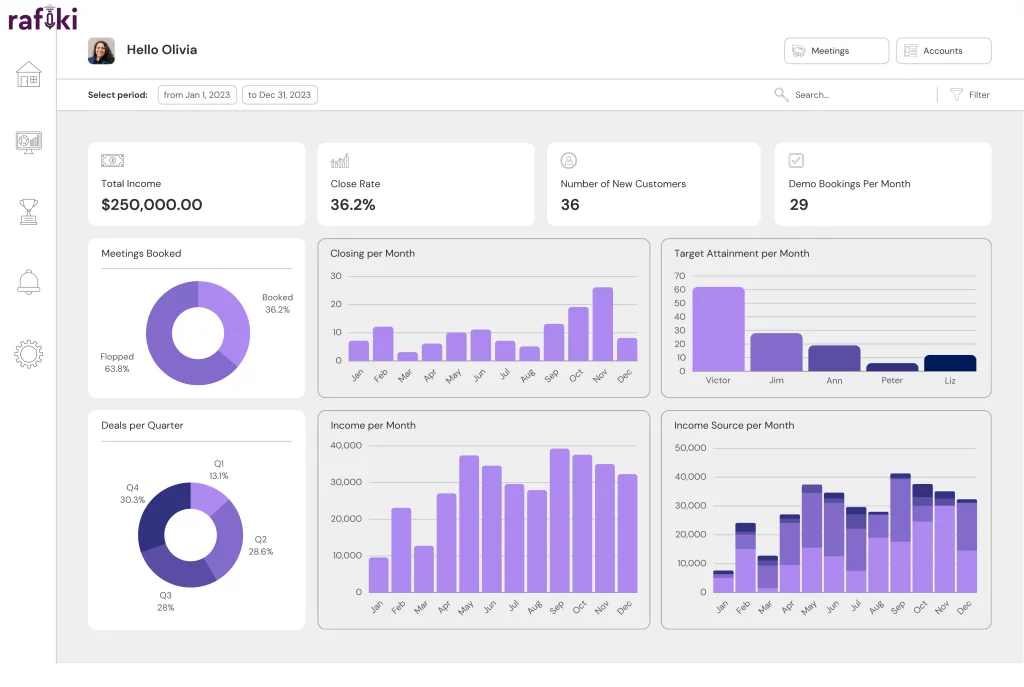
Rafiki AI's AI-native revenue intelligence platform is designed for efficiency and ease of use, supporting both in-person and remote sales coaching by leveraging your historical sales data as a foundation. This data serves as a reference point to monitor activities, establish goals, and assess your sales team's performance.
Here's how Rafiki AI powers data-driven sales coaching across any model:
The system not only aids sales representatives in refining their sales tactics but also provides detailed metrics such as call duration, moments of hesitation, and talk-to-listen ratios, facilitating a deeper understanding of your team's current standing and potential improvements.
By integrating Rafiki AI's intelligent insights into your sales coaching practices, you unlock the potential for truly data-driven coaching, significantly enhancing your team's conversion rates and overall success.
Every sales coaching model in this guide — GROW, OSKAR, CLEAR, FASTER, Situational Leadership®, Challenger Sale, ValueSelling Framework®, and SPIN Selling — offers a proven structure for developing your reps. But structure without signal is just theory. The teams that consistently outperform don't just pick a framework; they fuel it with conversation data, performance analytics, and AI-generated insights that turn every coaching session into a precision intervention.
The shift from opinion-based to data-driven sales coaching isn't optional anymore. It's the difference between coaching that feels productive and coaching that measurably moves the number.
Rafiki AI's conversation intelligence platform starts at $19 per seat per month with no minimums and no annual commitment. Start your free trial today or book a demo to see how AI transforms your sales coaching.
Start for free — no credit card, no seat minimums, no long contracts. Just better sales intelligence.