The frontline manager's hour is real — and in 2026, AI is the only thing standing between a manager of ten reps and a 60-hour week of low-leverage work.
Talk to any frontline sales manager running five to fifteen reps and you will hear a version of the same story. The week starts with a pipeline meeting they did not have time to prepare for, becomes a cascade of 1:1s where the coaching feels superficial because they could not listen to last week's calls, and ends with a forecast read built more on rep optimism than evidence. Somewhere in the middle, the manager is also expected to be a recruiter, a deal escalation point, a cross-functional negotiator with marketing and product, and the human emotional buffer between a rep having a hard month and the executive team asking why pipeline coverage is light.
The frontline manager is the most overloaded role in revenue. They are also the role that determines, more than any other, whether the rest of the org's investment in sellers actually pays off. A great manager with the wrong tools coaches three reps well and leaves seven on autopilot. The same manager with the right AI underneath can coach all ten, with evidence, every week — and still leave the office before dinner.
This is a playbook for that manager. Not a vision statement, not a "future of work" essay — a concrete weekly rhythm rebuilt around what AI coaching for sales managers actually replaces, what it cannot, and how to make the swap in 30 days without IT involvement.
Before describing the new rhythm, it is worth being honest about where a frontline manager's week actually goes today. The work is not glamorous. It is also not the work that earns the manager's salary.
A typical frontline manager of ten reps loses meaningful hours every week to four buckets of work that have nothing to do with coaching judgment:
None of these activities is coaching. None of them require the manager's most expensive skill — judgment about a specific rep on a specific deal in a specific moment. Yet they consume the bulk of the week. The manager who learns to delegate them to AI, deliberately and with structure, is the manager who gets to spend the hour they reclaim on the work that actually moves the team.
The first decision in rebuilding the manager's week is being precise about what AI replaces and what it does not. Get this boundary wrong in either direction and the playbook fails. Lean too lightly on AI and the manager stays buried in low-leverage work. Lean too heavily and the rep starts feeling coached by a machine instead of a person, which destroys the trust that makes any 1:1 work.
The clean line is this: AI absorbs the preparation, surfacing, and summarization layer. The human owns the conversation, the read on the rep's state, and the decision about what to actually do.
What AI should take off the plate:
What AI should not touch:
Keeping this line clear is what makes the playbook below work. The manager who treats AI as a research analyst that produces the brief — not as a coach that produces the verdict — gets the time back without losing the relationship.
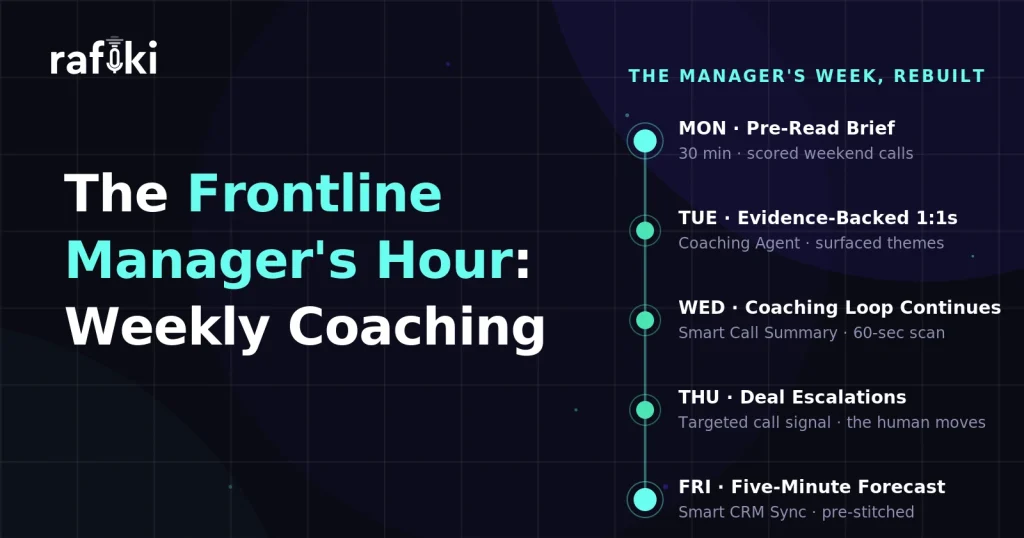
The new rhythm assumes AI is doing the prep work in the background, every day, on every call. The manager's job is to show up at a few specific moments in the week to make decisions, deliver coaching, and read forecast — each time with an AI-generated brief already waiting.
The shape of the week:
Each block is described in detail below, with the specific Rafiki capability that powers it and the specific manual activity it replaces.
Sit down at 8 AM Monday. Open Rafiki. Read the auto-generated weekend brief. That is the goal of Monday morning, end-to-end, in 30 minutes.
The brief is built from Smart Call Summary running across every call your team made the previous week. For each rep, the manager sees the calls that happened, the deals they touched, the scoring against the methodology your team runs, and the two or three moments worth coaching on. The Coaching Agent surfaces patterns that span multiple calls — a rep who keeps missing the next-step ask, a rep whose discovery is shallow on three out of five calls, a rep who is suddenly winning more deals after a specific framing change. These are the patterns a manager would have to listen to fifteen calls to notice, served up in a single scrollable view.
What the manager does with the 30 minutes:
What used to be a three-hour Monday morning of dashboard archaeology becomes a 30-minute read. The manager walks into the team standup with a real opinion. The reps see that the manager actually knows what happened last week — which is the foundation of every coaching relationship that works.
Mid-week is the coaching window. Most managers run 1:1s on Tuesday, Wednesday, or Thursday — the days when reps have enough fresh activity to discuss and enough runway in the week to act on the coaching. The legacy version of this rhythm fails because the manager walks into each 1:1 without having heard the rep's recent calls. The conversation defaults to "how are you feeling about the quarter" and the rep walks out with vague encouragement instead of a specific skill to work on.
The AI-supported version flips this. Before each 1:1, the manager opens that rep's view inside Rafiki and sees:
The 1:1 then becomes a real coaching conversation. "I noticed your discovery on three calls this week went deep on technical pain but skipped commercial pain. Let's play 45 seconds from the Globex call where you almost got there." That sentence is impossible without AI doing the listening and pattern-spotting for the manager. With it, the conversation has evidence, specificity, and a path to action — all in 25 minutes per rep, three or four times a week.
The downstream effect on the rep is what matters. Reps who get evidence-backed coaching report — anecdotally and consistently — that they trust the process more, prepare more for 1:1s, and improve faster than reps who get vibes-based encouragement. Research summarized by Harvard Business Review on agentic AI in sales has highlighted that the teams getting the most out of AI are the ones using it to make human coaching more specific, not to replace human coaching. The Tuesday-through-Thursday rhythm in this playbook is the operational version of that finding.
Friday afternoon is the forecast window. In the legacy rhythm, a manager spends two to three hours stitching together rep commits, deal stages, recent call signal, and gut feel — then writes a forecast email that the VP Sales reads with appropriate skepticism. The work is mostly reconstruction: pulling together context that already lives in the calls, the CRM, and the manager's own week.
The AI-supported version of Friday looks different. Smart CRM Sync has been quietly updating the deal records throughout the week — stage moves, contact changes, competitive mentions, next-step gaps — pulled from the actual calls instead of relying on the rep to remember to update Salesforce. Smart Call Scoring has flagged the deals where the call quality dropped or where a champion stopped engaging. The forecast view is largely built by the time the manager opens it.
What Friday becomes:
Two to three hours becomes five to fifteen minutes for the read, plus targeted deal work where it counts. The forecast quality goes up because it is grounded in call evidence, not optimism. The manager gets their Friday afternoon back. The VP Sales gets a forecast they can actually defend.
Rafiki AI is an AI-native revenue intelligence platform built from day one on multi-model AI, with autonomous AI agents that operate as a 24/7 revenue team. For frontline managers specifically, four capabilities do the heavy lifting in this playbook.
The Coaching Agent is the manager's pre-read engine. It listens to every call, scores it against your team's methodology, and surfaces the coaching themes worth raising — not as a list of every gap, but as the two or three patterns that matter this week for this rep. The agent turns "I should listen to more of my reps' calls" from a guilty manager aspiration into a 60-second scan before each 1:1.
Smart Call Scoring gives the manager a one-glance assessment of any individual call. Methodology coverage spans MEDDIC, BANT, SPIN, SPICED, GAP, Challenger, Sandler, and fully custom rubrics, so the scoring matches whatever framework your team actually runs. A call shows up as a single line with a score, the key moments tagged, and the recommendation surfaced — no need to listen to 35 minutes to know whether the call went well.
Smart Call Summary is the briefing that replaces the manager's 30-minute pre-1:1 listening session. Each call produces a structured summary covering the prospect's stated priorities, objections raised, competitive mentions, next steps, and any deal-relevant changes — written in plain language the manager can read in under two minutes. Five reps, five summaries, ten minutes total before a 1:1 block.
The Notetaking Agent ensures the manager and the rep are both working off the same source of truth. Every call has a clean, structured note attached to the deal record. The "what did the prospect actually say" question that used to derail half of every 1:1 is answered before the conversation starts. CRM hygiene improves as a side effect, because Smart CRM Sync is pulling the same signal into the account record automatically.
Because Rafiki AI starts at $19/seat/month with no seat minimums and no annual commitment, frontline managers can roll the platform out to their teams without going through a procurement cycle or fighting for a six-figure budget line. Setup runs about 15 minutes — no IT ticket, no implementation services contract. Native integrations cover Salesforce, HubSpot, Zoho, Pipedrive, Freshworks, and Monday.com on the CRM side, Zoom, Microsoft Teams, and Google Meet on the meetings side, and Slack, Aircall, and OpenPhone for messaging and dialer calls. Transcription and scoring extend across 60+ languages, so distributed and international teams operate on the same coaching standard regardless of region.
It is worth being direct here, because the easiest way for a coaching playbook to fail is to let the AI brief substitute for the human conversation. The brief is not the coaching. The 1:1 is the coaching. The brief makes the 1:1 better — but if the manager walks into the room thinking the work is done because the agent surfaced the gap, the rep will feel it and disengage.
Three specific moments where AI absolutely does not replace the manager:
The teams that get the most out of this playbook are the ones whose managers internalize this boundary up front. The AI is a research analyst. The manager is still the coach. Harvard Business Review's reporting on Gen AI in sales has consistently flagged that the failure mode is not AI replacing human work — it is teams misallocating which work is which. The playbook above is designed to make that allocation explicit.
Most frontline managers will not get IT involvement to roll out a new platform. They have to drive adoption themselves, with their own team, while still hitting the number. The 30-day plan below assumes exactly that — a manager of five to fifteen reps who decides on a Monday to rebuild their week and has it operational by the end of the month, with no implementation services, no procurement cycle, and no executive sponsorship beyond their own.
The plan:
The exit criteria at day 30 are not "implemented Rafiki." They are: the manager is running the Monday brief in under 45 minutes, the 1:1s have evidence-backed agendas, the Friday forecast takes under 30 minutes, and the reps are reporting that coaching feels more specific than it did a month ago. If those four criteria are met, the playbook is working. If not, the most common gap is that the manager has not actually changed their habits — they have layered Rafiki on top of the old rhythm instead of replacing the old rhythm.
The frontline manager role has been quietly expanding for a decade. The same person who used to manage five reps with one product is now managing ten reps across three product lines, two segments, a multi-region territory, and a forecast cycle that runs weekly instead of monthly. The expectation has scaled. The hours in the week have not.
Research from McKinsey's growth, marketing and sales practice has noted repeatedly that the gap between top-quartile and median sales teams compounds at the frontline-manager layer — because that is where coaching, hygiene, and forecast judgment all converge. The manager who can do all three well, every week, on every rep, is the manager whose team out-performs the org average. The constraint on doing it well has always been time.
AI does not replace the manager. It does not replace the coaching, the difficult conversation, or the read on a struggling rep. What it replaces is the listening, the summarizing, the pattern-spotting, the CRM data-entry, and the forecast reconstruction — the layer of low-leverage work that has been eating the manager's week for years. Take that layer off the plate and the hour comes back. The manager spends it on the conversations only they can have.
That is the trade this playbook is built around. Use AI for the prep. Keep the human in the coaching. Run the week on a rhythm — Monday brief, mid-week 1:1s, Friday forecast — that turns the platform into a workflow, not a tool sitting in a tab.
Ready to rebuild your manager's week? Explore the Rafiki AI workflow for frontline managers and see how the Coaching Agent, Smart Call Scoring, Smart Call Summary, and Notetaking Agent fit together as a single rhythm. Get the full capability overview. Start free at $19/seat/month — no seat minimums, no annual commitment, 15-minute setup, no IT ticket required.
Start for free — no credit card, no seat minimums, no long contracts. Just better sales intelligence.