Ramp time is the silent margin killer in sales — and in 2026, every quarter you wait for a new hire to produce is a quarter your competitor's AI-trained rep is already closing.
Hiring is more cautious than it was three years ago. Boards scrutinize every requisition. CFOs ask harder questions about cost-per-acquired-pipeline-dollar. And yet the math of a sales org has not changed: you need ramped reps producing predictable bookings, and the gap between "signed offer letter" and "first closed-won" is where most of the unit economics get destroyed. A rep who takes nine months to ramp instead of three is not a 6x slower rep. They are a structurally different financial event — one that costs you not just salary, but lost pipeline, manager time, peer attention, and territory carrying cost.
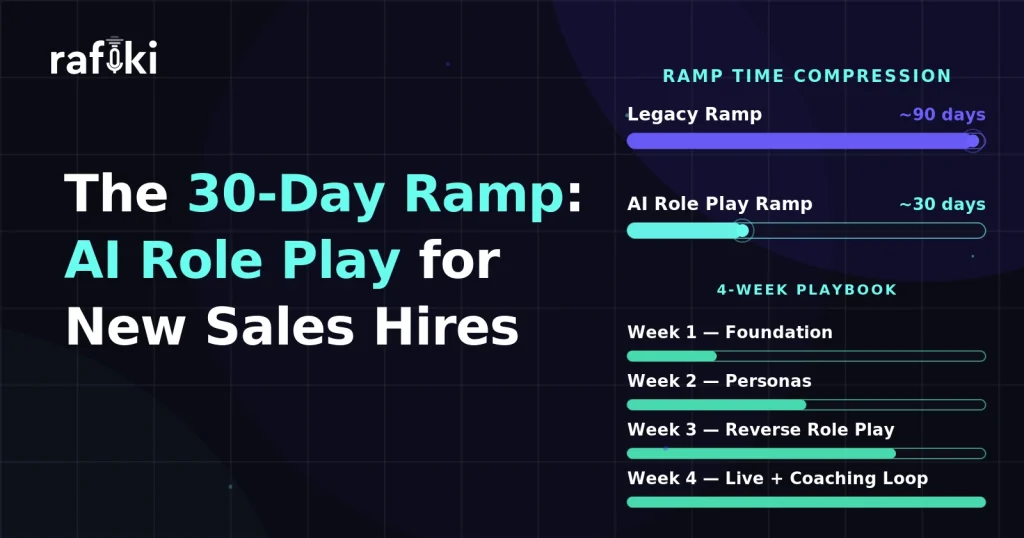
The traditional ramp model — two weeks of slides, a few shadowed calls, role play with a manager who does not have time, then "go live and we'll see" — was already broken before the current hiring climate. Now it is indefensible. The teams pulling ahead are rebuilding ramp around AI role play for sales training: unlimited, scored, persona-driven practice that compresses what used to take 90 days into 30, before a new hire ever touches a live prospect.
Ask a CRO what their average ramp time is and you will get a confident answer. Ask them how that number is calculated, what its variance looks like, and whether it has moved in the last four quarters, and the answers get fuzzy fast. Ramp time is the metric that everybody references and almost nobody manages with the rigor it deserves.
That is a problem because ramp time silently determines almost every other revenue metric:
The Gartner sales research practice has highlighted for years that seller productivity gains come disproportionately from compressing the early-tenure window, not from squeezing more out of veterans. Yet most enablement budgets still flow toward generic curriculum and quarterly kickoffs rather than into the specific machinery that gets a new hire to a first qualified conversation faster.
The traditional ramp playbook was designed for a world where managers had time, peers had patience, and customers tolerated a learning-curve conversation. None of those conditions hold in 2026.
The classic ramp sequence — product training, shadow a senior rep, role play with your manager, then start dialing — fails for structural reasons:
The result is a system that produces reps who can pass a certification quiz but freeze on a discovery call. The investment is real. The output is unpredictable. And the variance is destructive, because it shows up as missed pipeline three months later when the cohort that was supposed to be ramped is still asking what to say when a CFO pushes back on price.
AI role play replaces the bottleneck — manager and peer time — with unlimited, on-demand practice against realistic buyer personas. The new hire can run a discovery scenario at 9pm, get scored against the same methodology and rubric the org uses for live calls, and try the same scenario again ten minutes later with a different persona's pushback. The economics of practice shift from "scarce, manager-rationed" to "abundant, self-directed."
That changes ramp in four concrete ways:
This is not about replacing human coaching. It is about freeing human coaching to focus on the moments where it actually moves the needle, while AI absorbs the volume of repetition that human managers were never going to be able to deliver anyway.
A 30-day ramp is not a marketing slogan. It is an operating model with a specific weekly cadence, specific outputs each week, and specific exit criteria before a new hire ever touches a live prospect or a real pipeline number. The playbook below assumes you have AI role play capability in place, a defined sales methodology, and a frontline manager committed to the cadence.
The four-week shape:
Exit criteria at day 30 are not "completed the program." They are: methodology score above a defined threshold on three consecutive role plays, two completed live discovery calls scored at parity with the tenured-rep average, and a first qualified opportunity in pipeline. If those criteria are not met, the rep stays in structured practice for another week. The point is to make the gating objective, not vibes-based.
Week one is about building the absolute minimum context — what we sell, who we sell to, the methodology we use, and the first persona the rep will practice against. Everything else is held back. The mistake most ramp programs make is trying to cover every persona, every objection, and every product variation in week one. The result is a rep who knows a little about everything and can execute nothing.
The week-one schedule looks like this:
The deliberate constraint of week one — one persona, one call type, one methodology framework — is what makes the rest of the playbook work. Reps leave the week with measurable competence in one scenario rather than vague familiarity with twenty.
Week two expands persona coverage and turns objection handling into a structured practice discipline rather than a wing-it conversation. By the end of week two, the rep should be able to handle the top five objections your team faces with responses that are scored at parity with tenured-rep performance in role play.
The structure:
The output of week two is not just "practice happened." It is a per-rep map of objection-handling strengths and weaknesses tied to specific personas. That map drives every subsequent coaching conversation and every role play assignment.
Week three is where the system gets interesting. The rep now shadows live calls actively — not just watching, but predicting what the senior rep will say next, what objection is about to come, and what the next-step ask should be. After each shadowed call, the rep runs the same scenario in AI role play, comparing their execution to what they observed live.
Reverse role play is the other innovation of week three. The new hire plays the buyer; the AI plays the seller. This sounds counterintuitive, but it forces the rep to think about what buyers actually want from a seller — the questions that feel intrusive versus generative, the discovery moments that build rapport versus erode it, the objections that emerge when a seller's pitch is misaligned with the buyer's actual priority. Harvard Business Review has highlighted that pairing structured AI practice with deliberate perspective-shifting is one of the most underused mechanisms for accelerating skill acquisition in complex sales roles.
Week three structure:
Week four is when the rep takes live calls — but with a coaching loop tight enough that no gap goes uncorrected for more than 24 hours. Every live call is scored against the same rubric as the role plays. Gaps surfaced by scoring become the role play assignments for the next morning, before the rep goes back into another live call. The cycle compresses what used to be a week-long feedback delay into a daily rhythm.
The cadence:
The defining feature of week four is that role play does not stop when live calls start. It becomes a tool the rep uses every morning for the rest of their tenure — not a one-time onboarding artifact. That continuity is what separates teams who treat AI role play as an onboarding tool from teams who treat it as a permanent capability.
Rafiki AI is an AI-native revenue intelligence platform built from day one on multi-model AI, with autonomous AI agents that operate as a 24/7 revenue team. For ramp programs specifically, three capabilities do the heavy lifting.
The Role Play capability gives new hires unlimited, on-demand practice against customizable buyer personas. Enablement teams can spin up the personas that match their actual ICP — a skeptical mid-market CFO, a technical buyer with a competitor evaluation in flight, a stalling champion who has gone dark — and reps can run those scenarios across discovery, demo, objection handling, and pricing conversations. Every session is scored against the same methodology rubric used for live calls, so the rep gets immediate, consistent feedback in private before any of it shows up on a real prospect.
The Coaching Agent turns role play scores into a personalized development path. Instead of generic coaching agendas, the agent surfaces the specific two or three skills each rep should focus on this week, with the role play moments and live-call clips that prove the gap. Frontline managers walk into one-on-ones with an evidence-backed agenda instead of a blank page.
Smart Call Scoring closes the loop by grading live calls against the same rubric as the role plays. That parity is what makes the day-30 exit criteria objective. When a new hire's live discovery call is scored on the same dimensions as the role plays they have been running for four weeks, ramp completion becomes a measurable threshold instead of a manager's gut feel. Methodology coverage spans MEDDIC, BANT, SPIN, SPICED, GAP, Challenger, Sandler, and fully custom criteria, so the scoring matches whatever your team actually runs.
Because Rafiki AI starts at $19/seat/month with no seat minimums and no annual commitment, growing teams get enterprise-grade ramp infrastructure without the enterprise contract. Setup runs about 15 minutes, with native integrations across Salesforce, HubSpot, Zoho, Pipedrive, Freshworks, and Monday.com on the CRM side, Zoom, Microsoft Teams, and Google Meet on the meetings side, and Slack, Aircall, and OpenPhone for messaging and dialing. Transcription and role play coverage extends across 60+ languages, so distributed and international teams ramp against the same framework regardless of region.
Most ramp programs measure activity — modules completed, certifications passed, hours of training delivered. Those metrics tell you the program ran. They do not tell you the rep ramped. The three metrics below tell you whether the playbook is working.
The third metric is the most diagnostic and the most overlooked. A team can claim to have a 30-day ramp program, but if a discovery gap surfaced on Monday is not addressed in role play until the following Monday's one-on-one, the loop is not actually closed. The latency metric forces the cadence to be real. Industry research like the Salesforce State of Sales survey has consistently flagged feedback speed as one of the biggest determinants of seller productivity, and a closed-loop ramp program is where that finding becomes operational.
Pair these three metrics with a fourth diagnostic — variance across the cohort. A ramp program that produces one fast ramper and three slow ones is not a ramp program. It is a hiring program with survivorship bias. The teams running mature AI-driven ramp see variance compress significantly, because the practice volume each rep gets is no longer dependent on whether their manager happened to have time that week.
In a cautious hiring climate, every ramped rep matters more, and every dollar spent on a rep who does not ramp matters more too. The teams that compress ramp from 90 days to 30 do not just save salary. They convert a structural cost into a strategic asset — a hiring engine that produces predictable bookings in a single quarter, a manager bench that spends its time on high-leverage deals instead of basic objection mechanics, and a culture where new hires expect to be productive fast and have the practice infrastructure to actually do it.
McKinsey research on workforce productivity has noted repeatedly that the biggest gains in skilled-role onboarding come from structured, high-repetition practice with fast feedback. AI role play is what makes that pattern operational at sales-team scale. The playbook is no longer the bottleneck. The bottleneck is whether you commit to running it.
If you are designing your 2026 ramp program, the question is not whether to use AI role play. It is whether you build the playbook around it deliberately — with weekly cadence, exit criteria, and the three ramp metrics that matter — or whether you bolt it onto a legacy program and hope. The teams that win the next four quarters will choose the first path.
Ready to compress your ramp from 90 days to 30? Explore the Role Play capability and see how Rafiki for sales enablement wires role play, scoring, and coaching into a single closed loop. Start free at $19/seat/month — no seat minimums, no annual commitment, 15-minute setup. Book a demo when you are ready to see AI-driven ramp on your own personas and your own methodology.
Start for free — no credit card, no seat minimums, no long contracts. Just better sales intelligence.