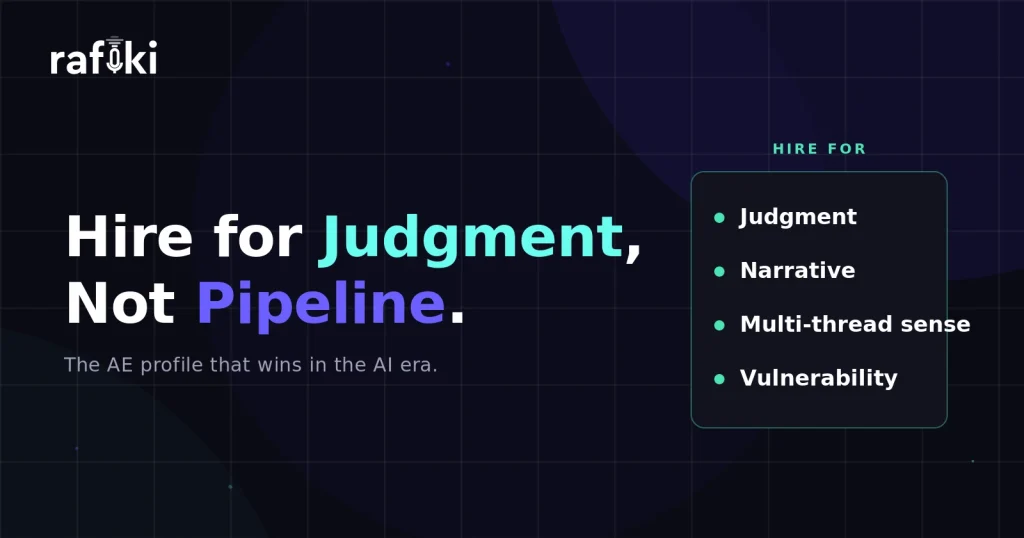
The AE profile that worked in 2022 is the AE profile that will get you fired in 2026. The job changed. Most hiring rubrics have not caught up.
For a decade, frontline managers hired on a stable formula: pipeline-generation grit, dial volume, demo polish, and a familiar logo on the resume. That formula assumed the job was an activity job. In 2026, that assumption is dead. Autonomous AI agents handle the activity layer. The sequencing is automated. The note-taking is automated. CRM updates write themselves. The first-draft follow-up is in the rep's inbox before the call has ended.
So what is the human AE actually for? For the things AI cannot do credibly: judgment under ambiguity, narrative construction, vulnerability in front of a skeptical buyer, and the multi-thread sense it takes to land a complex deal across five stakeholders with conflicting priorities. Harvard Business Review's September 2025 analysis of sales teams growing alongside AI framed it bluntly: the winning teams redesigned the rep role around what AI cannot replace. Most hiring rubrics still screen for what AI now does for free. The result is a hiring market full of resumes that look strong on paper and reps who flame out in their first quarter.
If you are hiring an AE in 2026, the question is whether the candidate has the AE hiring AI era profile: judgment, narrative, vulnerability, multi-thread sense. This playbook shows how to find out before the offer.
The 2022 AE profile was built around scarcity of activity. Reps were valuable in proportion to how many calls they made, how many sequences they ran, how many demos they landed. The rubric reflected it: years of SDR experience, dial counts, pipeline-sourcing percentages. The interview was largely a screen for hustle.
None of those signals are useless. But they no longer separate the reps who will succeed from the ones who will not, because the activity layer has been absorbed by AI. The rep who could send 200 personalized sequences a week was a star in 2022. In 2026, every rep on the team can do that, because the autonomous AI agents are doing it. The differentiating skill has moved one floor up — to the moments where a human has to read a room, decide whether to push or hold, reframe a dying deal, or earn trust from a buyer who has been burned before.
The candidate who closed eight figures at a hot logo in 2022 may have done it on a market tailwind, a famous brand, and a fed SDR pipeline. Strip those out, and what is left? Sometimes real selling skill. Often not. The rubric has to be built to tell the difference, because the resume will not.
"Hire for judgment" means nothing unless you can describe what it looks like in the moments where it matters. Judgment is a series of micro-decisions a rep makes inside a 45-minute call, each one shifting the trajectory of the deal:
These are moments AI can support but cannot make. Autonomous AI agents can surface that the champion has gone quiet, that the deal slipped twice, that the price pushback echoes language the buyer used before. The decision about what to do with that signal — push, hold, reframe, walk — is the human rep's job. And it is what your hiring process has to test for.
If pedigree is no longer the best predictor, what is? The signals below are what frontline managers running modern AE hiring rubrics are weighting more heavily — and candidates who light up on these signals are outperforming the pedigree hires from the same cohort.
None of these signals require a famous logo on the resume. All require a candidate who has been a thoughtful, self-aware practitioner — the profile your interview loop has to surface.
Most sales interview questions are pattern-matched to death. "Tell me about a time you overcame an objection" produces rehearsed answers from anyone who has interviewed in the last five years. The questions below are harder to game because they require the candidate to reason in real time about specifics, not recite a STAR-format anecdote:
Notice what is missing: questions about quota attainment, pipeline coverage, and dial volume. Those are resume-screen questions. By the time the candidate is in the interview, the question is whether they have the judgment to win the deals AI will tee up.
Interview questions tell you what a candidate thinks they would do. A role play tells you what they actually do under pressure. The pre-hire role play is the most predictive step in a modern AE interview loop — and the step most teams skip because they do not know how to run it consistently.
The structure that works: a 30-minute scenario with a defined buyer persona, a defined situation, and a defined set of objections, run against an AI buyer persona that responds dynamically rather than reading from a script, and scored against a published rubric so every candidate is evaluated against the same dimensions.
Three scenarios to use in your pre-hire assessment:
Score each scenario against five dimensions: discovery depth, narrative clarity, judgment under pressure, methodology adherence, next-step credibility. Publish the rubric. Score every candidate against it. The candidates who score high across all three are the ones whose judgment will hold up in your funnel.
Rafiki AI is an AI-native revenue intelligence platform with autonomous AI agents that operate as a 24/7 revenue team. For hiring managers building a judgment-first AE rubric, four capabilities turn the playbook above into something measurable.
The Role Play capability is the pre-hire judgment assessment in operational form. Hiring teams spin up the three scenarios above against the exact buyer personas they sell into. Every candidate runs the same scenarios. Every session is scored against the same five-dimension rubric. The interview loop stops being a series of subjective conversations and becomes a comparable, evidence-backed evaluation.
Post-hire, the Coaching Agent turns the same rubric into a development path. The new hire's first-month role plays and live calls are scored against the same dimensions used in the interview, so the gap between "how they showed up in hiring" and "how they show up in production" is visible — with the call clips that prove it.
Smart Call Scoring provides the team baseline. Once tenured calls are scored against the same rubric, the hiring manager has a comparison set: what does a 4.5 in judgment look like on the team today, and where does the candidate sit? Methodology coverage spans MEDDIC, BANT, SPIN, SPICED, GAP, Challenger, Sandler, and custom criteria.
Ask Rafiki closes the loop on the question every hiring manager should ask: what does judgment actually look like in our closed-won deals? Query the corpus for "which closed-won deals had the most judgment-heavy moments" and the answers come back with the actual calls. The rubric is now anchored to the specific moments that won the last 30 deals.
Because Rafiki AI starts at $19/seat/month with no seat minimums and no annual commitment, growing teams get hiring-grade assessment infrastructure without the enterprise contract. Setup runs about 15 minutes, with native integrations across Salesforce, HubSpot, Zoho, Pipedrive, Freshworks, and Monday.com, plus Zoom, Microsoft Teams, Google Meet, Slack, Aircall, and OpenPhone. Coverage extends across 60+ languages.
It would be easy to conclude hiring should be reduced to a role play score and a rubric. That conclusion is wrong. The rubric tells you whether the candidate has the skill. It does not tell you whether they will thrive on your team, believe in the mission, or stay through the inevitable hard quarter. Those questions are still the hiring manager's job.
The hiring manager's read on fit covers three things the rubric cannot: mission alignment, team chemistry, and trajectory. Scores can be perfect and a candidate can still be wrong for the team. Scores can be middling and a candidate can still be the right hire because of how they will grow.
What changes in 2026 is not that the hiring manager's judgment matters less. It is that the judgment is now applied to a meaningfully better signal — a role play score, an Ask Rafiki query against closed-won judgment moments, and a structured interview loop. The gut still calls the final decision. It is just informed by an order of magnitude more evidence.
If the rubric is right, the loop should be fast. Slow hiring loops bleed candidates to faster competitors and drain hiring-manager energy. A 14-day loop is aggressive but achievable when the steps are scoped to surface judgment efficiently.
Every step surfaces a different dimension of judgment, and the day-13 decision is informed by the cumulative signal, not the last conversation. Harvard Business Review's analysis of teams embracing agentic AI noted that the winners redesigned their entire talent flywheel around what AI changed. Hiring is the first part of that flywheel. For the post-hire side, the natural follow-on is the 30-day ramp playbook, which wires the same role play infrastructure into the new hire's first month — so hiring and ramp run as one continuous loop scored against the same rubric.
The AE hires that will produce in 2027 are not the ones who hit dial counts in 2022. They are the ones who can read a room, hold a dying deal together, push back on a buyer without losing the trust, and make the judgment call when AI surfaces a signal that could go three ways. That profile is hireable — but it requires a rubric built for it, an interview loop that surfaces it, and a pre-hire assessment that tests it.
The teams pulling ahead in 2026 stopped pretending the AE job had not changed. They rewrote the JD. They retired the pedigree screen. They built a role play assessment that surfaces judgment under pressure, and they scored every candidate against it. The result is a hiring funnel that produces reps who can do the parts of the job AI will not do — and a manager bench that coaches judgment rather than supervising activity.
Ready to build a judgment-first hiring rubric? Explore the Role Play capability and see how Rafiki for sales enablement wires pre-hire assessment, post-hire coaching, and team baseline scoring into a single closed loop. Start free at $19/seat/month — no seat minimums, no annual commitment, 15-minute setup.
Start for free — no credit card, no seat minimums, no long contracts. Just better sales intelligence.