The new discovery playbook shipped in July. Enablement ran three sessions, the completion dashboard shows every rep certified, and the leadership update called the rollout a success. Then a manager listens to four discovery calls from last week and hears the old questions in the old order, one rep improvising a version of the new framework, and nobody using the objection responses that took a month to write. The playbook exists in the learning system. It does not exist on the calls. That gap is the whole story of playbook adoption, and few enablement teams measure it.
Enablement teams are good at producing plays and good at proving that reps consumed them. What they rarely have is evidence that the plays are being run, because the only place a play can actually be run is in a live conversation with a buyer, and until recently nobody could look there at scale. Completion became the metric because it was the metric that could be measured. Adoption stayed a feeling.
This article is about closing that gap. It covers what playbook adoption actually means, why completion metrics mislead, the four adoption signals that show up in call recordings, how to build an adoption scorecard, and how to use it to fix, promote, or retire plays based on what happens on calls rather than in the learning system.
Playbook adoption is the degree to which the plays an enablement team publishes actually appear in the conversations reps have with buyers. It is a behavioral measure, not a consumption measure. A rep who completed the training and never runs the play has not adopted it; a rep who skipped the training and runs the play anyway has. The distinction sounds obvious, and it is routinely ignored, because consumption is easy to count and behavior used to be invisible.
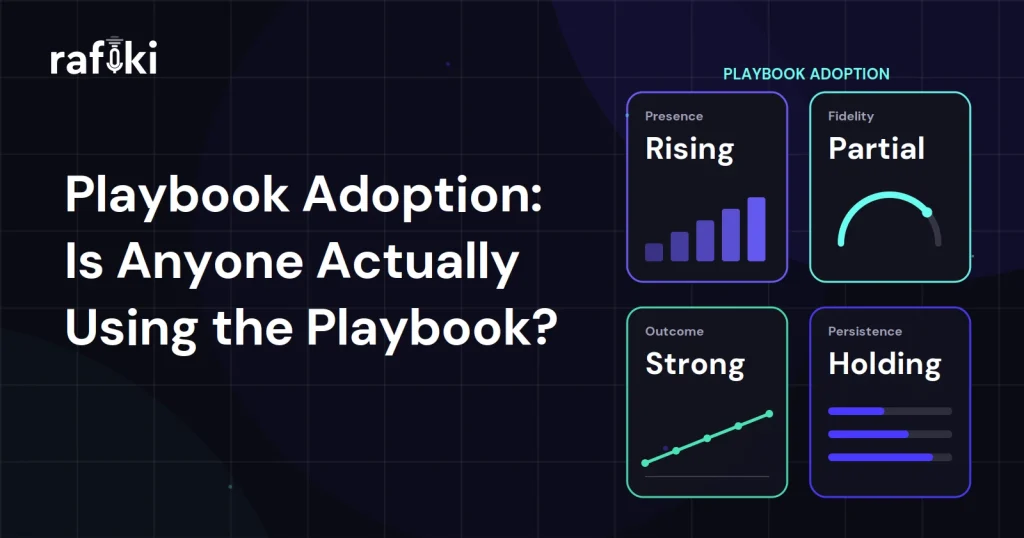
Adoption has three components worth separating. Reach is how many reps run a given play at all. Fidelity is how closely the play as run matches the play as written, or, more usefully, whether the important parts survived. Persistence is whether the play is still being run a quarter after launch, when the training is a memory and the old habits have had time to return.
A playbook with high completion and low adoption is not a training problem. It is an evidence problem: nobody can see that the plays are not running, so nobody intervenes, and the playbook quietly becomes a document rather than a practice.
Why do enablement teams keep reporting completion when everyone involved suspects it does not predict behavior? The reasons are structural, and each one reinforces the others.
The consequence is a cycle familiar to every enablement leader: launch, certify, celebrate, discover six months later that nothing changed, launch a refresh. As Harvard Business Review's discussion of gen AI myths in sales and marketing is a useful reminder, the obstacle is often how teams think about the tools rather than the tools themselves. Enablement has thought of AI as a way to produce more content. What it lacks is a view of the field.
The obvious cost is the enablement effort itself: weeks of work on plays that live in a document. The larger costs are downstream and rarely attributed to the playbook.
First, the sales motion never actually changes. A repositioning, a new discovery framework, or a competitive response is decided at the top and dissolves before it reaches the buyer, so the company keeps getting the results of the old motion while believing it has a new one. Second, coaching becomes incoherent. Managers coach against the playbook in one-on-ones while reps run something else on calls, and the rep learns that the playbook is what you talk about rather than what you do. Third, enablement loses credibility. When a leader asks what the playbook changed and the answer is a completion rate, the next budget conversation is harder.
Salesforce's State of Sales research tracks, year after year, how sales organizations invest in tools and how reps actually spend their time. The playbook is the clearest example of the gap between the two, because it is entirely a matter of whether behavior on calls changed, and that has been the one thing enablement could not see.
Every play, if it is well designed, has observable markers: a question that gets asked, a framing that gets used, an objection response that gets deployed, a step that gets proposed. Those markers appear in the conversation record or they do not. A conversation intelligence platform that captures every call makes the markers searchable, and four signals fall out of them.
The most basic signal is whether the play's markers show up in the calls where the play should apply. A discovery play should appear in discovery calls; an objection response should appear when the objection is raised. Presence, measured per rep, is reach. It answers the question the completion dashboard cannot: who is actually running this?
Reps adapt plays, and they should. The question is whether the parts that make the play work survived the adaptation. If the play's core is a specific sequence of questions and reps are asking the first one and skipping the rest, presence is high and fidelity is low. Fidelity tells enablement which parts of the play are landing and which are being silently dropped, which is exactly what the next revision needs to know.
Calls where the play was run can be compared to calls where it was not, on the outcomes the play was designed to affect: whether the buyer stated a problem, whether a next step was agreed, whether the deal progressed. This is where a play earns its place or loses it. A play that reps run faithfully and that changes nothing should be retired, and only outcome evidence can say so.
Adoption decays. The signal that matters most for the enablement calendar is the trend in presence over the quarter after launch. A play that peaks in week two and fades by week eight was never adopted; it was performed while someone was watching. Persistence is what separates a change in the motion from a change in the training log.
The four signals combine into a scorecard that replaces the completion dashboard as the measure of enablement's impact. Building it is a matter of defining markers and then letting the conversation record do the counting.
The scorecard also changes the relationship between enablement and frontline managers. Instead of asking managers to reinforce the playbook in general, enablement can show each manager which plays their reps are running, which they are dropping, and which parts are surviving, which is a coaching agenda rather than a request.
An adoption scorecard is only useful if it drives decisions about the playbook itself. Three decisions recur.
Run quarterly, this loop keeps the playbook the size of what reps actually use, which is the only size at which a playbook gets used at all.
Rafiki AI is built to make playbook adoption measurable, because it captures and analyzes every conversation across meetings and phone calls, transcribed in more than sixty languages, and lets enablement define what to look for. The markers for each play become criteria, and every applicable call gets scored automatically.
Smart Call Scoring supports custom criteria alongside MEDDIC, SPICED, BANT, and other methodologies, so a sales enablement team can score presence and fidelity for each play on each call type without a manual review. Gen AI Search answers the questions that build the scorecard and the revisions: which reps used the new discovery sequence this week, where reps deployed the competitive response, and what phrasing the reps who adapted the play actually used.
Gen AI Reports turns the scorecard into a standing weekly view by play, by rep, and by manager, so persistence is visible as a trend rather than discovered at the quarterly review. For the fix loop, AI Role Play lets reps practice a revised play against a simulated buyer before it goes back onto live calls. Rafiki AI's autonomous AI agents do the listening and the scoring; enablement keeps the judgment about what the playbook should contain.
| Dimension | Completion-based enablement | Adoption-based enablement |
|---|---|---|
| Primary metric | Certification rate | Presence of plays on applicable calls |
| Where it is measured | Learning system | Conversation record |
| What it says about a rep | They finished the module | They run the play, and how faithfully |
| Play revisions | Based on feedback surveys | Based on what reps actually say |
| Retirement decisions | Rarely made | Based on presence and outcome |
| Manager involvement | "Please reinforce" | Per-rep coaching agenda from the scorecard |
| Proof of impact | Completion dashboard | Outcome difference where the play ran |
Many enablement teams are preparing a Q4 playbook update right now: new positioning for the year-end push, refreshed objection responses, a competitive update. The best time to start measuring adoption is before that update ships, for two reasons. A baseline of the current playbook's adoption shows what the update is competing with. And building the markers into the new plays as they are written makes the scorecard available on launch day rather than reconstructed afterward.
The practical sequence is short. Define markers for the plays that matter most, score the last month of calls to establish the baseline, share the baseline with managers, and then launch the Q4 update with the scorecard already running. By the end of October, the question "is anyone using the playbook?" will have an answer with names attached.
Playbook adoption is a behavior, and behavior happens on calls. Completion metrics measured the only thing that could be measured, and in doing so they let enablement teams mistake consumption for change. The conversation record ends that: presence, fidelity, outcome, and persistence are all visible, per play and per rep, and they turn the playbook from a document into a managed practice. Rafiki AI makes the scorecard automatic, with autonomous AI agents that score every call against the plays enablement defines, surface how reps actually adapt them, and show which plays deserve promotion or retirement. Before the Q4 playbook ships, find out whether anyone ran the last one.
In practical terms, playbook adoption means the plays enablement publishes showing up in real buyer conversations, which makes it a measure of behavior rather than of training consumed. Completion and certification measure whether reps went through the material; adoption measures whether they use it. Adoption has three components: reach, meaning how many reps run a play at all; fidelity, meaning whether the parts of the play that make it work survive reps' adaptations; and persistence, meaning whether the play is still being run a quarter after launch. A playbook can show full certification and near-zero adoption, which happens more often than enablement teams expect and, until conversation records became searchable, was invisible.
Define observable markers for each play, such as the question it asks, the phrase it uses, or the step it proposes, and tag the call types where each play should apply. Then score every applicable recorded call for presence of the markers and for fidelity to the important parts, using custom scoring criteria in a conversation intelligence platform so no manual listening is required. Link each scored call to the deal's next outcome to see whether the play changes anything, and track presence week over week to see whether adoption persists after launch. The result is a per-play, per-rep scorecard that replaces the completion dashboard.
Because the systems around them reward completion rather than use. Learning platforms measure views and certifications, none of which happen on a call. Reps are required to certify and merely encouraged to run the plays, so they satisfy the requirement and revert to habit. Managers coaching from memory reinforce the plays they know, which are usually the old ones. And enablement's attention moves to the next initiative the week a playbook ships, leaving the two months in which adoption is actually decided without an owner. None of these failures is visible until someone looks at the calls.
When the evidence shows low presence and no outcome difference: reps are not running it, and the calls where it does appear do not progress differently from the calls where it does not. Retiring such plays publicly, with the evidence, keeps the playbook the size of what reps actually use and signals that it is curated rather than accumulated. The opposite cases matter too: a play with low fidelity should be rewritten from the versions reps actually run, and a play with modest reach but a strong outcome effect should be promoted through managers and one-on-one coaching. A quarterly fix-promote-retire review keeps the playbook alive.
Rafiki AI's conversation intelligence platform starts at $19 per seat per month with no minimums and no annual commitment. Start your free trial today or book a demo to see which plays your team is actually running.
Start for free — no credit card, no seat minimums, no long contracts. Just better sales intelligence.