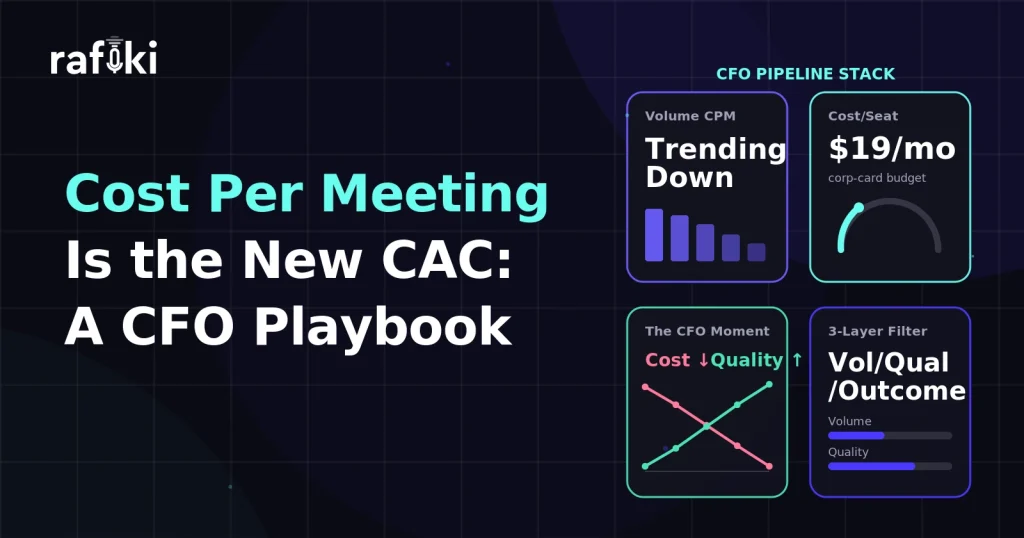
The CFO is now the most important person in the room when revenue tooling gets purchased — and the metric that used to anchor every "is this working" conversation, Customer Acquisition Cost, has quietly stopped telling them what they need to know. In an AI-disrupted go-to-market motion where meeting volume is cheap, pipeline coverage is suspect, and rep productivity is no longer a steady linear input, CAC is too coarse, too lagging, and too easy to game. The new unit economic that survives all of it is cost per booked meeting — and the CFOs winning their 2026 budget cycle are already running it as their primary go-to-market gauge.
This shift is happening fast. According to Grant Thornton's Q1 2026 CFO survey, 68 percent of CFOs are planning to increase IT and digital transformation spending this year, with generative AI named as the top driver. That spending mandate did not come with a free pass — the same CFOs are tightening the screws on every existing SaaS line item, demanding tighter unit economics, and asking RevOps leaders for metrics they can defend in a board meeting. The combination is unforgiving: more budget for AI, less tolerance for vanity. The CFO needs a sharper number, not a softer one.
Cost per booked meeting is that number. It is granular enough to expose where the revenue funnel actually breaks, leading enough to inform next-quarter spend, and clean enough that finance can compute it without translating sales-speak. Done well, it becomes the bridge between the CFO's P&L view of the world and the VP Sales's funnel view of the world — and the CFO ends up owning a metric they can actually move.
CAC was built for a slower world. It assumes a relatively stable conversion rate from spend to customer, a roughly linear contribution from each rep, and a marketing-and-sales mix that doesn't change quarter over quarter. None of those assumptions hold anymore. AI-augmented prospecting can multiply outbound output overnight. Conversation intelligence can change qualification quality without changing spend. A single platform consolidation can collapse three line items into one. CAC sums all of that complexity into a single number, six to nine months after the fact, by which time the lever it would have told the CFO to pull is long gone.
The bigger problem is that CAC obscures where the funnel is breaking. A CAC of $8,000 looks the same whether the team is booking too few meetings (a top-of-funnel problem), booking the wrong meetings (a qualification problem), or losing the right meetings (a closing problem). The CFO who only sees the rolled-up number cannot tell their VP Sales which fix to fund. They end up approving an SDR hire when the real issue was call quality — or sponsoring a coaching program when the real issue was meeting volume.
Here is what CAC, as a standalone metric, can no longer answer for a modern CFO:
The CFO who runs the business on CAC alone in 2026 is running on a lagging indicator that hides three or four different operating problems behind a single average. Cost per booked meeting cracks that average open.
Cost per booked meeting — CPM, in the finance shorthand the rest of this piece will use — is exactly what it sounds like: the fully loaded cost of producing one booked, qualified, attended sales meeting. It sits one layer above CAC in the funnel, which means it shows up months earlier in the data, and it is composed of inputs the CFO already controls: marketing spend, SDR cost, tooling cost, and the AI layer that increasingly sits between all three.
The reason CPM survives the AI disruption is that it normalizes for output volume. If an AI prospecting tool doubles meeting volume but the meetings convert at half the rate, CPM exposes it. If a conversation intelligence platform raises qualification quality so the same meeting volume converts twice as well, CPM rewards it. CAC takes two to three quarters to register the same signal. CPM registers it in weeks.
It is also a metric the CFO can defend without translating. Marketing spend, SDR salary, and SaaS subscriptions are already line items on the P&L. A meeting count is a number the CRM already produces. The arithmetic is straightforward. The CFO can stand in front of the board and trace every dollar back to a contract or a payroll line. That defensibility is exactly what makes it CAC's natural successor in the AI era — finance leaders need a number they can explain without a translator.
A CPM that only includes software spend is a vanity calculation. The CFO who runs CPM properly includes every cost that contributes to producing a qualified meeting, and then divides by the count of meetings that actually happened. The denominator matters too — only meetings that were attended, qualified, and made it past the discovery threshold should count. Booked-but-no-showed and booked-but-immediately-disqualified meetings inflate the denominator and hide a real productivity gap.
A real CPM stack includes:
Divided by qualified meetings attended, the result is the true CPM. For most SMB and mid-market teams, the number is initially uncomfortable — much higher than the SaaS vendor's marketing copy would suggest. That discomfort is the metric working. The point of CPM is to surface the real economics so the next dollar gets allocated honestly.
The temptation with AI tooling is to chase volume. More outreach, more dials, more sequences, more meetings. Volume looks great on a slide and terrible on a CPM line, because the meetings that get booked under volume pressure tend to be the meetings that no-show, get disqualified, or never reach a second call. The CFO who funds volume without quality is funding meeting junk — and CPM is the metric that catches it.
The right use of AI is to compress CPM by lifting both sides of the ratio at once: lowering the cost numerator and raising the qualified-meeting denominator. Harvard Business Review's June 2025 analysis of AI in sales and marketing makes the point directly — the biggest gains do not come from doing more of the same activity faster, they come from making better decisions earlier in the funnel. For a CPM line, "better decisions earlier" means qualification at the first conversation, accurate disposition coming out of the call, and CRM data clean enough that finance can audit the number without a six-week reconciliation.
Specifically, AI lowers CPM when it:
The CFO who measures CPM monthly catches each of these levers in the data before the next budget cycle. The CFO who waits for CAC to roll up catches them two quarters late.
CPM gets sharper when the CFO runs it through three layers, not one. Each layer answers a different question and each layer rewards a different operational fix.
Running all three together turns CPM from a single number into a small dashboard the CFO can read in 30 seconds. When the volume CPM trends down but the quality CPM holds flat, the team is producing more junk meetings — a coaching or qualification problem, not a spend problem. When all three trend together, the AI investment is working. When volume and quality both improve but outcome does not, the issue is downstream: pricing, deal structure, or competitive positioning, not meeting production.
This is the exact problem Rafiki AI was built to solve at the data layer. The platform's autonomous AI agents produce the inputs a CFO needs for a defensible CPM model — without adding another SaaS line item, another implementation project, or another vendor for procurement to manage. Setup takes 15 minutes and pricing starts at $19 per seat per month with no seat minimums and no annual commitment, which means the CFO can pilot the metric before committing the budget.
Here is how Rafiki AI's capabilities map to a CFO-grade CPM stack:
The autonomous AI agents work in concert as the data infrastructure underneath the CFO's metric. The CFO doesn't have to wait for the VP Sales to send a clean number — the number is clean by default. Explore the full capability map on the Rafiki AI product overview.
For most of the last decade, conversation intelligence and revenue analytics sat on the CFO's "expensive subscription" shelf — a six-figure annual contract, a seat minimum that assumed a 30-person sales org, an implementation timeline that consumed a quarter, and a renewal conversation every fall that required a CFO sign-off. The category was structurally hostile to SMB and mid-market budgets. Pricing made the buy a CFO-level decision; complexity made the renewal a CFO-level fight.
That stack has collapsed. AI-native platforms now deliver conversation intelligence, scoring, CRM hygiene, and reporting in a single integrated layer — with seat-level pricing, no minimums, no annual commitments, and a setup measured in minutes. Deloitte's CFO guide to tech trends has been consistent on the point: the CFOs who win the AI cycle are the ones who unbundle their incumbent SaaS stack and replace fragile multi-vendor configurations with consolidated, AI-native platforms that can be expensed without negotiation.
The practical implication for a CFO is striking:
This is the part of the story that finance leaders find genuinely surprising. The category that used to require a board-level conversation now fits inside a manager's expense report. The unit economics of the buy are no longer a negotiation; they are an arithmetic check.
The CFO who wants to run CPM as their primary go-to-market metric does not need a long implementation. Sixty days is enough to stand up the data layer, validate the metric, and start informing the next budget cycle. Here is the sequence that works for most SMB and mid-market finance leaders.
By day 60, the CFO has a defensible CPM model, a working dashboard, and a budget conversation that no longer relies on rolled-up CAC. The unit economics of the go-to-market motion become a finance-led conversation instead of a sales-led one.
The shift from CAC to cost per booked meeting is not a metric swap. It is a change in who owns the go-to-market conversation. CAC was a sales-presented number that finance had to interpret. CPM is a finance-owned number that sales has to operate against. The CFO who installs it well gets the next two years of operating leverage right; the CFO who waits gets it from someone else's incident report.
The other implication is that the SaaS stack has to justify itself against CPM the same way every other line item does. Tools that cannot prove they lower CPM — or raise the quality denominator inside it — will not survive the next renewal cycle. Tools that can will become the spine of the modern revenue org. The AI-native platforms that compress the stack, drop the seat minimum, and price inside a manager's expense report are not just a procurement convenience. They are the only category of revenue tooling that survives a CFO's CPM review intact.
Ready to build a CFO-grade CPM model on top of clean conversation and CRM data? See Rafiki AI's pricing ($19 per seat per month, no seat minimums, no annual commitment, 15-minute setup, 60+ languages) and tour the full platform. Rafiki AI's autonomous AI agents give finance leaders the meeting-level data infrastructure their cost-per-booked-meeting model needs — at a price point that lives inside a corporate-card budget and a setup that fits between two finance review meetings.
Start for free — no credit card, no seat minimums, no long contracts. Just better sales intelligence.