Your forecast says the deal closes this quarter — but the buyer stopped returning calls two weeks ago, the champion dodged the last pricing discussion, and legal has gone silent on redlines.
This is deal slippage in its most familiar form: not a dramatic loss, but a quiet drift. The close date slides from March to April, then to "next quarter," and eventually the opportunity decays into a graveyard of stale CRM records. The damage is not just one missed deal. It is a compounding forecast miss that erodes board confidence, destabilizes compensation plans, and forces leadership into reactive pipeline scrambles. Every revenue leader knows the feeling. Fewer know how to catch it early enough to act.
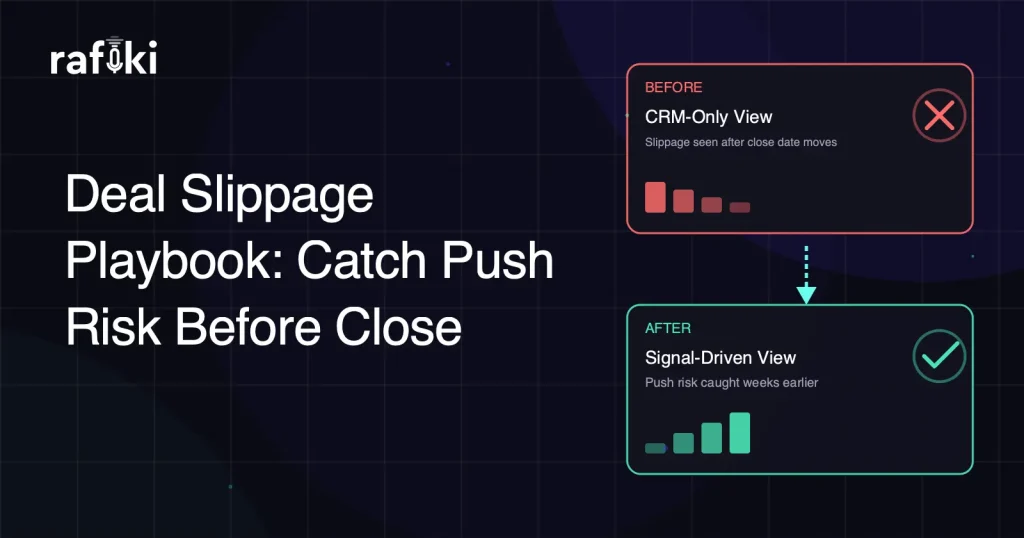
The painful truth is that most teams detect deal slippage only after it has already happened — when the rep updates the close date in the CRM, weeks or months after the real risk signals surfaced in conversations no one reviewed. By then, the intervention window has closed. The deal is not lost, but it is no longer yours to control.
Why Deal Slippage Is the Silent Forecast Killer
Deal slippage refers to the pattern in which an opportunity's expected close date moves later than originally projected, often repeatedly, without a corresponding change in deal stage or strategy. It is the single most common source of forecast error in B2B sales organizations, and it hides in plain sight because CRM data alone cannot capture its root causes.
The problem is structural. Reps self-report deal health. Managers rely on pipeline reviews that happen weekly at best. Close dates are set optimistically and rarely stress-tested against actual buyer behavior. As McKinsey's research on B2B growth highlights, the highest-performing revenue organizations have moved away from intuition-driven forecasting toward signal-driven decision systems. The result for everyone else is a forecast built on intention rather than evidence.
- Buyer engagement drops — fewer meetings, shorter calls, delayed email responses — but the CRM stage stays the same
- Champions go quiet after internal reorganizations or budget freezes, and the rep interprets silence as "still working on it"
- Procurement or legal introduces new stakeholders late in the cycle, adding weeks the timeline never accounted for
- Competitors re-engage the account with a lower price or a last-minute proof of concept, creating evaluation loops the rep does not surface
- The economic buyer was never truly engaged, and the deal stalls at the approval stage that was always going to be the bottleneck
Each of these patterns leaves traces in conversations — tone shifts, vague commitments, unanswered questions about next steps. But those signals live in call recordings and meeting transcripts that no one has time to review at scale. So the deal keeps its optimistic close date until reality forces a change.
The Cost of Catching Slippage Too Late
When deal slippage is identified reactively — after the close date has already moved — the consequences cascade across the entire revenue organization. This is not a minor operational inconvenience. It is a systemic failure that touches forecasting, resource allocation, and team morale.
- Forecast accuracy collapses. Most revenue leaders know from experience that a significant share of B2B deals do not close as originally forecasted. Every slipped deal widens that gap, making it harder for CROs to commit numbers to the board with confidence.
- Pipeline coverage ratios become meaningless. If a significant portion of "committed" pipeline is actually at risk of slipping, your 3x coverage is an illusion. RevOps teams end up over-building pipeline to compensate, burning SDR capacity on volume instead of quality.
- Rep behavior degrades. When reps learn that slipped deals carry no consequences until the close date passes, they lose urgency. Sandbagging and happy ears become cultural defaults rather than individual failures.
- Buyer trust erodes. Repeated follow-ups on a deal the buyer has mentally deprioritized signal desperation, not partnership. The rep's credibility drops, and with it, the probability of eventual close.
- Management interventions become rescue missions. When a VP of Sales discovers a deal is at risk three days before quarter-end, the only play is a discount or executive escalation — both of which destroy margin and set bad precedent.
The aggregate effect is a revenue machine that runs on hope rather than signal. And hope, as every seasoned operator knows, is not a strategy.
The Five Signals of Push Risk: What to Listen For
Deal slippage does not happen overnight. It builds through a sequence of behavioral signals that are visible in buyer conversations well before the CRM reflects any change. The challenge is capturing and interpreting those signals at scale.
Signal 1: Vague or Missing Next Steps
A healthy deal has clear mutual action plans. When a buyer ends a call with "let me circle back internally" or "we will figure out timing on our end" without committing to a specific date or action, the deal is decelerating. One vague close is a data point. Two in a row is a pattern.
Signal 2: Champion Disengagement
Track how your champion's participation changes across the deal cycle. Shorter responses, fewer questions, delegating meetings to junior stakeholders — these are all indicators that your champion has either lost internal sponsorship or deprioritized the initiative. The conversation data tells you this weeks before the CRM does.
Signal 3: New Stakeholders Entering Late
When procurement, legal, or a new executive appears in calls during what should be the final negotiation stage, the deal timeline is about to expand. This is not inherently negative — it can signal genuine buying intent — but it must trigger an immediate timeline reassessment.
- Late-stage introductions of new stakeholders correlate strongly with close date pushes
- Reps often fail to adjust the CRM timeline, creating a gap between deal reality and forecast data
- The right response is not alarm, but recalibration — update the close date, map the new stakeholder's concerns, and build a revised mutual action plan
Signal 4: Pricing or Budget Conversations That Stall
If the buyer engaged actively on pricing in week two but has not revisited it in three subsequent calls, something changed. Either the budget shifted, a competitor entered the evaluation, or the initiative lost executive priority. Silence on pricing is rarely a sign that everything is fine.
Signal 5: Sentiment and Tone Shifts
Beyond the words themselves, how the buyer says things matters. A shift from enthusiastic, forward-looking language ("when we roll this out," "our team is excited") to hedging language ("we are still evaluating," "there are a lot of moving pieces") indicates an internal change that the buyer may not explicitly communicate.
These five signals are not hypothetical. They appear in real conversations every day. The question is whether your team has the infrastructure to detect them systematically — or whether you rely on individual reps to self-diagnose risk in their own pipeline.
Building a Deal Slippage Early Warning System
Catching push risk before close dates move requires a shift from reactive pipeline management to proactive signal detection. This means building a system — not just a process — that continuously monitors buyer behavior across every conversation in your pipeline.
- Conversation-level monitoring: Every call, every meeting, every email thread associated with an active opportunity should be analyzed for the five signals above. Manual review does not scale. You need AI that processes every interaction and flags anomalies.
- Deal scoring based on behavior, not rep input: Call scores should reflect what actually happened in the conversation — whether MEDDIC fields were advanced, whether the buyer committed to next steps, whether new objections surfaced — not what the rep wrote in a CRM note after the fact.
- Trend analysis across the deal timeline: A single call is a snapshot. The real insight comes from tracking how engagement, sentiment, and commitment evolve across the full sequence of buyer interactions. A deal that was strong in discovery but weakened in evaluation tells a different story than one that was always lukewarm.
- Automated CRM alignment: When conversation data reveals a disconnect between what the buyer said and what the CRM says — a committed close date that no buyer has verbally confirmed, for example — the system should surface that gap to the manager without waiting for the next pipeline review.
- Manager-ready alerts: Frontline managers need push risk flagged with context, not just a red indicator. The alert should include the specific call moment, the language used, and a recommendation for the intervention.
This is not a wish list. It is the operational standard that modern revenue intelligence makes possible — and the teams that adopt it in 2026 will have a structural advantage in forecast accuracy and win rates.
How Rafiki AI Detects and Surfaces Deal Slippage Risk
This is where an AI-native architecture makes the difference. Rafiki AI was built from day one on multi-model AI to function as an autonomous revenue intelligence layer across your entire deal cycle — not a call recorder with a GPT wrapper bolted on.
Rafiki AI deploys six autonomous AI agents that work continuously across every conversation in your pipeline, creating the early warning system described above without requiring manual review or rep self-reporting.
- Smart Call Scoring evaluates every call against your methodology of choice — MEDDIC, BANT, SPIN, SPICED, GAP, Challenger, Sandler, or your own custom criteria. When a deal that was scoring well in discovery starts declining in negotiation-stage calls, the trend is visible immediately. You see which specific qualification criteria weakened and on which call.
- Smart CRM Sync auto-populates methodology-specific fields and custom CRM fields directly from call content, eliminating the gap between what buyers say and what your CRM reflects. When a buyer mentions a budget freeze on a call but the CRM still shows "Budget Confirmed," Smart CRM Sync surfaces the contradiction.
- Smart Call Summary delivers concise, AI-generated summaries of every conversation, ensuring that key moments — including slippage signals — are captured and accessible without requiring anyone to listen to full recordings.
- Ask Rafiki Anything (Gen AI Search) lets managers query their entire deal library in natural language — "Show me all deals closing this quarter where the buyer has not confirmed next steps in the last two calls" — and get instant, evidence-based answers. No more guesswork in pipeline reviews.
- Smart Follow Up generates contextual follow-up actions after every call, ensuring that vague buyer commitments are immediately translated into specific rep tasks. When a buyer hedges on timing, the follow-up reflects that reality instead of defaulting to the original close date.
- Gen AI Reports aggregate deal health trends across your pipeline, giving RevOps and frontline managers a real-time view of which deals are progressing on track and which are showing early push risk patterns.
Rafiki AI analyzes conversations in 60+ languages, integrates with Salesforce, HubSpot, Zoho, Pipedrive, Freshworks, Zoom, Teams, and Google Meet, and sets up in minutes. It starts at $19 per seat per month with no seat minimums, no annual contracts, and no hidden fees — enterprise-grade deal intelligence without the enterprise procurement cycle.
The Deal Slippage Intervention Framework: A Five-Step Playbook
Detecting push risk is only half the equation. The other half is intervening early enough to change the outcome. Here is a practical framework for turning slippage signals into deal-saving actions.
- Triage by signal severity. Not all push risk is equal. A deal where the champion has gone dark for three weeks is in a different category than one where legal introduced a new stakeholder. Classify slipping deals into three tiers: active risk (buyer disengaged), timeline risk (process expanded), and uncertainty risk (mixed signals). Each tier demands a different intervention speed and approach.
- Review the conversation evidence. Before contacting the buyer, review the actual call moments that triggered the alert. Understand the specific language, the context, and the stakeholder involved. Managers who intervene based on data instead of gut feel earn rep trust and make better strategic decisions.
- Reset the mutual action plan. Contact the buyer with a direct, respectful acknowledgment that the timeline needs revisiting. Propose a revised mutual action plan with specific dates and owners. Avoid the temptation to push harder on the original date — that destroys trust and accelerates disengagement.
- Escalate or multi-thread strategically. If the champion has gone quiet, it is time to engage another stakeholder. If the economic buyer was never confirmed, this is the moment to pursue executive sponsorship. Use conversation intelligence to identify every stakeholder who has appeared on calls and determine who has the authority and motivation to move the deal forward.
- Update the forecast with conviction. The worst outcome is intervening on the deal but leaving the forecast untouched. If the close date is moving, update it in the CRM immediately — with a note explaining the evidence and the revised plan. Accurate forecasts, even when the news is bad, build organizational credibility over time.
This framework works because it is evidence-based. Every step relies on conversation data rather than assumptions, which means interventions are targeted and timely rather than reactive and generic.
Embedding Slippage Detection Into Your Weekly Operating Rhythm
A playbook only works if it is woven into the team's regular cadence. Deal slippage detection should not be a quarterly audit — it should be a continuous signal that feeds into every pipeline review, every 1:1, and every forecast call.
- Monday pipeline review: Start with the AI-flagged deals showing push risk. Review the specific call moments, discuss intervention plans, and assign ownership. This replaces the traditional "walk me through your deals" format with a signal-first approach.
- Wednesday 1:1s: Managers use deal-level conversation trends to coach reps on specific behaviors — how to secure firm next steps, how to re-engage a quiet champion, how to handle late-stage stakeholder introductions. Rafiki AI surfaces the coachable moments automatically through Smart Call Scoring.
- Friday forecast sync: RevOps pulls the weekly push risk report and compares it against committed pipeline. Deals with deteriorating conversation scores move from "commit" to "best case" or "pipeline" before the rep asks for the reclassification. This is proactive forecasting.
- Monthly deal retrospective: Review deals that slipped in the prior month. Identify the earliest signal that push risk was present and measure how quickly the team responded. Over time, this tightens the detection-to-intervention gap and builds organizational muscle memory.
The teams that embed this rhythm consistently report that deal slippage surprises drop dramatically. Not because deals stop slipping — some deals will always push — but because the team sees it coming and adjusts before the forecast breaks. This is the difference between managing pipeline and managing revenue.
From Reactive Forecasting to Predictive Revenue Management
The shift from catching deal slippage after the fact to predicting it before it happens represents a fundamental evolution in how revenue teams operate. It moves the locus of control from the buyer's internal timeline — which you cannot influence — to your team's ability to read, interpret, and act on behavioral signals — which you absolutely can develop.
- Traditional pipeline management asks: "What does the rep think will happen?" Predictive revenue management asks: "What does the conversation data say is happening?"
- Traditional forecasting adjusts after close dates move. Predictive forecasting adjusts when engagement patterns shift — days or weeks earlier.
- Traditional coaching addresses skill gaps in aggregate. Signal-driven coaching addresses specific deal behaviors in real time.
AI-driven decision-making excels precisely in environments where humans face information overload and cognitive bias — both of which define pipeline management. The organizations that operationalize this capability in 2026 will not just forecast better. They will close more of their pipeline because they intervene on the right deals at the right time with the right actions.
Rafiki AI exists to make this operational for growing sales teams — not just the enterprises with six-figure tool budgets and dedicated RevOps headcount. With no seat minimums, no annual contracts, and quick setup, Rafiki AI delivers the same autonomous deal intelligence that enterprise platforms promise, at a fraction of the cost and without the implementation burden.
Conclusion: The Teams That See Deal Slippage First Win More Often
Deal slippage is not a mystery. It leaves fingerprints in every buyer conversation — vague commitments, fading engagement, surprise stakeholders, pricing silence, tone shifts. The teams that build systems to detect these signals early, intervene strategically, and update their forecasts with conviction do not just improve forecast accuracy. They change win rates because they stay relevant to the buyer when competitors are still waiting for the CRM to tell them something is wrong.
- The cost of ignoring push risk is compounding: missed quarters, eroded trust, wasted pipeline
- The technology to detect it exists today — AI-native conversation intelligence that works across every call, every deal, every language
- The operational framework is straightforward: detect, triage, intervene, update, learn
- The competitive advantage belongs to the teams that act on signals rather than waiting for symptoms
Your team is leaving winnable deals on the table because nobody catches the signals buried in their calls. That does not have to be the case.
Rafiki AI gives growing sales teams an AI-native revenue intelligence platform with six autonomous agents that detect deal slippage risk, score every call against your methodology, sync insights directly to your CRM, and surface push risk before close dates move — starting at $19 per seat per month with no seat minimums and no annual commitment. Start free or book a demo at getrafiki.ai and stop losing winnable deals to signals you never saw.