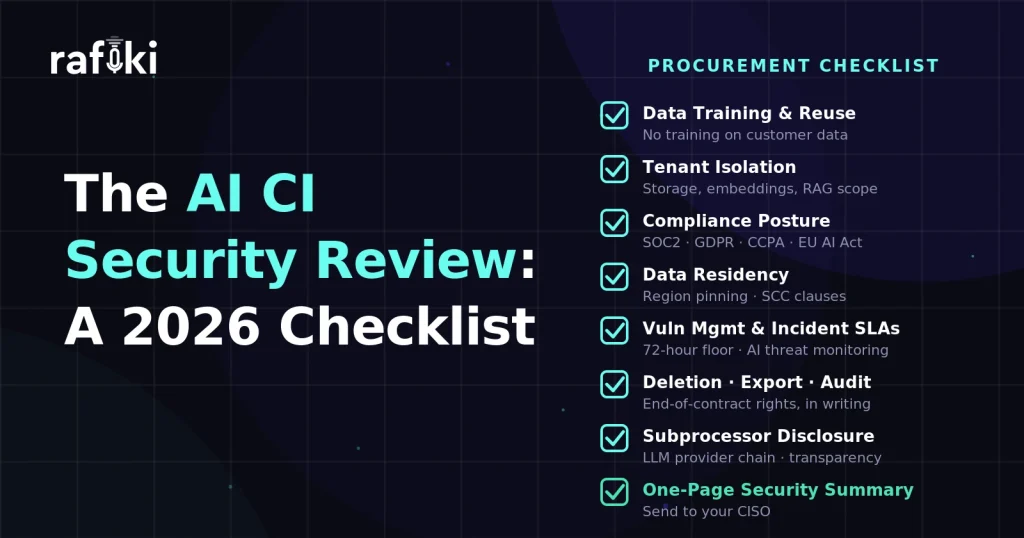
The security review is now the gating event for AI sales tools in 2026 — and the AE who used to swipe a corporate card for a pilot is now stuck behind a 90-question questionnaire from a CISO writing AI vendor policy in real time.
Two years ago, a sales leader could deploy conversation intelligence on a corporate card and ask forgiveness later. That window is closed. Public companies are flagging AI as material risk in their annual filings, regulators on three continents are drafting AI-specific procurement rules, and procurement teams have learned — sometimes the hard way — that an AI vendor with weak data hygiene is a breach liability waiting to happen. Every meaningful AI sales tool purchase in 2026 routes through security and legal before a single seat is provisioned.
The friction is real, but it is fair. The questions — does the vendor train on our data, where does it live, who are the subprocessors, what happens when we leave — are exactly the questions a serious buyer should ask. The problem is there is no widely circulated, category-specific checklist for AI conversation intelligence vendors. General SaaS procurement frameworks miss the AI-specific risks. General AI frameworks miss the CI-specific risks. This piece closes that gap with a structured AI sales tool security review your CISO, procurement lead, and RevOps team can all work from.
The classical SaaS security review covered the same ground for a decade: SOC2, encryption, identity federation, breach notification, data residency, subprocessor list. A competent vendor had a packet ready and a competent buyer signed off in a week.
AI conversation intelligence breaks that pattern in four ways. The data being processed is not metadata — it is the recorded voice of customers, some of the most sensitive content an enterprise holds. The processing is not deterministic — large language models introduce model-behavior risk classical frameworks were not designed for. The vendor usually relies on third-party model providers, so the buyer is accepting a chain of trust two or three companies deep. And regulators are writing the rules in flight, with the EU AI Act, US state privacy laws, and sector guidance all evolving on different timelines.
The practical effect: the same team that approved a CRM in five days now needs four to twelve weeks for an AI sales tool. Harvard Business Review's reporting on agentic AI adoption highlights that the teams getting AI into production fastest are the ones whose security, legal, and revenue functions are aligned on a shared checklist before the vendor conversation begins. The eight sections below are that checklist.
The single most important question on the checklist, and the one most vendors answer ambiguously on the first pass. Does the vendor — or any model provider in their stack — train, fine-tune, improve, or otherwise reuse your conversation data? The acceptable answer in 2026 is no, in contractual language written into the master services agreement, not buried in a help-center article.
This question matters more than any other because customer conversations contain everything: pricing, roadmap, competitive intelligence, named individuals, internal strategy. If that content is used to train a model — even an "anonymized" one — the buyer has lost control of information they have a duty to protect, and there is no remediation path. You cannot un-train a model.
The checklist questions:
Most SaaS platforms are multi-tenant — multiple customers' data lives in the same logical infrastructure, separated by access controls. AI conversation intelligence raises the stakes because the underlying processing involves model inference, vector embeddings, and search indices that have historically had weaker isolation guarantees than traditional database queries.
The question: is your data co-mingled with other customers' data at any layer — storage, embeddings, indices, model context — or is it isolated? "Logically isolated" is the standard answer and acceptable for most buyers. "Physically isolated" or "dedicated tenant" is what some regulated buyers will require.
The checklist questions:
SOC2 Type II is table stakes. GDPR and CCPA readiness is table stakes. What is new in 2026 is the EU AI Act, which classifies certain sales and HR AI systems as high-risk and imposes obligations on both providers and deployers. Your vendor should be able to tell you which Act categories their product falls into and what documentation supports deployer compliance.
The other piece worth pushing on is the gap between "we are aligned with" and "we are certified for." Many vendors design to a standard without holding the certification — often defensible, but the buyer needs the precise state. Ask for the report, the date of the most recent audit, and the auditor's name.
The checklist questions:
Data residency used to be niche. In 2026 it is baseline, especially for buyers with European, UK, or APAC operations. The default of "the vendor processes everything in US-East-1" is no longer acceptable for legal teams managing transfer risk under GDPR, Schrems II, and the growing patchwork of national localization laws.
The question is not just where data sits at rest. It is where data is processed during model inference, where backups are stored, where logs are written, and whether any of those involve a cross-border transfer that requires accommodation.
The checklist questions:
Classical security territory, but AI vendors warrant extra scrutiny because the attack surface is novel. Prompt injection, model-extraction, training-data extraction, and embedding inversion are live risks that did not exist in pre-AI SaaS. Your vendor should articulate how they detect and mitigate AI-specific threats, not just generic application vulnerabilities.
The other thing to push on is incident disclosure. The 72-hour notification window from GDPR is the floor, not the ceiling. Mature vendors commit to faster notification and define "incident" to include AI-specific events like model misbehavior or unintended data exposure through generated outputs.
The checklist questions:
The end-of-contract questions are where SaaS deals get sloppy and where AI vendors deserve extra scrutiny. Buyers should leave a relationship with confidence that data is fully deleted, fully exported in usable format, and that they have the contractual right to verify deletion happened.
Right to deletion is straightforward in concept but tricky in AI practice — are embeddings deleted, are backups purged on the same schedule as primary storage? Right to export should produce usable artifacts — transcripts, audio, structured metadata, scoring history — not a screenshot dump. Right to audit is the one most buyers do not negotiate hard enough on, and the one that lets you verify the rest.
The checklist questions:
Subprocessor disclosure matters more for AI vendors than almost any other SaaS category. Most conversation intelligence vendors rely on third-party LLM providers, and the buyer's data flows through those providers during inference. The buyer needs to know who those providers are, what their contractual posture is on training, and how the vendor monitors that chain.
Transparency separates serious vendors from opaque ones. A vendor who lists their LLM providers publicly and notifies buyers of subprocessor changes in advance is signaling that they understand the buyer's risk position. A vendor who treats the LLM stack as a trade secret is asking the buyer to extend a chain of trust without visibility.
The checklist questions:
Rafiki AI is an AI-native revenue intelligence platform built from day one on multi-model AI, with autonomous AI agents that operate as a 24/7 revenue team. The posture below reflects how Rafiki approaches each area; specific certifications, attestations, and contract language are available for review under NDA during procurement.
On data training and reuse. Rafiki's commitment is no training on customer data. Conversations — audio, transcripts, summaries, derived metadata — are not used to train, fine-tune, or improve Rafiki's models or any third-party model. The commitment is contractual, not a setting buyers have to enable. Underlying model providers are contracted on terms that exclude customer data from their training pipelines.
On data isolation. Rafiki is designed for logical tenant isolation at every layer where customer data lives — storage, embeddings used for retrieval, and any indices. Retrieval-augmented workflows are tenant-bound by default, so a query from one customer cannot surface another's content.
On regulatory compliance. Rafiki maintains alignment with SOC2 and supports GDPR and CCPA workflows including subject access requests, deletion, and standard DPAs. EU AI Act posture is documented and updated as the regulation phases in. Specific certification status and audit dates are provided during review.
On data residency. Rafiki supports multi-region processing so buyers with European, UK, or APAC requirements can pin data to a specific region. Standard Contractual Clauses are part of the standard contracting package.
On vulnerability management and incidents. Rafiki operates a documented vulnerability management program, monitors for AI-specific threat patterns, and maintains an incident notification SLA aligned with GDPR's 72-hour floor. Uptime SLAs and historical performance are available for review.
On deletion, export, and audit. Buyers can export transcripts, audio, scoring history, and CRM-synced records in machine-readable formats at any time. End-of-contract deletion is contractual, covering primary storage, backups, and derived data. Audit rights are negotiated as part of standard enterprise contracts.
On subprocessor and LLM transparency. Rafiki maintains a documented subprocessor list including LLM and hosting providers, and notifies customers of changes in line with contractual notice periods. Underlying model provider contracts are reviewed for training exclusions.
On commercial terms. Rafiki AI starts at $19/seat/month with no seat minimums and no annual commitment — buyers do not have to commit to a multi-year enterprise contract to access enterprise-grade security posture. Setup takes about 15 minutes. Native integrations span Salesforce, HubSpot, Zoho, Pipedrive, Freshworks, and Monday.com on the CRM side, Zoom, Microsoft Teams, and Google Meet on the meetings side, and Slack, Aircall, and OpenPhone for messaging and dialing. Coverage extends across 60+ languages.
If your CISO has fifteen minutes for an AI CI vendor, the one-page summary below is the format that gets a decision instead of a deferral. Use it as the cover sheet on your RFP package or the standalone document you forward to security after a demo.
The eight rows:
For each row, your vendor should answer in a sentence and supply backing documentation in one click. Gartner's sales technology research has consistently noted that procurement velocity is one of the strongest predictors of AI adoption velocity. Vendors who can populate this one-pager in a day get into pilots faster than vendors who take three weeks to answer the first email.
The reflex when a security review lands on a deal is to treat it as a tax — friction to be managed, a delay to be apologized for. The buyers and sellers winning in 2026 are doing the opposite. They are treating the security review as a sales asset. Buyers who run a tight, structured, category-aware checklist signal seriousness and get better terms and faster engagement. Vendors who arrive with documentation in hand close deals weeks faster than those scrambling after the questionnaire arrives.
The eight-section checklist is intentionally not vendor-specific. Use it on Rafiki AI, use it on every other vendor in your evaluation, and use it on the tools already in your stack that may not have been reviewed under modern criteria. McKinsey's State of AI research has highlighted that the gap between leading and lagging adopters of enterprise AI is not the depth of the technology — it is the maturity of the governance wrapped around it. Procurement and security review is where that governance gets operationalized.
Ready to run Rafiki AI through your security checklist? Explore the product overview for the capability landscape, then bring the eight-section questionnaire above to your evaluation call. Start free at $19/seat/month, no seat minimums, no annual commitment, 15-minute setup. The procurement packet is ready when you are.
Start for free — no credit card, no seat minimums, no long contracts. Just better sales intelligence.