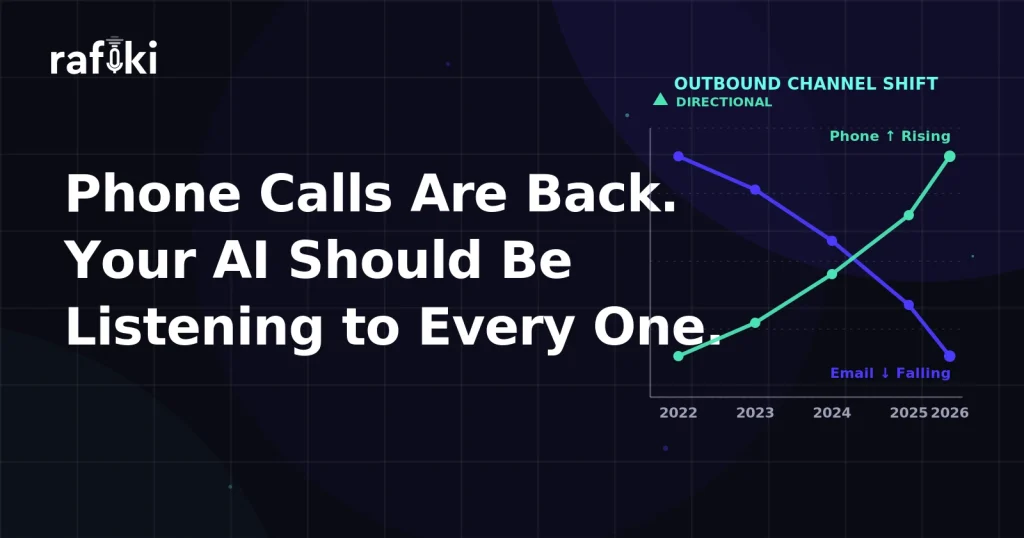
For most of the last decade, "conversation intelligence" meant one thing in practice: recording Zoom calls. Every major platform built its category around the meeting bot, the video transcript, and the 45-minute discovery recap. Phone calls — the dialed, voice-only, often unscheduled conversations SDRs and AEs were still having by the dozen every day — quietly fell out of the frame.
That default has broken. The phone is back as a serious outbound surface — not as a nostalgic throwback, but as a structural response to the collapse of cold email economics, the maturation of dialer platforms, and the simple math of intent. A connected call is the single highest-intent moment your pipeline produces, and most teams are running it blind.
The teams getting this right have made one decision: every phone call gets the same AI treatment a Zoom call does. Same transcription, same scoring rubric, same coaching review, same CRM sync. If your conversation intelligence stack only listens to meetings, you are walking past the channel where intent is highest and review rates are lowest.
Five years ago, the dominant outbound playbook was email-first, with phone as a fallback for non-responders. That playbook is breaking, and the reasons are structural, not cyclical.
The first is regulatory. Through 2024 and 2025, Google and Yahoo rolled out bulk sender authentication requirements — enforced SPF, DKIM, and DMARC alignment, mandatory one-click unsubscribe, tighter spam complaint thresholds. GDPR and CASL enforcement also stepped up on cold outbound. Cold email volume did not stop, but the cost of getting it wrong — domain reputation damage, deliverability collapse, sometimes actual fines — went up sharply.
The second is reply-rate decay. AI personalization commoditized fast. When every rep can hit "personalize with AI" and produce a passable line referencing the prospect's last LinkedIn post, the advantage evaporates. Inboxes flooded with AI-drafted email all read the same — and prospects stopped reading it.
The third is the dialers. Aircall, OpenPhone, and Twilio-powered stacks have matured into modern software with parallel dialing, AI-assisted voicemail drops, local presence, and analytics. The friction of running a phone-led day — once a brutal slog — has dropped enough that frontline SDRs can dial 80 to 150 numbers in a focused session and still keep notes flowing.
Harvard Business Review's 2025 research on sales teams growing alongside AI documents the pattern: the teams pulling ahead matched AI tooling to the highest-intent moments in their pipeline, not the ones who automated every channel uniformly. Phone is back as a primary surface, not a fallback.
The conversation intelligence category was born on Zoom. Its product surface, integrations, and data model all assumed a video meeting with a meeting bot in attendance. That assumption is now a liability for any team running phone-led outbound.
The legacy architecture works like this: a meeting platform fires a webhook, a bot joins the call, recording happens server-side, and the transcript flows back to the intelligence layer. Phone calls — which never had a meeting bot, a calendar invite, or a place inside Zoom's API — fall outside that pipeline entirely. Some platforms hacked phone in later through partner dialers, but the integration was always second-class: late transcripts, rubrics that did not map, coaching reviews built around video timelines that did not exist.
The result is a measurement gap that has widened as phone activity has risen. An SDR dials 80 numbers on a Tuesday. Twelve calls connect. Three get notes typed into the CRM. Zero get reviewed by a manager. By Friday, the only record of what was said is whatever the rep remembered and bothered to type. For a channel driving meaningful pipeline, that is not a measurement system — it is willful blindness.
If your team runs phone-led outbound on a meeting-platform-first intelligence layer, you are paying for a system structurally unable to see the channel where most of your activity actually happens.
The phrase is easy to misunderstand. "AI listening to every call" does not mean a bot joins the call. It does not mean the rep changes their workflow. It means every recorded call — Zoom, Teams, Meet, Aircall, OpenPhone, or a Twilio-backed dialer — flows into the same processing pipeline, gets the same transcription, the same scoring, the same summary, and the same CRM sync.
The rep does not see anything different. They dial out of Aircall or OpenPhone the way they always have. What changes is what happens after: instead of the recording sitting in a dialer audit log nobody opens, it gets transcribed, scored against the same MEDDIC or BANT or custom rubric your AEs use, summarized into structured fields, and synced to the CRM with notes pre-populated.
For the manager, the change is bigger. Instead of reviewing the three calls that came up in this week's one-on-one, every connected call from every rep is searchable, scored, and reviewable. The coaching surface goes from "what I remember about that one rep" to "every objection pattern across the team this week."
Phone is a different kind of signal than email. Email gives you words on a page — typed, edited, often AI-drafted, stripped of tone. Phone gives you the unfiltered version: the pause before the price question, the change in pace when the buyer mentions a competitor, the relief when the rep names the right pain. These are the signals that predict whether a deal closes, and they only exist on calls.
Phone-first conversation intelligence catches things email and even video tooling systematically miss. Shorter call length means higher signal density per minute. Voice-only means no slides, screen shares, or chat backchannels to dilute the conversation. The unscheduled nature of most outbound calls means the buyer is reacting in real time, not delivering rehearsed talking points.
None of this is visible in the dialer audit log or a CRM activity field. It only emerges when every call is transcribed, scored, and aggregated at team level.
Rafiki AI is an AI-native revenue intelligence platform built from the start to treat phone and video as equal first-class channels. Its native integrations with Aircall and OpenPhone — alongside Zoom, Microsoft Teams, and Google Meet — feed phone calls into the same processing pipeline as video, with the same transcription quality, scoring rubrics, and downstream CRM and coaching workflows.
The architecture matters. Rafiki does not replace your dialer or change how reps make calls. It listens passively to calls that already happen on Aircall or OpenPhone, then applies the same autonomous AI agents to phone calls that it applies to video.
Because Rafiki is AI-native, it supports 60+ languages, starts at $19/seat with no seat minimums and no annual commitment, and sets up in about 15 minutes. The Aircall and OpenPhone integrations are native, not a partner-API hack — phone calls are first-class citizens in the data model, not a second-class afterthought.
The most underrated unlock here is coaching. Frontline SDR managers have spent the last decade trying to coach phone-led teams without a coaching surface for phone. The status quo is brutal: a manager either rides along live with a rep for an hour, or pulls a handful of recordings from the dialer audit log and listens off-hours. Coverage is sparse, reviews are slow, and patterns across reps almost never get aggregated.
Once every connected call is transcribed and scored, that changes. A manager can pull every connect call from the last week, filter to the 30-second openers, and see which reps are hitting the rhythm and which are over-explaining. They can find every pricing objection and see whether the team's responses are converging on a winning pattern. They can compare calls where the SDR booked a meeting against calls where the buyer asked to "follow up via email" — and learn the difference.
This is the difference between coaching a phone-led team on instinct and coaching it on data. HBR's 2025 research on agentic AI in sales notes that top-performing teams use AI to expand coaching coverage, not just automate tasks — and the phone channel is where that coverage gap was widest.
The biggest objection sales leaders have to phone-first conversation intelligence is also the easiest to dispel: nobody is asking you to replace your dialer. Aircall, OpenPhone, and Twilio are good products. Your reps know them. Your ops team configured them. The right architecture layers conversation intelligence over the dialer you already run, not under it.
The pattern is simple. Rafiki connects to Aircall or OpenPhone via the native integration, listens to recorded calls, and processes them downstream. The dialer keeps doing what it does. The CRM stays the system of record. Reps make calls the same way they always have. The only change is that recordings — which were already happening — now have structured intelligence wrapped around them.
Setup is genuinely fast — about 15 minutes for a small team — because the integrations are native and the data model expects phone as a first-class input.
You do not need a quarter to bring phone calls into your intelligence layer. Most teams running Aircall or OpenPhone can get to coverage in 30 days, in three crisp phases.
By day 30, you will have something most phone-led outbound teams have never had: a structured view of what is being said on every connected call, scored on the same rubric as your video meetings, with coaching closed and CRM populated automatically.
A connected phone call is the highest-intent moment in your outbound funnel. A prospect picked up. They are talking to a human, in real time, with no async escape hatch. Whatever happens in the next four minutes either advances the deal or kills it — and most teams have no idea which, because no one is listening.
The category got this wrong for a decade by assuming the meeting was the only conversation that mattered. The teams winning in 2026 are the ones who reversed that assumption — who treat every dial as worth recording, every connect as worth scoring, and every objection as worth aggregating. The phone is back, and the teams that bring real intelligence to it will compound an advantage every quarter that meeting-platform-first vendors cannot match.
See how Rafiki AI brings phone-first conversation intelligence to teams running Aircall, OpenPhone, and Twilio-backed dialers — with autonomous AI agents that score, summarize, and coach every call on the same rubric you use for video. Native Aircall and OpenPhone integrations, Smart Call Scoring on every dial, Smart CRM Sync into Salesforce, HubSpot, Zoho, Pipedrive, Freshworks, or Monday.com. Starting at $19/seat, no seat minimums, no annual commitment, 15-minute setup. Start free or book a demo and find out what your reps have been saying on the phone all along.
Start for free — no credit card, no seat minimums, no long contracts. Just better sales intelligence.