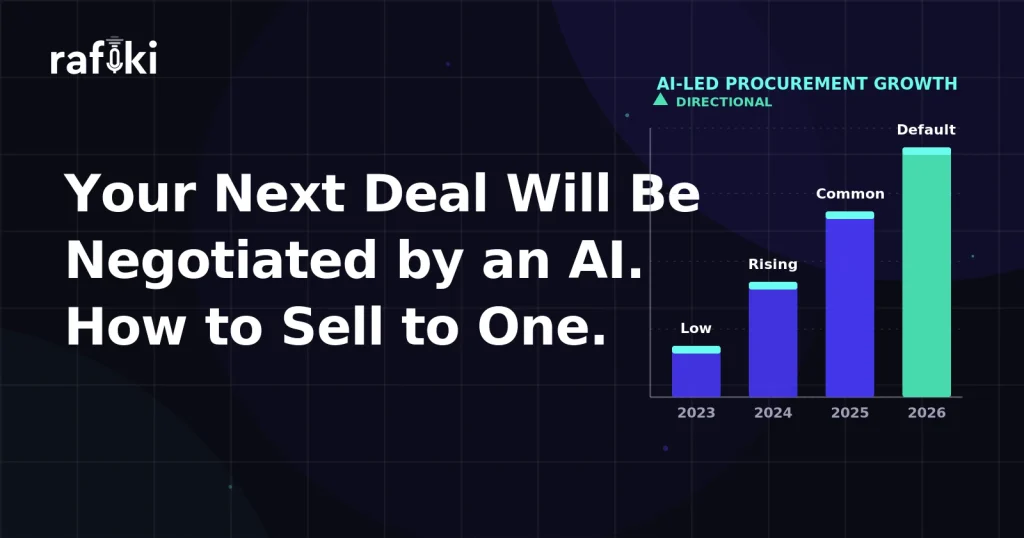
The next time you send a proposal to a mid-market or enterprise buyer, there is a very real chance that the first reader will not be a human at all — it will be an LLM acting on behalf of a procurement team that has quietly retooled around AI-assisted vendor evaluation.
Procurement organizations spent 2024 and 2025 wiring large language models into their workflows: RFP intake, vendor scoring, contract redlining, claim verification, even shortlist ranking. In 2026, that retooling has crossed a threshold. The person on the other end of your deal is still human — but the analysis they trust, the comparison sheet they bring into the executive review, and the rebuttals they fire back at your AE are increasingly generated by an AI sitting between you and the buyer.
This is what we call AI-to-AI selling. Your reps are no longer pitching only to people. They are also writing copy, sending answers, and posting documents that will be parsed, summarized, ranked, and challenged by an LLM whose only mandate is to find the cleanest fit at the lowest risk. If you are still selling like the buyer is the only reader, you are losing deals to vendors whose content is simply more machine-friendly than yours.
The shift is not subtle, but it is invisible to most sales teams. According to Gartner research, generative AI became the most frequently deployed AI solution inside enterprise organizations faster than any prior technology category — and procurement teams were among the earliest adopters. Vendor evaluation is a perfect LLM use case: lots of unstructured input (RFP responses, security questionnaires, case studies, demo recordings), a structured output (a scorecard), and a busy human decision-maker who is grateful for a draft.
The consequence for sales is that the document, email, or chat answer you write today is not just being read — it is being ingested. An LLM is summarizing it, comparing it against four other vendors, flagging anything ambiguous, and surfacing the cleanest competitor as the recommendation. The buyer then reviews the AI's summary, not your prose.
The buyer is still in charge — but the AI is increasingly the editor, the analyst, and the first-pass judge. If your content is not built to be read by that AI, you are quietly losing deals you would have won two years ago.
The teams that have not adapted are losing in three predictable ways, and they often cannot see the loss because the buyer's stated reason — "we went with another vendor" — masks what really happened inside the procurement workflow.
First, ambiguity penalties are stacking up. When an LLM parses your RFP response and finds a claim it cannot confidently match to evidence elsewhere in your materials, the safe move is to mark it as "unverified" or "soft." Multiply that across a 200-question RFP and your scorecard takes a quiet beating. A competitor whose answers are precise, schema-friendly, and easy to cite ends up ranked higher — not because they have a better product, but because they wrote for the reader the buyer is actually using.
The harder truth is that AI procurement is not slowing down. Salesforce's State of the Connected Customer research has tracked rising buyer expectations for vendor transparency and faster, cleaner answers — exactly the workflow that LLM-assisted procurement accelerates. Buyers are not going back to email threads and PDF comparisons. They are going further in the AI direction.
The instinct of most sales leaders, when they first hear "your buyer's AI is reading your proposal," is to tighten up the writing — clearer headers, shorter paragraphs, fewer adjectives. That helps, but it is not the real shift. The real shift is treating every piece of buyer-facing content as input to a downstream machine reader and engineering it for that reader's strengths and weaknesses.
LLMs are excellent at certain things — extracting structured claims, summarizing themes, comparing two passages, flagging contradictions. They are bad at other things — handling implicit context, weighting subtle differentiators, separating marketing language from technical substance. Selling to an AI buyer means leaning into the things LLMs do well and not relying on the things they do poorly.
The teams that win against AI-assisted procurement do not write better marketing copy. They write content that survives an LLM summarizer intact — and that comes out the other side as the cleanest, lowest-risk option on the scorecard.
A subtler shift is happening live on your sales calls. Buyers are increasingly bringing AI-generated rebuttals into negotiation — sometimes by reading from a tab they have open during the call, sometimes by reciting an objection they had an LLM draft the night before. These rebuttals have a distinctive texture: unusually structured, suspiciously well-balanced, and often built around claims that did not come from anything your rep actually said.
Most reps miss the signal in the moment. They hear a sharp, articulate objection and assume it reflects the buyer's own analysis. They respond on the merits — and walk into a trap a machine prepared for them.
Detecting these patterns at scale requires the same thing detecting any conversation pattern requires: every call captured, transcribed, and analyzed with enough linguistic resolution to flag the texture, not just the topic. The teams that operate at this resolution can train their reps to spot AI rebuttals and respond with the one move that breaks them — asking the buyer to ground the objection in their own context.
Rafiki AI is an AI-native revenue intelligence platform built for exactly this shift. Instead of treating call recordings and follow-up emails as compliance artifacts, it treats every piece of conversation data as structured signal — captured at a resolution that lets you both detect AI-driven buyer behavior and equip your reps to win against it.
Rafiki's autonomous AI agents work as a 24/7 revenue team. Each capability below targets a specific gap that opens up when you start selling to AI buyers:
Because Rafiki AI is AI-native — built from day one on multi-model AI rather than bolted onto a legacy recorder — it handles the linguistic resolution this kind of detection requires. It supports 60+ languages, integrates natively with Salesforce, HubSpot, Zoho, Pipedrive, Freshworks, and Monday.com on the CRM side, Zoom, Microsoft Teams, and Google Meet on the meetings side, plus Slack, Aircall, and OpenPhone for messaging and dialing — and starts at $19/seat with no seat minimums and no annual commitment. Enterprise-grade insight without enterprise-grade lock-in.
Once you accept that the first reader of your proposal is an LLM, the format of your outbound content has to change. This is not about dumbing down your writing. It is about engineering it so that the AI summarizer extracts the strongest version of your story, not the fuzziest.
Practical patterns that work in 2026:
This applies to every artifact: proposals, RFP responses, security questionnaires, follow-up emails, even meeting recap notes. If a piece of content might be ingested by a buyer's AI tool — and at this point, most of them will be — write it for both readers.
You do not need a transformation program to start selling well to AI buyers. The teams that have adapted fastest tend to phase the work over 90 days, focusing on detection first, content engineering second, and rep enablement third. Harvard Business Review research on agentic AI in sales has shown that the highest-performing teams differentiate themselves through preparation and pattern recognition more than raw activity — and selling to AI buyers raises the bar on both.
By day 90, you will have something most of your competitors do not: a quantified view of how AI is showing up in your pipeline, content that survives LLM summarization with your strongest claims intact, and reps who can spot — and disarm — an AI-drafted objection in real time.
AI procurement is not coming. It is in your pipeline today, parsing the proposal you sent last week and scoring the demo you ran this morning. The buyers who use it are not going back. The vendors who adapt — who treat every artifact as input to a downstream machine reader, who instrument their calls finely enough to detect AI-drafted rebuttals, who coach the reframing in real time — will compound advantage every quarter. The ones who do not will keep losing deals and never quite understand why.
The companies that move first get a quiet head start, because their content is cleaner, their rebuttal playbook is sharper, and their machine-to-machine handoffs are tighter than anyone else's in the category. McKinsey's growth, marketing, and sales research consistently shows that the early adopters of new buyer-side technologies extract outsized advantage before the rest of the market catches up — and AI procurement is on exactly that curve.
The window to build this before it becomes table stakes is open right now — and it will not stay open through 2027.
See how Rafiki AI helps growing sales teams win against AI procurement with autonomous AI agents, methodology-aware call scoring, and revenue intelligence built on multi-model AI from day one. Starting at $19/seat with no seat minimums, no annual commitment, and 15-minute setup — enterprise-grade insight without enterprise-grade cost. Start free or book a demo and see what your reps are missing every time an AI is the first reader in the deal.
Start for free — no credit card, no seat minimums, no long contracts. Just better sales intelligence.