The moment your AI agent says "I don't understand" is the moment you either recover a customer relationship or lose it forever.
In 2026, AI agents handle customer interactions daily across sales, support, and success teams. They qualify leads, answer product questions, schedule demos, and resolve billing issues with impressive accuracy. But here's what most revenue leaders are still getting wrong: they're treating AI agent handoffs as a failure rather than a strategic orchestration point.
The companies pulling ahead aren't trying to make their AI agents handle everything. They're obsessing over the handoff moment—that critical transition where a bot recognizes its limits and seamlessly transfers context, conversation history, and customer intent to the right human at exactly the right time. Get this wrong, and you're burning through customer goodwill faster than your AI saves operational costs. Get it right, and you've built a revenue engine that scales human expertise instead of replacing it.
Most organizations approach AI agent handoffs like an afterthought. They invest months perfecting their bot's conversational abilities, training it on product knowledge, and fine-tuning responses. Then they slap on a generic "transfer to human" button and call it done. The result is a customer experience that feels disjointed and a human team that inherits conversations without context.
The current approach creates predictable friction points that damage both customer relationships and team productivity:
These breakdowns happen because most teams design their AI strategy around what the bot can do, not around when humans should take over. That's backwards thinking that treats handoffs as AI failure instead of customer success strategy.
Smart revenue teams in 2026 aren't asking "Can our AI handle this?" They're asking "Should our AI handle this?" The distinction matters because some customer interactions are too valuable, too complex, or too emotionally charged to risk with automation, regardless of technical capability.
Intent-based handoff triggers recognize that customer interactions exist on multiple dimensions simultaneously. A simple pricing question from an enterprise prospect carries different weight than the same query from a free trial user. A billing issue mentioned alongside cancellation language requires human intervention even if the billing query itself is routine.
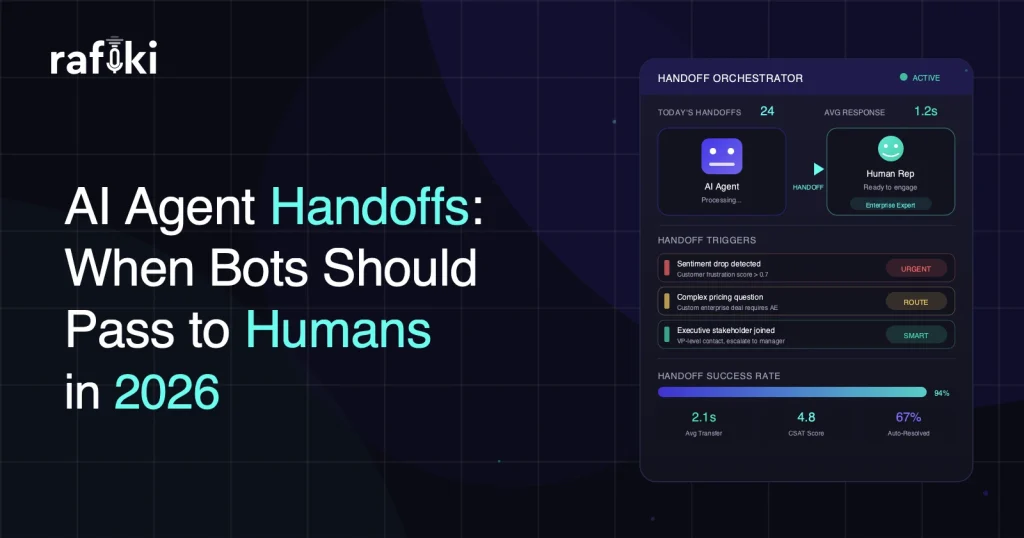
The most effective handoff strategies operate on four trigger categories:
These triggers work in combination, not isolation. A medium-value account asking integration questions while mentioning timeline pressure might trigger handoff even though each individual factor stays below threshold. The system recognizes interaction patterns, not just individual data points.
Traditional handoff logic relies on explicit customer requests ("I want to speak to a human") or rigid rule trees. But customers rarely announce their true intent directly. They say "I'm just looking" when they're weeks into an active buying process. They ask about basic features when they're really evaluating competitive alternatives.
Conversation intelligence changes handoff decision-making by analyzing what customers actually mean, not just what they literally say. Modern AI agents parse sentiment, detect urgency, identify buying signals, and recognize when questions indicate deeper needs that require human expertise.
The most sophisticated handoff systems analyze conversation patterns across multiple signals:
This intelligence transforms handoffs from reactive transfers to proactive opportunity capture. Instead of waiting for customers to explicitly request human help, agents identify moments when human involvement accelerates customer success and revenue outcomes.
Once an AI agent decides to hand off a conversation, traditional systems face another failure point: generic routing. Most platforms dump transferred conversations into a general queue or use simple round-robin assignment. This approach ignores everything the AI learned during the interaction and wastes the opportunity to match customer needs with specialized human expertise.
Intelligent routing treats the handoff as a matching problem, not a queuing problem. The system considers customer intent, conversation context, account importance, and available human skills to make optimal assignments in real-time.
Advanced routing systems operate across multiple matching dimensions:
The result is customers who feel heard and understood from the moment a human joins the conversation, and human team members who receive context-rich handoffs that set them up for success rather than starting from scratch.
The most frustrating customer experience isn't a bad interaction with an AI agent. It's having to repeat everything when a human takes over. Context preservation during handoffs separates amateur AI implementations from professional revenue operations.
Effective context preservation goes far beyond conversation transcripts. Modern handoff systems transfer customer intent, emotional state, previous touchpoints, account history, and strategic context that helps humans pick up exactly where the AI left off.
This context arrives before the human agent even greets the customer. By the time they say "Hi, I understand you were asking about integration options," they've already reviewed account history, conversation highlights, and strategic priorities. The customer experiences seamless continuation, not restart.
Rafiki's conversation intelligence platform transforms how revenue teams orchestrate AI agent handoffs by providing the analytical layer that makes smart routing and context preservation possible. Unlike traditional chatbot platforms that operate in isolation, Rafiki integrates handoff intelligence directly into your existing revenue infrastructure.
The platform's conversation intelligence capabilities continuously analyze interaction quality, customer sentiment, and opportunity signals to identify optimal handoff moments before customer frustration develops. When a handoff triggers, Rafiki's intelligence follows the customer through the transition.
Rafiki enables sophisticated handoff orchestration across multiple dimensions:
The platform's conversation intelligence works across every customer touchpoint, whether the initial interaction happened via chatbot, email, phone, or video call. Human agents receive rich context regardless of how the conversation started, eliminating the traditional disconnect between AI and human interactions.
Implementing intelligent AI agent handoffs requires systematic rollout that balances automation benefits with human expertise. Most successful deployments follow a phased approach that gradually increases AI responsibility while perfecting handoff triggers and routing logic.
The most effective implementation follows a structured four-phase progression:
Each phase requires close collaboration between RevOps, customer success, sales, and technical teams to ensure handoff logic aligns with actual customer needs and business priorities. The goal isn't perfect automation—it's perfect customer experience through smart human-AI orchestration.
Traditional customer service metrics don't capture the strategic value of intelligent AI agent handoffs. Resolution time, first-call resolution, and basic satisfaction scores miss the revenue impact of smart routing and context preservation.
Revenue-focused teams track handoff performance across customer experience and business outcome dimensions:
These metrics reveal whether handoff strategy actually improves customer experience and business outcomes, or just shifts workload between AI and human teams without creating value.
By 2026, the companies winning in revenue operations aren't those with the most advanced AI agents. They're the organizations that best orchestrate human expertise with AI capability. Intelligent handoffs become a competitive differentiator that scales customer success without sacrificing relationship quality.
The future belongs to revenue teams that treat AI agent handoffs as strategic orchestration points, not operational failures. These teams recognize that the transition moment between AI and human is often the highest-leverage point in the entire customer interaction. Get it right, and you've created a customer experience that feels personal at scale.
Smart handoff strategies compound over time. Customers who experience seamless AI-to-human transitions become more comfortable engaging with AI agents initially, knowing human expertise is available when needed. This creates a virtuous cycle where AI handles more routine work while humans focus on high-value relationship building and complex problem solving.
The revenue teams pulling ahead in 2026 understand that AI agent handoffs aren't about replacing human judgment—they're about amplifying it. Every handoff becomes an opportunity to demonstrate customer obsession, deploy specialized expertise, and convert AI-identified opportunities into revenue growth.
Ready to transform your AI agent handoffs from customer friction into revenue opportunities? Rafiki starts at $19 per seat per month with no minimums, no annual contracts, and a 15-minute setup. See how intelligent conversation orchestration works in your environment—start your free trial today or book a demo to see handoff intelligence in action.
Start for free — no credit card, no seat minimums, no long contracts. Just better sales intelligence.