Sales

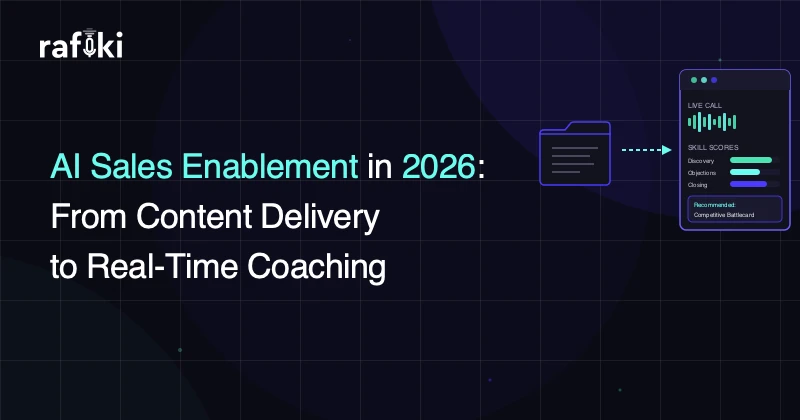
AI Sales Enablement in 2026: From Content Delivery to Real-Time Coaching
Apr 7, 2026
9 min read
Sales enablement is no longer a content library — it is a living intelligence system that coaches reps in real time.
For over a decade, enablement meant uploading decks to a shared drive, scheduling quarterly training sessions, and hoping reps retained enough to close deals. That model served its purpose when buyer journeys were predictable and sales cycles moved slowly. However, the reality of 2026 looks nothing like that era. Buyers arrive armed with research, competitors respond in hours, and deal complexity has multiplied across every vertical.
AI sales enablement represents a fundamental shift in how organizations develop, support, and measure their revenue teams. Instead of passively delivering materials and tracking content downloads, modern enablement platforms actively analyze conversations, surface skill gaps, recommend relevant assets mid-deal, and attribute pipeline outcomes back to specific coaching interventions. This article breaks down what that transformation looks like in practice — and why teams that still rely on static enablement are leaving revenue on the table.
Legacy enablement programs share a common flaw: they operate on assumptions rather than evidence. A training manager designs a curriculum based on what leadership thinks reps need, distributes it on a fixed schedule, and measures success by completion rates. Meanwhile, the actual skill gaps playing out on live calls go completely undetected.
Consider the typical workflow. A new battlecard gets published after a competitor launches a feature. By the time reps find it — if they find it — the competitive landscape has shifted again. Content consumption does not equal content application. In practice, reps default to whatever talk track feels comfortable, regardless of what enablement recommends.
The disconnect runs deeper than content discovery. Traditional platforms cannot answer the questions that matter most: Which coaching topics actually move deals forward? Where do reps struggle in live conversations versus role-plays? What content gets used at the right moment in the right deal stage? Without those answers, enablement teams operate blind.
The core transformation is architectural. Old enablement stacked content on top of an LMS and called it a platform. AI sales enablement, by contrast, starts with conversation data and builds outward — analyzing every customer interaction to drive coaching, content recommendations, and performance measurement.
| Dimension | Traditional Enablement | AI-Powered Enablement |
|---|---|---|
| Content delivery | Static library, manual search | Dynamic recommendations based on deal context |
| Coaching | Scheduled sessions, generic feedback | Real-time guidance from live conversation analysis |
| Skill assessment | Quiz scores, role-play evaluations | Objective scoring from actual customer calls |
| Battlecard updates | Quarterly refresh by product marketing | Auto-generated from competitive mentions in calls |
| ROI measurement | Content downloads, training completion | Pipeline attribution, win-rate correlation |
| Personalization | One-size-fits-all curriculum | Individual coaching plans based on conversation patterns |
This is not an incremental upgrade. It represents a completely different operating model where enablement becomes a continuous, data-driven feedback loop rather than a periodic content push.
The most valuable enablement insight comes from what reps actually say on calls — not what they claim in self-assessments. AI conversation analysis makes this possible at scale.
Modern systems evaluate every customer-facing interaction against objective criteria. They assess discovery depth: did the rep uncover budget, timeline, and decision-making authority? They measure objection handling quality: did the rep acknowledge the concern, reframe it, and advance the conversation? They track competitive positioning: when a rival came up, did the rep pivot effectively?
Managers traditionally relied on ride-alongs and selective call reviews to coach their teams. That approach covers perhaps five percent of actual conversations. As a result, feedback skewed toward whatever the manager happened to hear, not what reps consistently struggled with.
AI scoring changes this equation entirely. Every call receives structured evaluation across multiple competencies — discovery, presentation, negotiation, closing. Patterns emerge quickly. One rep might excel at rapport-building but consistently fail to establish next steps. Another might nail technical demos but fold under pricing pressure. These patterns only become visible when you analyze hundreds of conversations systematically.
Enablement content has an effectiveness problem. Organizations invest heavily in creating battlecards, case studies, ROI calculators, and objection-handling guides. Yet most of this content sits unused because reps cannot find it when they need it.
AI sales enablement solves the discovery problem by connecting content to context. When a conversation involves a specific competitor, the system surfaces the relevant battlecard. When a prospect raises a compliance concern, the matching case study appears. When a deal stalls at the procurement stage, negotiation frameworks get recommended automatically.
This works because AI systems analyze deal metadata — stage, industry, company size, stakeholders involved — alongside conversation signals like objections raised, competitors mentioned, and buying criteria discussed. The recommendation engine matches content assets to this combined context, essentially functioning as an intelligent content concierge that understands the deal as well as the rep does.
Consequently, enablement teams gain a new feedback signal: which content actually gets surfaced and used during deals that close. That data reshapes content strategy from guesswork into evidence-based production.
Competitive intelligence in traditional enablement flows one direction: product marketing researches competitors, writes battlecards, and distributes them to the field. The cycle takes weeks. In fast-moving markets, those battlecards are outdated before they reach reps.
AI flips this process. By analyzing every mention of competitors across customer conversations, the system extracts real-world positioning data — what prospects actually say about alternatives, which objections come up most frequently, and what competitive claims resonate or fall flat.
For example, if prospects repeatedly cite a specific competitor's onboarding experience as superior, that signal surfaces automatically. Enablement teams can then create targeted counter-positioning and track whether reps successfully deploy it in subsequent calls. This creates a living competitive intelligence system that updates continuously from the field rather than quarterly from a conference room.
Rafiki transforms raw conversation data into structured enablement intelligence. Rather than bolting AI onto a content library, Rafiki operates as a purpose-built enablement engine that analyzes every customer interaction and converts it into coaching opportunities, content signals, and performance insights.
Rafiki's Smart Call Scoring evaluates rep performance across objective criteria — discovery completeness, objection handling, competitive positioning, and closing technique. Each call receives a structured score, and aggregate patterns reveal exactly where each rep needs development. Managers no longer guess which skills to coach; the data tells them.
In addition, Rafiki surfaces competitive mentions, stakeholder sentiment, and deal risk signals across every conversation. It detects when reps miss qualification criteria, skip discovery questions, or fail to establish clear next steps. These insights feed directly into individualized coaching plans that address actual performance gaps rather than assumed ones.
Rafiki's Gen AI Reports enable enablement leaders to measure coaching impact at the pipeline level. You can track whether reps who improved their discovery scores also improved their win rates. You can identify which enablement interventions correlate with faster deal velocity. This closes the measurement gap that has plagued enablement teams for years.
Rafiki also extracts key topics, blockers, and competitive signals and structures them for easy consumption. As a result, enablement teams spend less time manually reviewing calls and more time designing targeted interventions that move revenue metrics.
The single biggest criticism of sales enablement has always been measurement. Leadership asks: "What is the ROI of our enablement program?" In most organizations, the honest answer has been: "We don't really know."
AI changes this by creating direct attribution paths between enablement activities and pipeline outcomes. Specifically, modern platforms can track a chain of evidence: a rep received coaching on competitive objection handling, their scores on that competency improved, and deals where they deployed the new approach closed at a higher rate.
These metrics elevate enablement from a cost center to a revenue driver. For the first time, enablement leaders can defend their budget with the same rigor as demand generation or sales operations.
Transitioning from traditional enablement to an AI-powered model does not require ripping everything out overnight. Most successful teams follow a phased approach that builds momentum through early wins.
Start by recording and analyzing customer-facing conversations across the team. This creates the data foundation for everything that follows. Without conversation data, AI enablement has nothing to work with. Prioritize discovery calls and competitive deals first — these contain the richest coaching signals.
Implement objective call scoring across core competencies relevant to your sales motion. Identify the three to five skill areas that matter most for your deal type — discovery, demo delivery, negotiation, or multi-threading, for instance. Use aggregate scoring data to build team-level and individual coaching priorities.
Connect enablement content to conversation context so the right resources surface at the right time. Simultaneously, build coaching workflows triggered by scoring patterns. When a rep's competitive handling score drops below threshold, the system should automatically queue relevant training and notify their manager.
Once you have sufficient data, begin measuring the pipeline impact of specific interventions. This is where enablement becomes genuinely strategic — you can allocate resources to the coaching topics and content types that demonstrably move revenue.
A common concern with AI sales enablement is that it replaces the frontline manager. In reality, it amplifies them. AI handles the surveillance-scale analysis that no human manager could perform — reviewing every call, scoring every interaction, tracking every competitive mention. Managers then focus on what humans do best: building trust, providing strategic context, and motivating behavior change.
The manager's role shifts from detective to coach. Instead of spending hours finding coachable moments buried in call recordings, they receive prioritized coaching opportunities with specific timestamps and context. A manager might see: "This rep's discovery depth scored below average on seven of their last ten calls — here are the three most coachable examples." That precision transforms the coaching conversation from vague encouragement to targeted development.
Furthermore, AI provides managers with objective data to support difficult conversations. When performance concerns are backed by structured scoring across hundreds of interactions, the discussion moves from opinion to evidence. This makes coaching more productive and less adversarial.
Organizations that extract maximum value from AI sales enablement share several common practices:
AI sales enablement in 2026 is not about building a better content library. It is about creating a real-time intelligence system that coaches reps in the flow of work, surfaces the right resources at the right moment, and measures its own impact on pipeline and revenue.
The organizations that embrace this shift gain a compounding advantage. Every conversation generates coaching data. Every coaching intervention improves rep performance. Every performance improvement accelerates pipeline. This flywheel simply does not exist in traditional enablement models.
For enablement leaders tired of defending their budget with vanity metrics, the path forward is clear. Move from content delivery to conversation intelligence. Move from scheduled training to continuous coaching. Move from activity tracking to revenue attribution. The tools exist today — the only question is how quickly your team adopts them.
Transform your enablement program from a content library into a revenue-driving intelligence system. See how Rafiki analyzes every conversation and converts insights into coaching, content recommendations, and measurable pipeline impact.
Start for free — no credit card, no seat minimums, no long contracts. Just better sales intelligence.