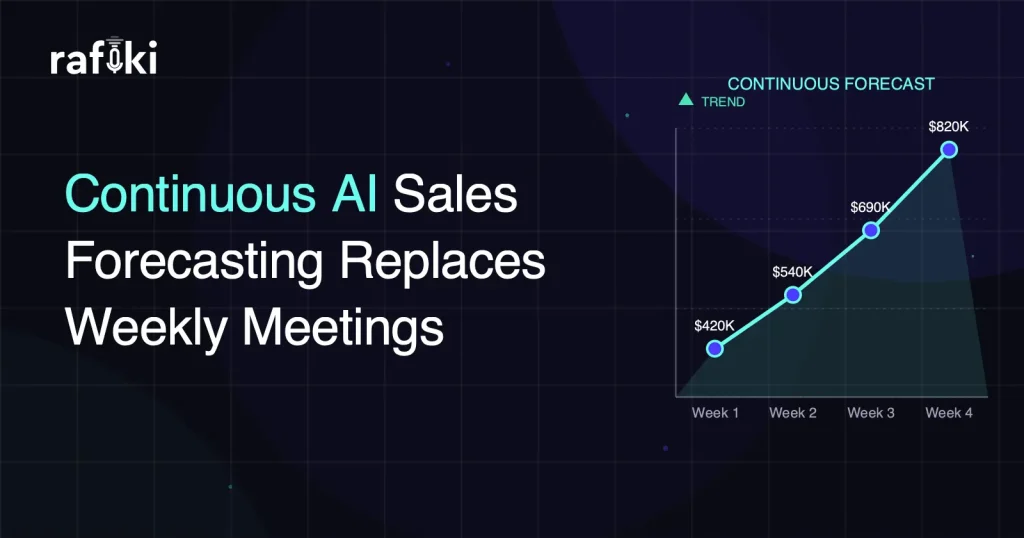
Your sales team is spending hours every week in forecast meetings that produce the same stale pipeline reviews while missing the revenue-critical signals buried in customer conversations.
It's 2026, and many sales organizations still operate with outdated processes. Every Monday, the ritual repeats: account executives scramble to update CRM fields before the forecast call. Sales managers pore over static spreadsheets asking the same questions about the same deals. RevOps leaders manually compile reports that are outdated before they're even distributed. Meanwhile, the actual predictive signals—the hesitation in a prospect's voice, the sudden shift from "we" to "I" language, the champion who stops responding—flow undetected through dozens of unanalyzed sales conversations.
This manual approach to sales forecasting creates inefficiencies. In today's hyper-competitive market, where deal cycles compress and buyer behavior shifts rapidly, weekly pipeline reviews limit revenue team agility. Revenue teams that embrace continuous AI sales forecasting gain better visibility into their pipeline and can respond more quickly to changing deal dynamics.
Traditional forecast meetings operate on a fundamentally flawed premise: that revenue predictability comes from asking humans to predict human behavior based on static data points. Sales managers spend the majority of these sessions not analyzing deal health, but simply gathering basic information that should already be captured and analyzed automatically.
The core challenges with manual pipeline reviews appear consistently across growing sales teams:
These limitations create missed opportunities. Sales teams operating with weekly forecast cycles often struggle to keep pace with their buyers' decision-making timeline because they're managing deals based on assumptions rather than real-time buyer intelligence. When your forecast process can't keep pace with your buyers' decision-making timeline, you're not managing revenue—you're hoping for it.
Continuous AI sales forecasting represents a fundamental evolution in how revenue teams predict and manage pipeline outcomes. Instead of periodic human-driven meetings, this approach uses artificial intelligence to continuously monitor, analyze, and score every buyer interaction as it happens, providing real-time insights that enable proactive deal management.
The transformation touches every aspect of revenue operations:
This shift from reactive to proactive revenue management changes not just what sales teams know about their pipeline, but when they know it. Instead of discovering deal risks during weekly reviews, managers receive intelligent alerts the moment concerning patterns emerge in buyer conversations. The result is a more agile, responsive approach to pipeline management that aligns with modern buyer expectations and decision-making timelines.
The accuracy of continuous AI sales forecasting depends entirely on its ability to extract meaningful insights from the one source of truth in every deal: the actual conversations between sellers and buyers. Traditional forecasting relies on subjective human interpretation of these interactions, filtered through memory and bias. AI-powered conversation analysis provides objective, comprehensive evaluation of every buyer signal.
Modern conversation intelligence platforms process multiple data streams simultaneously to build comprehensive deal health profiles:
The sophistication of modern AI conversation analysis extends far beyond simple transcription and keyword detection. Advanced models understand context, subtext, and behavioral patterns that even experienced sales professionals might miss in real-time conversations. This comprehensive analysis becomes the foundation for accurate, continuous forecast modeling that reflects actual buyer behavior rather than seller optimism.
Effective continuous AI sales forecasting integrates conversation intelligence with broader revenue signals to create a holistic view of deal health and pipeline predictability. This multi-signal approach provides context that pure conversation analysis cannot capture alone.
The most predictive AI forecasting systems combine conversation data with complementary intelligence sources:
When AI systems analyze these signals in combination with conversation intelligence, they can produce forecasting insights that exceed traditional methods. The key insight is that buyer behavior follows patterns across multiple touchpoints, and AI can detect these patterns more consistently and objectively than human analysis alone.
One of the most powerful applications of continuous AI sales forecasting is the automated evaluation of deal qualification frameworks like MEDDIC, BANT, and SPIN. Instead of relying on sales reps to manually assess and score these criteria, AI systems continuously monitor conversations for framework-specific indicators and update deal scores in real-time.
AI-powered deal scoring transforms traditional qualification from a periodic checkpoint into a continuous assessment process:
This automated approach to deal qualification provides unprecedented visibility into pipeline health and closing probability. Sales managers no longer need to rely on rep assessments of MEDDIC qualification—they have AI-generated scores based on actual buyer conversations, updated continuously as new information emerges.
Rafiki's AI-native revenue intelligence platform enables continuous sales forecasting through six autonomous AI agents that work together to monitor, analyze, and score every aspect of your pipeline in real-time. Unlike traditional tools that bolt AI features onto legacy architectures, Rafiki's AI Sales Agents are designed from the ground up to replace manual forecast processes with intelligent automation.
The platform's integrated approach to continuous forecasting combines multiple AI capabilities:
What sets Rafiki apart is its ability to provide enterprise-grade continuous forecasting capabilities at a fraction of traditional enterprise pricing, starting at $19 per seat with no minimums. Sales teams can implement Smart Call Scoring and automated pipeline intelligence without the massive upfront investments required by legacy revenue intelligence platforms.
The platform's 60+ language support and quick setup process mean global sales teams can deploy continuous AI forecasting across their entire organization quickly and cost-effectively. Gen AI Reports provide the executive-level forecast visibility that traditionally required dedicated RevOps resources to compile and maintain.
Successfully implementing continuous AI sales forecasting requires a phased approach that gradually shifts team behaviors while building confidence in AI-generated insights. The most effective transitions happen when organizations maintain some familiar processes while introducing automated intelligence capabilities.
A proven implementation roadmap follows these sequential phases:
The key success factor is ensuring that sales managers understand how to interpret and act on AI-generated forecasting insights. Training should focus on translating automated deal scores into specific coaching actions and strategic interventions. The goal is not to eliminate human judgment, but to focus that judgment on high-value strategic decisions rather than data compilation and basic analysis.
Organizations that successfully implement continuous AI sales forecasting can see improvements across multiple revenue metrics. The most significant gains typically come from faster deal cycle management and improved win rate optimization rather than pure efficiency improvements.
The primary value drivers of continuous forecasting include:
The time savings alone can justify the investment for many growing sales teams. When sales managers reclaim time from forecast meetings, that capacity typically redirects toward higher-value activities like deal coaching, strategic account planning, and team development. The compounding effect of better time allocation often enhances the direct forecasting improvements in total impact on revenue performance.
The evolution toward continuous AI sales forecasting represents more than a technology upgrade—it's a fundamental shift in how revenue teams operate and compete. Organizations that embrace this transformation position themselves for sustainable competitive advantage in an increasingly AI-driven sales environment.
The strategic implications extend beyond improved forecast accuracy. Teams operating with continuous AI intelligence develop better buyer insights, make faster strategic decisions, and maintain stronger customer relationships throughout longer, more complex sales cycles. As buyer expectations continue to evolve toward more personalized, responsive seller experiences, continuous forecasting capabilities become increasingly important for competitive revenue performance.
Sales teams that continue to rely on weekly forecast meetings and manual pipeline reviews may find themselves at a disadvantage. The question isn't whether continuous AI forecasting will replace traditional methods, but how quickly revenue leaders will embrace this transformation to maintain competitive positioning.
Ready to eliminate weekly forecast meetings and implement continuous AI sales forecasting for your revenue team? Rafiki's AI-native platform starts at $19 per seat with no minimums and no annual commitments. Get enterprise-grade revenue intelligence with 6 autonomous AI agents, 60+ language support, and quick setup. Start your free trial today or book a demo to see how continuous forecasting transforms pipeline predictability for growing sales teams.
Start for free — no credit card, no seat minimums, no long contracts. Just better sales intelligence.