Most sales teams are chasing accounts that will never close — and they have no systematic way to know the difference.
The pipeline looks healthy on the surface. Reps are busy. Demos are booked. But quarter after quarter, conversion rates disappoint, deal cycles drag, and marketing spend evaporates into accounts that were never a fit in the first place. The root cause is not effort. It is targeting. Without a rigorous definition of who you should be selling to, every function — marketing, SDRs, AEs, customer success — operates on gut instinct dressed up as strategy. Understanding ICP meaning and building an actionable Ideal Customer Profile is the single highest-leverage move a revenue team can make, yet most organizations either skip it entirely or treat it as a one-time slide in a strategy deck that nobody revisits.
The cost of this neglect compounds silently. Reps spend months nurturing prospects who churn within a year. Marketing generates MQLs that sales ignores. Customer success inherits accounts that were sold a vision the product cannot deliver. When every team defines "good fit" differently, alignment is impossible, and revenue becomes unpredictable. In 2026, with tighter budgets and boards demanding efficient growth, operating without a data-driven ICP is not just suboptimal — it is existentially risky.
ICP Meaning: What an Ideal Customer Profile Actually Is
ICP refers to a detailed, data-backed description of the type of company — not individual buyer persona — that derives the most value from your product and, in return, delivers the most value to your business. It is a firmographic, technographic, and behavioral blueprint that answers a deceptively simple question: who should we spend our finite selling time on?
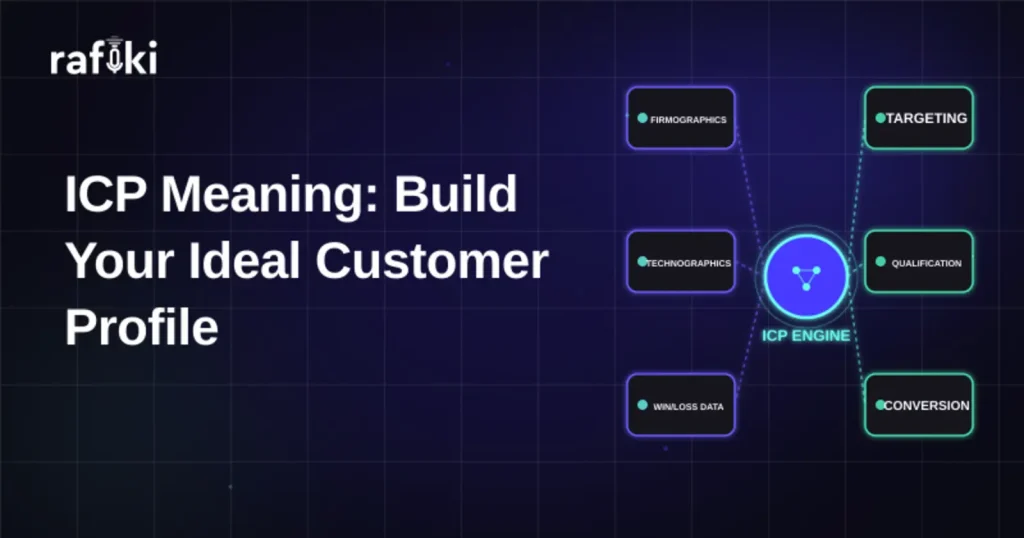
An Ideal Customer Profile is not a buyer persona. Personas describe people; ICPs describe accounts. They work together but serve different purposes. An ICP narrows the universe of addressable companies to those where you win faster, retain longer, and expand more predictably. A well-constructed ICP typically includes:
- Firmographics — industry, sub-vertical, company size (headcount and revenue), geography, growth stage
- Technographics — current tech stack, platforms they already use, integration requirements
- Operational indicators — team structure, budget authority, buying process maturity
- Pain and trigger signals — specific business problems your solution addresses, events that create urgency (funding rounds, leadership changes, regulatory shifts)
- Negative qualifiers — attributes that disqualify an account regardless of surface-level fit
The distinction matters because a vague ICP — "mid-market SaaS companies" — does nothing to sharpen execution. Precision is the entire point. When your ICP is specific enough to change daily decisions, it becomes a competitive weapon rather than a planning artifact.
Why Most ICP Definitions Fail: The Status Quo Problem
Grasping ICP meaning is straightforward. Building one that actually drives revenue is where organizations stumble. The failure modes are predictable and widespread.
- Built from opinion, not data — Founders and sales leaders define the ICP based on who they want to sell to, not who they actually win and retain. Aspiration overrides evidence.
- Static and outdated — The ICP is created once during a planning cycle and never revisited. Markets shift, product capabilities evolve, but the targeting criteria stay frozen.
- Too broad to be useful — To avoid "missing opportunities," teams define an ICP so wide it includes nearly every prospect in the TAM. This defeats the purpose entirely.
- Disconnected from frontline reality — The ICP lives in a strategy document. Reps have never seen it, SDRs ignore it, and marketing interprets it differently than sales.
- Missing negative qualifiers — Teams describe who they want without describing who they should actively avoid. This is the fastest leak in any pipeline.
The consequence is a revenue engine running without a filter. Reps fill pipelines with accounts that look promising in a CRM but fall apart during discovery. Marketing celebrates MQL volume while sales-qualified conversion rates stay flat. As Harvard Business Review has explored, companies that align go-to-market strategy around data-driven customer definitions tend to outperform those relying on intuition-based segmentation. The gap is widening as AI-native competitors move faster with better targeting.
The Foundation: Building Your ICP From Closed-Won and Retention Data
A durable ICP starts not with hypothesis but with historical evidence. The data you need already exists — in your CRM, in your support tickets, and especially in your sales conversations. Here is how to extract it.
Step 1: Analyze Your Best Customers, Not Just Your Biggest
"Best" does not mean highest ARR. It means highest lifetime value relative to acquisition and servicing cost. Start with customers who:
- Renewed at least once (or expanded) — proving sustained value realization
- Had below-average sales cycle length — indicating strong product-market fit
- Required minimal custom work or heavy support during onboarding
- Generated positive NPS or CSAT scores over time
- Came through repeatable channels, not one-off referrals
Export this cohort and look for patterns. What industries dominate? What company size range appears most frequently? What tech stack do they share? The clusters that emerge are your empirical ICP candidates.
Step 2: Study Your Worst-Fit Customers With Equal Rigor
Negative data is as valuable as positive data. Examine churned accounts and deals lost after deep-stage engagement. The patterns here reveal your anti-ICP — the profile you must actively filter out.
- Which industries churn fastest?
- At what company size does your product consistently under-deliver?
- Which use cases did churned customers buy for that your product does not actually solve well?
- What objections recurred in lost deal conversations?
Codifying what does not work is often more immediately actionable than codifying what does. It gives SDRs a concrete disqualification framework and saves AEs from investing months in accounts destined to fail.
Beyond Firmographics: Behavioral and Conversational ICP Signals
Traditional ICP frameworks stop at firmographics and technographics. In 2026, that is not enough. The most effective revenue teams layer in behavioral and conversational signals — patterns that emerge from actual buyer interactions, not just database fields.
- Discovery call patterns — ICP-fit prospects articulate specific pain points your product addresses without heavy prompting. Non-ICP prospects need the problem explained to them.
- Buying committee structure — Ideal accounts have a clear champion, economic buyer, and decision-making process. Non-ICP accounts have diffuse authority and no internal urgency.
- Language and terminology — Prospects who already use your category's vocabulary (e.g., "revenue intelligence," "deal inspection," "pipeline hygiene") are signaling market awareness and intent.
- Engagement velocity — ICP-fit accounts move through stages faster, respond to follow-ups sooner, and bring additional stakeholders into calls without being asked.
- Objection types — Timing objections ("not this quarter") are different from fit objections ("we do not have this problem"). The latter is an ICP signal; the former is a sequencing issue.
These signals live in your call recordings, emails, and meeting transcripts. They are extraordinarily rich — and almost universally ignored because extracting them manually is impractical at scale. This is where AI-native revenue intelligence changes the equation. Instead of relying on rep self-reporting (notoriously unreliable) or manager call reviews (limited to a handful per week), purpose-built AI analyzes every conversation to surface the behavioral patterns that separate ICP-fit accounts from the rest.
Operationalizing Your ICP Across the Revenue Team
An ICP that lives only in a strategy document is worthless. The test of a real ICP is whether it changes what people do on Monday morning. Operationalization means embedding ICP criteria into every stage of the revenue workflow.
- SDR qualification — ICP attributes become mandatory fields or scoring criteria in outbound prospecting. Reps prioritize accounts that match the profile and deprioritize those that do not, before a single email is sent.
- Discovery frameworks — Call scoring templates (MEDDIC, BANT, SPICED, or custom) are weighted toward ICP-relevant signals. A technically qualified lead that fails ICP criteria gets flagged early.
- Pipeline reviews — Managers inspect deals not just on stage progression but on ICP alignment. A Stage 3 deal with low ICP fit receives scrutiny, not celebration.
- Marketing targeting — Campaign audiences, content topics, and ad spend allocation map directly to ICP firmographics and behavioral triggers.
- Customer success handoff — CS teams know which incoming accounts are strong ICP fits (and should be nurtured for expansion) versus marginal fits (and require proactive retention effort).
This level of operationalization requires infrastructure. You need a system that scores calls against your methodology, syncs ICP-relevant data to your CRM automatically, and gives every team member access to insight without manual overhead.
How Rafiki AI Powers ICP-Driven Revenue Execution
Rafiki AI is an AI-native revenue intelligence platform built from day one on multi-model AI architecture — not a call recorder with AI features bolted on. For teams serious about building and operationalizing an Ideal Customer Profile, Rafiki AI provides the infrastructure to move from theory to execution.
- Smart Call Scoring scores every single call against any methodology — MEDDIC, BANT, SPIN, SPICED, GAP, Challenger, Sandler, or your own custom criteria. This means ICP-relevant qualification signals are captured consistently across every rep and every call, not just the ones a manager happens to review. You see immediately which deals exhibit ICP-fit discovery patterns and which are forcing a fit that does not exist.
- Smart CRM Sync auto-populates methodology-specific fields and custom CRM fields directly from call content. ICP attributes that emerge in conversation — buying committee structure, pain articulation, tech stack mentions, budget signals — flow into Salesforce, HubSpot, Zoho, Pipedrive, or Freshworks without rep data entry. Your CRM becomes a living ICP validation engine rather than a graveyard of stale fields.
- Gen AI Reports enables revenue leaders to analyze ICP patterns across the entire pipeline — which segments close fastest, which verticals churn, where deal velocity correlates with specific discovery behaviors. These reports turn conversational data into the empirical foundation your ICP needs to evolve quarterly, not annually.
Rafiki AI deploys six autonomous AI agents that work around the clock — Smart Call Summary, Smart Follow Up, Smart Call Scoring, Smart CRM Sync, Ask Rafiki Anything, and Gen AI Reports — giving growing teams enterprise-grade intelligence at a fraction of enterprise cost. With support for 60+ languages, global teams build ICPs informed by conversations across every market, not just English-speaking ones. Pricing starts at $19 per seat per month with no seat minimums.
The practical impact: your ICP stops being a static slide and becomes a dynamic, data-enriched framework that every team member — SDR, AE, manager, CS leader — can act on in real time.
A Phased Approach to Building and Refining Your ICP
Building a durable ICP is iterative. Here is a phased rollout that moves from foundation to continuous refinement.
- Audit your closed-won and churned accounts (Week 1-2). Pull the last 12-18 months of data. Segment by lifetime value, sales cycle length, and retention outcome. Identify the top and bottom quartile patterns across firmographic, technographic, and behavioral dimensions.
- Draft your ICP hypothesis (Week 2-3). Define 3-5 primary ICP attributes and 3-5 disqualification criteria. Be specific enough that an SDR can apply them to a prospect list without interpretation. Include both firmographic and behavioral signals.
- Instrument your call scoring and CRM (Week 3-4). Configure call scoring templates to capture ICP-relevant discovery signals on every call. Map ICP attributes to CRM fields and ensure they auto-populate from conversation data. Rafiki AI's Smart CRM Sync and Smart Call Scoring handle this without custom engineering.
- Train the team and launch (Week 4-5). Walk SDRs, AEs, and managers through the ICP framework. Make ICP alignment a standing item in pipeline reviews. Share examples of ICP-fit versus non-ICP-fit conversations so the criteria feel concrete, not abstract.
- Review and refine quarterly (Ongoing). Use AI-generated reports to validate or adjust ICP criteria based on new closed-won, expansion, and churn data. ICPs are living documents. The market does not stand still, and neither should your targeting framework.
The teams that treat ICP building as a continuous intelligence process — rather than a one-time planning exercise — are the ones that compound their targeting advantage over time. Each quarter's data makes the next quarter's prospecting sharper.
Common ICP Mistakes and How to Avoid Them
Even well-intentioned teams fall into traps that undermine ICP effectiveness. Recognizing these patterns early saves months of wasted motion.
- Confusing TAM with ICP — Your total addressable market is everyone who could theoretically buy. Your ICP is the subset where you win reliably and retain predictably. Conflating the two leads to bloated pipelines and thin conversion rates.
- Ignoring the anti-ICP — Disqualification criteria are just as valuable as qualification criteria. If you do not codify who to walk away from, reps default to pursuing every inbound lead regardless of fit.
- Over-indexing on company size — Headcount and revenue are useful filters but insufficient alone. A 500-person company in a non-relevant vertical is a worse fit than a 50-person company in your sweet spot. Layer behavioral and pain-based signals on top of firmographics.
- Building the ICP without sales input — Marketing or strategy teams sometimes build ICPs in isolation. The reps who run discovery calls daily have pattern recognition that no spreadsheet captures. Involve frontline sellers in the process.
- Never updating it — As McKinsey has highlighted, high-growth companies revisit their customer segmentation and targeting regularly as part of a broader growth discipline. Static ICPs decay in accuracy as markets evolve, product capabilities expand, and competitive dynamics shift.
Avoiding these mistakes is easier when your ICP is grounded in conversational evidence rather than assumptions. When every call is scored and every behavioral signal is captured automatically, the data corrects your blind spots before they become costly.
ICP as a Competitive Advantage in 2026
Understanding ICP meaning is table stakes. Executing on it with precision is the differentiator. In a market where capital efficiency defines winners, the ability to focus finite resources on the accounts most likely to convert, expand, and renew is not a nice-to-have — it is the foundation of sustainable revenue growth.
- Sales efficiency — Reps spend time on accounts that close, not accounts that stall. Win rates improve without adding headcount.
- Marketing ROI — Campaigns target the right companies with the right messages. Cost per acquisition drops as relevance increases.
- Customer success outcomes — Accounts that fit the ICP onboard faster, adopt deeper, and renew at higher rates. NRR improves structurally, not through heroic effort.
- Forecasting accuracy — When your pipeline is built on ICP-fit accounts, stage-to-stage conversion rates stabilize, making forecasts trustworthy rather than aspirational.
- Team alignment — A shared ICP gives marketing, sales, and CS a common language. Pipeline reviews become more productive. Handoffs become smoother. Finger-pointing decreases.
The teams winning in 2026 are not the ones with the most reps or the biggest ad budgets. They are the ones with the sharpest targeting — informed by AI-analyzed conversations, validated by retention data, and operationalized into every workflow. Rafiki AI exists to make that level of precision accessible to growing teams, not just enterprises with seven-figure tech stacks.
Your ICP should be the most-used document in your revenue org. If it is not, you are leaving winnable deals on the table and wasting resources on accounts that were never going to work. Explore Rafiki AI's revenue intelligence platform to see how six autonomous AI agents turn every conversation into ICP intelligence — start free with no seat minimums, or book a demo to see it in action with your own data.