Your reps are running complex deals with a methodology designed for strategic selling — and still losing, because the critical buying influences mapped on a whiteboard never make it into the actual conversation.
The Miller Heiman sales process remains one of the most respected frameworks in B2B sales. Its emphasis on identifying buying influences, understanding each stakeholder's win-results, and managing the politics of multi-threaded deals has shaped how enterprise teams sell for decades. But here is the uncomfortable truth: most teams that claim to follow Strategic Selling execute it inconsistently, incompletely, or not at all once the deal moves past the initial strategy session. The Blue Sheet gets filled out once and forgotten. Coaching conversations reference concepts no one tracks. And the buying influences that should determine every next step go unvalidated from one call to the next.
The result is a methodology-shaped gap between strategy and execution. Deals stall because no one confirmed the Economic Buyer's decision criteria. Competitors slip in through a Technical Buyer no one engaged. Forecasts collapse because the "single sales objective" was never pressure-tested against what prospects actually said. The framework is sound. The failure is in operationalizing it — and that failure is costing your pipeline real revenue every quarter.
Why the Miller Heiman Sales Process Still Matters in 2026
The Miller Heiman sales process, formally known as Strategic Selling, is a B2B sales methodology developed by Robert Miller and Stephen Heiman that structures complex deals around buying influences, win-results alignment, and a single sales objective. Unlike transactional selling frameworks, it assumes that enterprise deals involve multiple stakeholders with competing priorities — and that winning requires a deliberate strategy to address each one.
In 2026, the core principles are more relevant than ever. B2B buying groups now routinely involve multiple decision-makers, each armed with independently sourced information. That complexity is exactly what Miller Heiman was designed to navigate. The framework forces sellers to answer questions most reps avoid:
- Who are all the people who can say yes, say no, or influence this decision — and have you engaged every one of them?
- What does each buying influence need to "win" personally and professionally from this purchase?
- Where are the red flags — gaps in information, uncontacted stakeholders, misaligned priorities — that threaten the deal?
- What is your single sales objective, stated in specific, measurable terms?
These questions remain the backbone of strategic deal management. The challenge is no longer understanding the methodology. It is making sure your team actually applies it in every deal, on every call, throughout the entire sales cycle.
The Four Buying Influences: Mapping the Decision Landscape
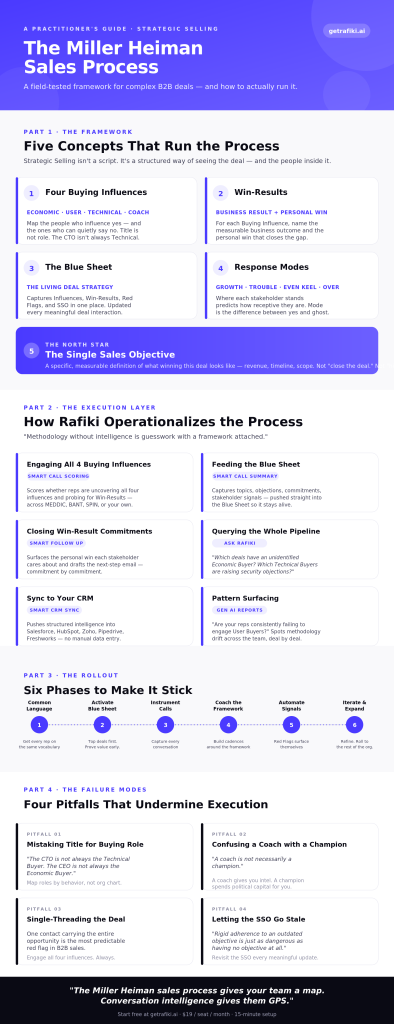
At the heart of the Miller Heiman sales process are four buying influences — distinct roles that exist in every complex sale, regardless of titles on an org chart. Understanding and engaging each one is non-negotiable for deal progression.
- Economic Buyer — the person who gives final approval and controls budget release. There is only one per deal, and failing to identify them is the most common reason strategic deals die silently
- User Buyer — the people who will use or supervise the use of your solution daily. Their evaluation criteria are operational: will this make my work better or worse
- Technical Buyer — the gatekeepers who screen out vendors based on specifications, compliance, integration requirements, or procurement policy. They cannot say yes, but they can absolutely say no
- Coach — your internal advocate who provides guidance on navigating the account's politics, priorities, and decision process. A coach is not necessarily a champion — they are a source of credible, actionable intelligence
The mistake most teams make is treating these as a one-time mapping exercise. Buying influences shift as deals evolve. A User Buyer who was enthusiastic in month one may become a Technical Buyer blocker when implementation concerns surface in month three. Your strategy has to be a living document, updated after every meaningful interaction.
Win-Results: Aligning Business Outcomes with Personal Wins
Win-results is the Miller Heiman concept that separates adequate deal strategies from exceptional ones. Every buying influence evaluates your solution on two dimensions: the business result (what it does for the organization) and the personal win (what it does for them individually). Ignoring either dimension leaves your deal exposed.
- A CFO acting as Economic Buyer needs to see a defensible ROI model (business result) and confidence that this decision will not create political risk for them (personal win)
- A department head acting as User Buyer needs proof of productivity gains (business result) and reassurance that their team will not revolt during adoption (personal win)
- A procurement lead acting as Technical Buyer needs compliance with vendor policies (business result) and the ability to demonstrate due diligence to their leadership (personal win)
Win-results are rarely stated explicitly by prospects. They surface in the language buyers use, the objections they raise, the questions they ask more than once. The reps who consistently win strategic deals are the ones who listen for these signals and adjust their approach stakeholder by stakeholder. The reps who lose are the ones who pitch the same value proposition to every audience and wonder why the deal stalls.
The Blue Sheet: Structuring Your Deal Strategy
The Blue Sheet is the operational artifact of the Miller Heiman sales process — a structured template where sellers document their analysis of each deal across buying influences, win-results, response modes, red flags, and the single sales objective. It transforms strategic thinking from an abstract exercise into a concrete, coachable document.
When used properly, the Blue Sheet serves multiple functions:
- It forces sellers to identify what they know, what they do not know, and what they are assuming — eliminating the "happy ears" problem that inflates forecasts
- It gives managers a coaching framework that goes beyond "how's the deal going" and into "which buying influence have you not validated, and what is your plan to reach them"
- It creates a shared language across the revenue team — from SDRs qualifying initial interest to AEs navigating procurement to customer success managing renewals
- It documents response modes — whether each buying influence sees your solution as addressing growth, trouble, even keel, or overconfidence — which dictates how to position your messaging
The problem with the Blue Sheet in practice is maintenance. If you want to learn how to properly complete one, the guide on filling out a Miller Heiman Blue Sheet template walks through each section in detail. But even the best template is only as good as the data feeding it — and that data lives in your team's conversations, not in their memories.
Response Modes: Reading Where Each Stakeholder Stands
The Miller Heiman sales process identifies four response modes that describe how a buying influence perceives their current situation relative to the change you are proposing. Accurately reading response modes determines whether your messaging resonates or falls flat.
- Growth mode — the buyer sees a gap between where they are and where they want to be. They are receptive to change and looking for a solution. This is your best entry point
- Trouble mode — the buyer is experiencing a problem that is getting worse. Urgency is high, but so is anxiety. They need confidence that your solution resolves the issue without creating new ones
- Even keel mode — the buyer sees no discrepancy between their current state and their desired state. They are not looking for change. Selling to an even keel buyer requires reframing their perception before pitching your solution
- Overconfident mode — the buyer believes their current situation is better than it actually is. This is the hardest mode to sell into because the buyer does not recognize the problem. Direct challenge often backfires; third-party proof and peer benchmarking work better
Response modes are not static. A single event — a missed quarter, a competitor win, a leadership change — can shift a stakeholder from even keel to trouble overnight. The teams that win are the ones who track these shifts in real time, not the ones who assessed response modes once during discovery and never revisited them.
The Single Sales Objective: Defining What Winning Looks Like
The single sales objective is the Miller Heiman concept that keeps deals from drifting. It is a specific, measurable statement of what you are trying to achieve in this particular sales cycle — not a vague goal like "close the deal" but a precise outcome like "secure a signed 18-month enterprise agreement for 200 seats of Platform X at $Y ARR by end of Q2."
Defining a sharp single sales objective does several things at once:
- It forces alignment between the seller's strategy and the buyer's timeline, scope, and budget reality
- It makes it immediately obvious when a deal is drifting off course — if your actions are not advancing this specific objective, you are wasting cycles
- It gives managers a clear coaching anchor: is the team's activity aligned with the stated objective, or are they chasing tangents
- It prevents scope creep in the sales cycle itself — a common problem when sellers try to solve every problem at once instead of winning a specific commitment
The single sales objective should be revisited after every major deal milestone. If new information changes the scope, timeline, or decision criteria, the objective needs to change too. Rigid adherence to an outdated objective is just as dangerous as having no objective at all.
How Rafiki AI Operationalizes the Miller Heiman Sales Process
The gap between knowing Strategic Selling and executing it consistently is a data problem. Your reps have dozens of conversations with buying influences across multiple deals. The signals that indicate response modes, win-results, red flags, and stakeholder sentiment are all there — buried in call recordings, email threads, and meeting notes that no human has the bandwidth to systematically analyze. This is where Rafiki AI transforms the Miller Heiman sales process from a periodic planning exercise into a continuously updated intelligence system.
Rafiki AI is an AI-native revenue intelligence platform built from day one on multi-model AI architecture — not a call recorder with AI bolted on. Its six autonomous AI agents work around the clock to extract, structure, and surface the insights your team needs to execute Strategic Selling at scale:
- Smart Call Summary automatically generates structured summaries after every call, capturing the key topics, objections, commitments, and stakeholder-specific signals that should feed your Blue Sheet. No more relying on rep memory or handwritten notes
- Smart Follow Up generates intelligent follow-up actions and next steps from every conversation, ensuring that commitments made to buying influences are captured and acted on — not lost between calls
- Smart Call Scoring evaluates calls against frameworks including MEDDIC, BANT, SPIN, and custom criteria — so you can score whether reps are actually engaging all four buying influences and uncovering win-results, not just running a generic demo. Explore how Smart Call Scoring maps to your methodology
- Ask Rafiki Anything lets you query your entire conversation dataset in natural language. Want to know which deals have an unidentified Economic Buyer? Which accounts have a Technical Buyer raising security objections? Ask, and Rafiki surfaces the answer in seconds. Learn more about natural-language revenue queries
- Smart CRM Sync pushes conversation intelligence directly into Salesforce, HubSpot, Zoho, Pipedrive, or Freshworks — keeping your deal records current without requiring reps to manually update fields
- Gen AI Reports aggregate patterns across your pipeline to identify systemic gaps: are your reps consistently failing to engage User Buyers? Are deals in a specific segment stalling at the same stage? These reports turn anecdotal coaching into data-driven enablement
With transcription in 60-plus languages and seamless integrations with Zoom, Microsoft Teams, and Google Meet, Rafiki AI enables global sales organizations to apply the Miller Heiman sales process consistently across regions, languages, and teams — something legacy tools simply cannot match. And because Rafiki AI starts at $19 per seat per month with no seat minimums and no annual contracts, growing teams get enterprise-grade deal intelligence without enterprise-grade procurement cycles.
Implementing Strategic Selling: A Phased Approach
Rolling out the Miller Heiman sales process across your team is not a one-day training event. It requires deliberate implementation in phases that build competence and habit simultaneously. Here is a practical roadmap:
- Establish the common language — Train the entire revenue team on buying influences, win-results, response modes, and the single sales objective. Do not limit this to AEs. SDRs need to identify buying influence types during qualification. Customer success needs to recognize response mode shifts during renewals
- Activate the Blue Sheet for top deals — Start with your ten highest-value open opportunities. Complete a Blue Sheet for each, identifying gaps in stakeholder coverage and unvalidated assumptions. Use this exercise to demonstrate the framework's value before expanding it
- Instrument your conversations — Deploy conversation intelligence to capture every buyer interaction across calls, demos, and follow-ups. This is where the methodology moves from theory to operational reality. Every conversation becomes a data source for updating your deal strategy
- Build coaching cadences around the framework — Shift one-on-ones and deal reviews from pipeline walkthroughs to Blue Sheet reviews. Managers should ask: which buying influences have we engaged this week? What response modes did we observe? Where are our red flags? Research consistently shows that coaching tied to a structured framework outperforms ad hoc deal advice
- Automate signal detection — Use AI to flag when deals exhibit classic Miller Heiman red flags: single-threaded engagement, unconfirmed Economic Buyer, Technical Buyer objections going unaddressed. Proactive alerts prevent the deal-killing surprises that manual review misses
- Iterate and expand — Once your team demonstrates consistent application on top deals, extend the process to mid-market opportunities and eventually to the full pipeline. Measure adoption through call scoring adherence, Blue Sheet completion rates, and forecast accuracy improvements
The teams that succeed with Strategic Selling are the ones who treat it as an operating system, not a training module. It has to be embedded in your tools, your coaching rhythms, and your data infrastructure.
Common Pitfalls That Undermine Strategic Selling Execution
Even well-intentioned teams sabotage their Miller Heiman implementation with predictable mistakes. Recognizing these patterns early saves months of frustration and lost deals.
- Treating the Coach role casually — A Coach is not just someone who likes you. They are someone with credibility inside the account who is willing to share intelligence about the decision process. Mistaking a friendly contact for a Coach leads to blind spots that competitors exploit
- Mapping buying influences to titles instead of behaviors — The CTO is not always the Technical Buyer. The CEO is not always the Economic Buyer. Influence is determined by role in the specific decision, not by org chart position. Rafiki AI surfaces who is actually raising technical objections or budget concerns in conversations, regardless of their title
- Ignoring even keel stakeholders — Teams focus on buyers in growth or trouble mode because they are easier to engage. But an even keel User Buyer who is not engaged becomes a passive blocker — they will not advocate for change, and without their support, adoption stalls
- Static deal strategies — The Blue Sheet completed during initial discovery is outdated by the second meeting. Deal dynamics shift with every interaction. If your strategy document does not evolve, it is fiction
- Over-indexing on the Economic Buyer — Yes, they give final approval. But a Technical Buyer veto or a User Buyer revolt kills deals just as effectively. Strategic Selling requires multi-threaded engagement, not a top-down shortcut
Each of these pitfalls has the same root cause: insufficient visibility into what is actually happening in your deals. Methodology without intelligence is guesswork with a framework attached.
The Strategic Advantage: Why Process Plus Intelligence Wins
The Miller Heiman sales process gives your team a map. Conversation intelligence gives them GPS. Neither is sufficient alone. A map without real-time data leads to wrong turns. Data without a strategic framework is noise. The combination — a rigorous methodology operationalized through AI-native revenue intelligence — is what separates teams that consistently win complex deals from teams that win them occasionally and cannot explain why.
The competitive landscape in 2026 rewards this combination disproportionately:
- Buyers are more informed, more skeptical, and more multi-stakeholder than ever. The teams that map and engage every buying influence win
- Sales cycles are longer and involve more interactions. The teams that extract intelligence from every conversation have a compounding advantage
- Forecasting accuracy directly impacts resource allocation, hiring, and investor confidence. The teams that ground their forecasts in validated deal strategies, not rep optimism, make better decisions
- Coaching at scale is impossible without structured data. The teams that can identify methodology gaps across hundreds of deals and coach to them systematically build better sellers faster
Strategic Selling was designed for a world of complex, high-stakes B2B deals. That world has not gone away — it has gotten more complex. The methodology remains the strategic foundation. AI-native intelligence is the execution layer that makes it work at the speed and scale modern revenue teams demand.
If your team is running the Miller Heiman sales process on spreadsheets, memory, and good intentions, you are leaving winnable deals on the table. Rafiki AI gives you the always-on intelligence layer that turns Strategic Selling from a quarterly training topic into a daily competitive advantage — starting at $19 per seat per month, with no seat minimums, no annual contracts, and setup in under fifteen minutes. Start free or book a demo and see what your team's conversations have been trying to tell you.