Your CRM has every field filled in, every stage mapped, every report scheduled — and your sales velocity is still declining.
That paradox haunts revenue leaders in 2026. Teams invested heavily in CRM customization, built elaborate pipelines, added required fields, and mandated data hygiene protocols. Yet deals still stall in mid-pipeline limbo. Reps still lose momentum between touches. Forecast calls still devolve into guessing games about which opportunities are real and which are zombie deals consuming bandwidth. The problem is not a lack of data. The problem is that the systems holding your data were never designed for the humans who have to act on it.
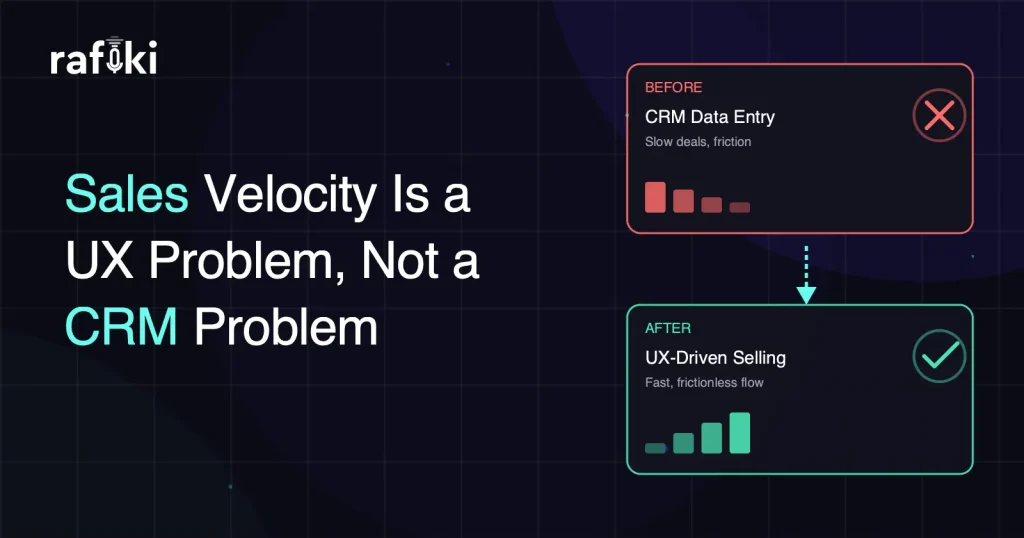
Sales velocity — the rate at which your pipeline converts to revenue — is treated almost universally as a CRM optimization challenge. Adjust your stages. Tighten your qualification criteria. Add another dashboard. But the real bottleneck sits upstream of any database schema: it lives in the daily experience of your reps, managers, and RevOps teams as they navigate fragmented tools, context-switch between apps, and manually reconstruct what happened on a call thirty seconds after it ended. Sales velocity is a UX problem. And until you treat it as one, no amount of CRM engineering will fix it.
Sales velocity is the product of four variables: number of qualified opportunities, average deal value, win rate, and sales cycle length. Every revenue leader knows the formula. The instinct is to attack each variable inside the CRM — add stricter qualification gates, coach reps to increase deal size, build reports to identify win-rate patterns, and create alerts when deals age past benchmarks. That instinct is logical, and it is incomplete.
CRMs are systems of record. They store outcomes. They do not shape behavior in the moments that determine those outcomes. Consider where deals actually accelerate or stall:
None of these velocity-defining moments happen inside a CRM. They happen in conversation, in context, in the cognitive load a rep carries between apps. The CRM only learns about them after the fact — if someone bothers to log the details. Any experienced sales leader knows that reps spend a disproportionate share of their time on non-selling activities, with CRM data entry consistently ranking among the top friction points cited by frontline sellers. The system designed to accelerate revenue is actively decelerating it.
When we say sales velocity is a UX problem, we mean something specific. UX friction in the sales workflow refers to every unnecessary step, context switch, manual entry, or information gap that slows a rep's ability to move a deal forward. That friction compounds silently across every opportunity in your pipeline.
Here is what the UX tax looks like in practice:
Each of these friction points erodes one or more components of the velocity equation. Qualification suffers because signals are lost. Deal values shrink because reps miss expansion cues. Win rates drop because follow-ups arrive late and generic. Cycles stretch because buyers repeat themselves to each new contact. The CRM faithfully records the damage. It does nothing to prevent it.
Fixing sales velocity requires rethinking the seller's workflow from the conversation outward — not from the CRM inward. The distinction matters. A system of record captures what happened. A system of action captures what happened, interprets what it means, and initiates the next step — autonomously, in real time, without requiring the rep to context-switch.
This is the UX reframe that changes the game. Instead of asking "how do we get reps to put better data into the CRM," ask "how do we eliminate the need for reps to manually put data into the CRM at all?" Instead of "how do we build better dashboards for managers," ask "how do we surface coachable moments before the manager even opens a dashboard?"
The principles of a system of action for sales velocity:
This is not futuristic aspiration. This is the architecture that AI-native platforms — built from day one on multi-model AI rather than bolting intelligence onto legacy infrastructure — deliver right now. And it is the architecture that directly attacks every friction point eroding your sales velocity.
AI-native architecture refers to a platform designed with machine learning and language models as foundational components, not afterthought integrations. The distinction matters because bolted-on AI inherits the UX limitations of the host system. If your CRM adds a summarization feature, you still have to navigate to the CRM, find the right record, and read a summary in a context disconnected from the conversation itself.
An AI-native system, by contrast, treats the conversation as the primary data object and builds every workflow around it:
When these architectural choices combine, the impact on sales velocity is structural, not incremental. You do not shave a day off the sales cycle through better CRM reports. You remove entire categories of manual work that were adding days in the first place.
To make this concrete, consider how autonomous AI agents directly improve each component of the sales velocity formula.
Qualification frameworks like MEDDIC only work when they are applied consistently — and when the evidence behind each score is grounded in actual buyer language, not a rep's optimistic interpretation. AI-powered call scoring evaluates every conversation against your chosen framework and flags gaps in qualification before the deal advances. Reps who might self-report a strong champion get an objective assessment based on what the prospect actually said.
Upsell and cross-sell signals almost always surface in conversation — a passing mention of a new team, a question about a capability outside the current scope, frustration with an adjacent tool. These signals are revenue waiting to be captured, but only if someone catches them.
Every hour between a call and a relevant follow-up is an hour for buyer momentum to fade. Automated follow-up generation closes that gap to minutes. Meanwhile, managers who can review AI-generated call summaries and coaching highlights instead of listening to full recordings can coach more reps in less time — raising the skill floor across the team.
When every conversation is captured, structured, and synced, handoffs stop being lossy. The AE picking up from an SDR reads a complete account brief — not a three-line CRM note. The CS team inheriting a closed deal understands the promises made during the sales process. Buyers never have to repeat themselves, and the cycle compresses because no one is rebuilding context that already exists.
Rafiki AI is an AI-native revenue intelligence platform built from the ground up on multi-model AI — not a call recorder with summarization bolted on. Its architecture embodies the system-of-action principles outlined above through six autonomous AI agents, each targeting a specific velocity bottleneck.
Rafiki AI supports 60+ languages, integrates with Zoom, Teams, and Google Meet, and sets up in under fifteen minutes. It starts at $19 per seat per month with no seat minimums, no annual contracts, and no hidden fees — making it accessible to growing teams that need enterprise-grade intelligence without the enterprise procurement cycle. This is revenue intelligence designed for the way reps actually work, not the way CRM architects wish they worked.
Shifting from a CRM-centric to a conversation-centric velocity model does not require ripping out your existing stack. It requires layering intelligence on top of it. Here is a practical phased approach:
The key principle at every phase: reduce the distance between insight and action. Every manual step you eliminate is a direct contribution to sales velocity.
The teams that treat sales velocity as a UX problem in 2026 will outpace those still optimizing CRM fields. The reason is structural. Competitive advantage increasingly accrues to organizations that reduce internal friction faster than their peers. In sales, that friction lives in the gap between what your reps learn in conversation and what your systems capture, interpret, and act on.
Your competitors are not going to slow down. Buyers are not going to become more patient. The window where AI-native revenue intelligence is a differentiator — rather than table stakes — is open right now. The teams that move first will compound velocity advantages that become nearly impossible to close.
Sales velocity has never been a CRM problem. It has always been a problem of friction between conversations and actions — friction that CRMs were never designed to solve. The formula is straightforward: more qualified opportunities, larger deal values, higher win rates, shorter cycles. But the levers that move those numbers live in the moments between calls and CRM entries, in the follow-ups that arrive late, in the coaching that never happens because no one had time to review the recording, in the handoffs where context evaporates.
The organizations accelerating sales velocity in 2026 are not the ones with the most customized CRMs. They are the ones that removed the UX friction standing between their reps and the next right action. That is the shift. And it is happening now.
Rafiki AI gives growing sales teams an AI-native revenue intelligence platform with six autonomous agents, 60+ language support, and enterprise-grade insights — starting at $19 per seat per month with no seat minimums and no annual contracts. Start free or book a demo and see what happens when you stop treating sales velocity as a CRM problem and start treating it as the workflow design challenge it has always been.
Start for free — no credit card, no seat minimums, no long contracts. Just better sales intelligence.