Sales

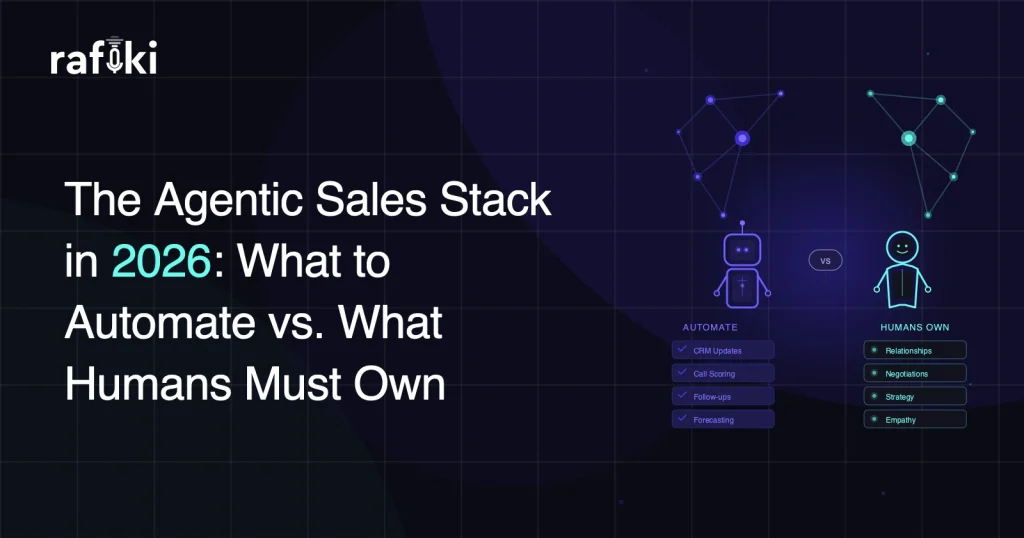
The Agentic Sales Stack in 2026: What to Automate vs. What Humans Must Own
Feb 24, 2026
4 min read
Sales Teams Don’t Need More Tools. They Need Smarter Ownership. For the past decade, sales teams kept adding tools:
CRM.
Sequencer.
Dialer.
Conversation intelligence.
Forecasting software.
Coaching platform.
But adding tools didn’t solve the real problem.
Execution gaps remained.
In 2026, high-performing revenue teams are no longer asking:
“What tools should we buy?”
They’re asking:
“Which decisions should AI agents own — and which must remain human?”
That’s the defining shift behind the Agentic Sales Stack.
The agentic sales stack is a revenue architecture where autonomous AI agents:
This is not simple workflow automation.
It’s not “if X then Y.”
Agentic systems operate on live intelligence — especially conversation data.
And that’s where platforms like Rafiki become foundational.
Traditional stacks relied on:
The result?
Lagging visibility.
By the time leadership sees a problem, it’s already too late.
The 2026 stack flips this model.
It’s built on:
Instead of asking reps to summarize reality, the system understands reality directly from customer conversations.
The CRM still matters.
It stores:
But CRM is no longer the source of truth.
It’s the destination for structured intelligence.
This is where Rafiki sits.
Rafiki captures every meeting, demo, negotiation, and QBR.
But more importantly, it extracts:
Without this structured conversation layer, AI agents operate blindly.
With Rafiki, they operate on grounded customer context.
Once conversations are structured, agents can:
The key difference:
These actions are based on what buyers actually said.
Not rep memory.
Agentic stacks must include:
Rafiki supports this by linking every extracted insight back to specific call moments — ensuring transparency and trust.
AI agents can:
But humans must own:
The agentic stack doesn’t replace humans.
It removes cognitive overload so humans can focus on what actually closes deals.
Manual CRM updates are obsolete.
Rafiki automatically maps conversation signals into:
This saves reps 5–8 hours per week.
Agents should draft follow-ups using:
Rafiki enables contextual follow-up generation grounded in meeting intelligence.
Agents should continuously monitor:
Rafiki surfaces these patterns before quarter-end surprises.
Instead of managers reviewing random calls, AI agents:
Rafiki structures conversations to power this scoring.
AI can suggest positioning.
Humans navigate leverage.
AI can summarize.
Humans build trust.
Buying committees involve hidden agendas.
AI detects signals.
Humans manage dynamics.
AI identifies risk.
Humans decide tradeoffs.
Agentic systems are only as strong as their context layer.
Without structured conversation intelligence:
Rafiki provides:
It transforms conversations into actionable, structured revenue intelligence.
That intelligence powers the entire stack.
Companies that implement an agentic stack correctly see:
Companies that don’t?
They continue managing pipeline by anecdote.
The old sales stack was tool-heavy.
The new stack is intelligence-driven.
The question in 2026 isn’t:
“Do we use AI?”
It’s:
“Is AI embedded deeply enough to influence execution?”
When conversation intelligence (Rafiki) feeds structured context into autonomous agents, execution improves automatically.
Not because reps work harder.
But because the system works smarter.
In 2026, revenue predictability is competitive advantage.
The agentic sales stack is not about replacing salespeople.
It’s about reallocating cognitive load.
Let agents:
Let humans:
When Rafiki powers the intelligence layer of your stack, every meeting becomes structured insight — not forgotten dialogue.
The future of sales isn’t more tools.
It’s better orchestration between AI and human judgment.
And the teams that design that balance correctly will outperform those still relying on manual updates and instinct-driven forecasting.
Start for free — no credit card, no seat minimums, no long contracts. Just better sales intelligence.