Open any B2B inbox in 2026 and you will find the same message wearing twenty different disguises. "Congrats on the Series B." "Saw you spoke at SaaStr." "Loved your recent LinkedIn post about hiring." Outbound personalization was supposed to be the antidote to spray-and-pray, yet buyers now delete these messages as quickly as the generic ones. AI made biographical flattery infinitely cheap to produce, and everyone can smell it.
Meanwhile, the most relevant asset your outbound team owns sits almost completely unmined. Your recorded calls hold hundreds of conversations with people who share your prospect's title, industry, and daily problems. Inside them live the actual pains buyers voice, the exact words they use to describe them, the objections that stall deals, and the reasons similar companies eventually said yes.
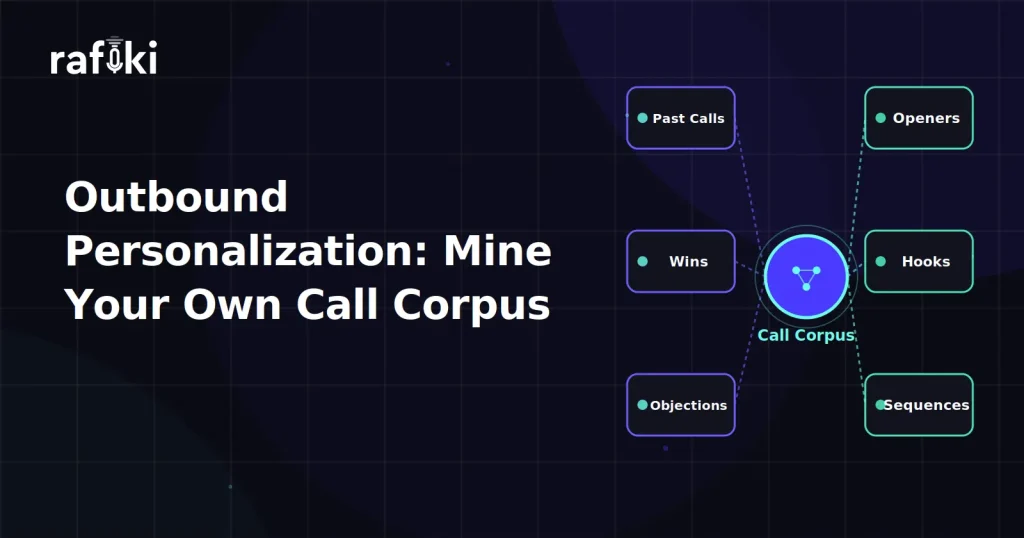
This article makes the case for a different kind of relevance: personalization mined from your own call corpus rather than scraped from a prospect's social feed. We will cover why lookalike evidence beats biographical trivia, how to mine the corpus systematically, and how to turn what you find into email sequences and cold calls. Just as importantly, we will cover how to do all of it without compromising customer confidentiality.
Personalized outbound worked for one underlying reason: it signaled effort. When a rep referenced a prospect's podcast appearance, the message implied a human had spent twenty minutes researching before hitting send. That effort earned a reply, or at least a pause before the delete key.
Generative AI erased that signal. Today, any tool can scrape a LinkedIn profile, a funding announcement, and a company blog in seconds. The findings get woven into a superficially bespoke email. As a result, every SDR's "personalized" opener now looks identical: a biographical fact, a strained segue, and a pitch. Buyers receive dozens of these per week and have learned to pattern-match them instantly.
The deeper problem is that today's buyer arrives better informed than the seller expects. Prospects research categories with AI assistants before a rep ever reaches them — a shift we unpacked in The AI-Researched Buyer. When your prospect has already synthesized your entire category in a chat window, "congrats on the funding" does not just fall flat. It actively signals that you know less about their world than they do.
Here is the distinction most outbound teams miss: biographical facts prove you looked someone up. Evidence proves you understand their problem. Only the second one earns a meeting.
Consider two openers aimed at the same VP of Customer Success:
The first opener is about the prospect's biography. The second is about the prospect's job — and it carries proof that you have spent real time with people exactly like them. In other words, relevance is "we talked to twenty people with your title and here is what they struggle with." It is not "I noticed where you went to school."
Flattery asks the buyer to feel seen. Evidence lets the buyer feel understood. The difference shows up in replies, in meeting acceptance, and in how the first conversation starts.
Your call corpus is the accumulated body of recorded and transcribed conversations your team has held with buyers. It spans discovery calls, demos, negotiations, onboarding sessions, renewal discussions, and win-loss debriefs. For most teams, it is the single richest source of buyer truth they own — and the least used one in outbound.
Think about what actually lives inside those recordings:
This is not survey data or analyst abstraction. It is primary research your team already paid for, one conversation at a time. Harvard Business Review has written about how sales teams can use gen AI to discover what clients need. Notably, the richest raw material for that discovery is not the open web. It is the corpus of conversations sitting in your own call library.
Lookalike evidence is insight drawn from conversations with people who resemble your prospect. Same role, same industry, same growth stage, same use case. It answers the only question a cold recipient actually cares about: "Do you understand people like me?"
Biographical trivia cannot answer that question, because knowing where someone worked says nothing about what keeps them up at night. Lookalike evidence answers it directly. When you write "controllers at logistics companies keep telling us month-end close slips because of X," you are not guessing at relevance. You are reporting it.
Buyer expectations have moved in exactly this direction. Salesforce's State of Sales research has consistently found that buyers expect sellers to understand their business before the first conversation, not to discover it during the call. Lookalike evidence is how an outbound team meets that expectation at the very first touch. The understanding was built in advance, across dozens of prior conversations with the prospect's peers.
There is a compounding advantage here, too. Competitors can scrape the same LinkedIn profile you can. However, nobody else has your call corpus. Evidence-based outbound personalization is built on an asset that is, by definition, proprietary.
Mining the corpus means treating your call library like a research database instead of a compliance archive. In practice, the workflow has three steps: segment, extract, and catalog.
Start by slicing the corpus to match your target segment. Before writing a sequence aimed at heads of RevOps at mid-market fintech companies, pull every past conversation with that profile: discovery calls, demos, churned accounts, closed-won deals. Modern conversation intelligence platforms make this practical, because transcripts become searchable by role, industry, topic, and deal outcome. As a result, a question like "what did operations leaders say about reporting pain this year?" takes minutes instead of weeks of manual review.
The goal of this step is a working set: the twenty, fifty, or two hundred conversations that most resemble the person you are about to contact.
Next, harvest the phrases buyers actually use. Not your marketing team's words — theirs. If five different sales managers described their forecast as "a guessing game we dress up in a spreadsheet," that phrase belongs in your opener. The next sales manager will recognize it instantly.
Verbatim language matters more than summarized themes. A summary says "prospects struggle with visibility." The transcript says "I find out a deal died two weeks after it died." One of those sentences will stop a scrolling thumb; the other will not. Collect the vivid, specific formulations and keep them in a shared library organized by persona.
Finally, study the resistance. For each segment, list the objections that appeared repeatedly in stalled or lost deals. Common entries include security review fears, integration doubts, "we already have something for this," budget timing, and change fatigue. Note where in the deal each objection surfaced and what, if anything, defused it.
This catalog becomes the backbone of your sequence design. If you know the objection is coming, you can address it in touch two — before the prospect has even raised it.
The two approaches differ in source, signal, and scalability. This comparison makes the contrast concrete:
| Dimension | Biographical Personalization | Evidence-Based Personalization |
|---|---|---|
| Source | Prospect's LinkedIn, news, social feeds | Your own corpus of buyer conversations |
| Core message | "I looked you up" | "I understand people like you" |
| Example opener | "Congrats on the funding round" | "CS leaders at your stage keep telling us renewals slip for the same reason" |
| Defensibility | None — any competitor can scrape the same facts | Proprietary — nobody else has your calls |
| Buyer reaction | Pattern-matched as automated flattery | Recognition: "that is exactly my problem" |
| Objection handling | Reactive, improvised on the live call | Preempted in the sequence itself |
| Improvement over time | Static — same scrape, same template | Compounds — every call enriches the corpus |
Notice the last row. Biographical outbound personalization is a treadmill: each new prospect requires a fresh scrape that produces the same shallow output. Evidence-based personalization, in contrast, is a flywheel. Every conversation your team holds makes the next sequence sharper.
Research only pays off when it changes what you send. Here is how corpus insight maps onto the three moments that decide whether a sequence works.
Lead with the pain your lookalike buyers actually described, phrased the way they phrased it. A strong corpus-derived opener names the problem so precisely that the prospect assumes you have been sitting in their staff meetings. Skip the biographical throat-clearing entirely — the pain statement is the personalization.
The same principle governs voice. We made this argument in our guide to outbound calls and scripts that convert: the first ten seconds live or die on whether the buyer hears their own reality reflected back. Corpus language is how you guarantee that reflection.
Your objection catalog tells you exactly what the skeptical prospect is thinking after touch one. Use touch two to answer it before it is asked. For example: "Most operations leaders we talk to worry this becomes another tool nobody logs into — here is how teams like yours avoided that." Preempting the objection does two things at once. It removes a barrier, and it demonstrates a depth of understanding no scraped fact can imitate.
Later touches carry proof: the anonymized story of a similar company that had the same pain, evaluated the same options, and got to an outcome. Because the story comes from your corpus, it matches the prospect's situation far more closely than a generic case study. This is where platforms like Rafiki AI change the economics of the workflow. Instead of an SDR manually rewatching calls, Gen AI Search lets the team ask questions across every transcript — "what convinced mid-market CFOs who were skeptical about switching costs?" — and get sourced answers in seconds. The insight then flows into whatever sales engagement tooling actually sends the sequence.
Ready to see what your own call library has been trying to tell you? Start your free trial today and run your first corpus search in minutes.
Evidence-based outbound is not a one-time research project. It is a loop, and the loop is what makes it compound.
Track every corpus-derived hook the way you would track an experiment. Which pain-language openers earn replies? Which objection-preempting touches revive silent threads, and which proof points convert first meetings into second ones? Positive replies and booked meetings are your ground truth. When a hook wins, promote it into the team playbook; when it fizzles, retire it and mine the corpus for the next candidate.
Then close the loop completely. The meetings your sequences generate become new calls, and those calls enrich the corpus with fresher pain language and newer objections. For SDR leaders, this reframes the entire function. The team is no longer just booking meetings — it is running a continuous research operation in which every conversation improves the next thousand emails. Rafiki AI keeps that loop tight by scoring and structuring every new call automatically, so the corpus stays current without anyone doing archival work.
Everything above applies to the phone, and arguably applies harder. On a cold call there is no time to recover from a weak opener — the first sentence either lands in the buyer's reality or triggers the brush-off.
The corpus supplies that first sentence. Dialer-native conversation intelligence brings phone conversations into the same analyzed library as scheduled meetings. Cold calls made through dialers like Aircall and OpenPhone generate transcripts, get scored, and feed the same pattern analysis as your discovery calls. Consequently, the opener that referenced a voiced pain and the objection response that worked at the ninety-second mark both become searchable, teachable assets rather than tribal knowledge.
This matters because voice is regaining ground in outbound precisely as email saturates — a shift we explored in Phone Calls Are Back. Treat the dialer as a corpus-connected instrument rather than a volume machine, and you get a double advantage. Sharper talk tracks go out; richer evidence comes back in.
Corpus mining comes with a non-negotiable ethical line. The conversations in your library were held in confidence, and the trust that produced them is worth more than any sequence.
Four rules keep the practice clean:
Handled this way, corpus mining is simply structured listening. It gives the whole team the insight a veteran rep carries after five hundred calls — without betraying anyone who spoke candidly.
The outbound personalization arms race has reached its logical end: when every message is "personalized," none of them are. Scraped biography no longer signals effort, and buyers who research with AI can spot templated flattery in a single glance.
The way out is not more scraping — it is better evidence. Your call corpus holds what no data vendor can sell you: the voiced pains, verbatim language, recurring objections, and proven proof points of buyers exactly like your next prospect. Mine it by segment, write openers in the buyer's own words, and preempt the objections you know are coming. Feed winning hooks back into the loop, and extend the whole system to the phone. Above all, protect the confidentiality of every customer who trusted you with a candid conversation.
Teams that make this shift stop asking "what can we find out about this prospect?" Instead, they ask a much better question: "what have people like this prospect already told us?" The second question has hundreds of answers on file.
Evidence-based outbound personalization is the practice of tailoring cold emails and calls using insight mined from your own past buyer conversations, rather than facts scraped from a prospect's online footprint. Instead of referencing an alma mater or funding announcement, the message references the pains, objections, and outcomes that surfaced repeatedly in calls with similar buyers. The relevance signal changes from "I looked you up" to "I understand people like you," which is the question a cold recipient actually cares about. Because the underlying evidence comes from a proprietary call corpus, no rival running the same scraping tools can replicate it. Better still, it improves continuously as every new conversation adds to the library.
Fewer than most teams assume. Meaningful patterns start emerging once you have a few dozen conversations with a given persona or segment, because buyer pains cluster tightly. In practice, five discovery calls with heads of RevOps will usually surface the same two or three frustrations in strikingly similar language. Early-stage teams and founders doing outbound can start mining after their first month of recorded calls, treating each new conversation as another data point. That said, depth compounds. A corpus with hundreds of calls per segment supports finer slicing by industry, deal size, or use case. It also yields objection catalogs precise enough to preempt resistance touch by touch. The practical rule: start mining immediately with whatever you have, and let the corpus grow into the workflow.
No — it replaces the centerpiece, not the whole practice. Account-level facts still matter for targeting and timing. A new executive hire, a tooling change, or an expansion signals that a company may be in-market, and that context helps you choose whom to contact and when. The shift is in what carries the message. Corpus-derived evidence does the persuading, because it demonstrates understanding of the prospect's problem; biographical facts merely establish that you did your homework. In practice, strong sequences use light situational context ("as you scale the SDR team") as a frame, then lead with lookalike evidence as the substance. What corpus mining eliminates is flattery-as-strategy — the "congrats on the funding" opener that buyers in 2026 have learned to delete on sight.
Follow one governing principle: mine patterns, never identities. Concretely, that means no customer is ever quoted identifiably in outbound copy — no names, company names, or details specific enough to reverse-engineer the source. Anonymize upward when a segment is small, so "the one shipping startup we work with" becomes "logistics teams we talk to." Exclude accounts covered by NDAs or that declined reference use from any externally facing language. Additionally, make sure your call recording follows consent requirements in every region where you operate. Restrict corpus access to the revenue team members who need it. The asset you are extracting is aggregate insight: recurring pains, common objections, shared vocabulary. Aggregates, properly anonymized, protect the candor that made the corpus valuable in the first place.
Rafiki AI's conversation intelligence platform turns every call your team records into searchable, minable buyer evidence. Autonomous AI agents score, summarize, and structure each conversation automatically, starting at $19 per seat per month with no seat minimums. Start your free trial today or book a demo to see what your own call corpus already knows about your next prospect.
Start for free — no credit card, no seat minimums, no long contracts. Just better sales intelligence.