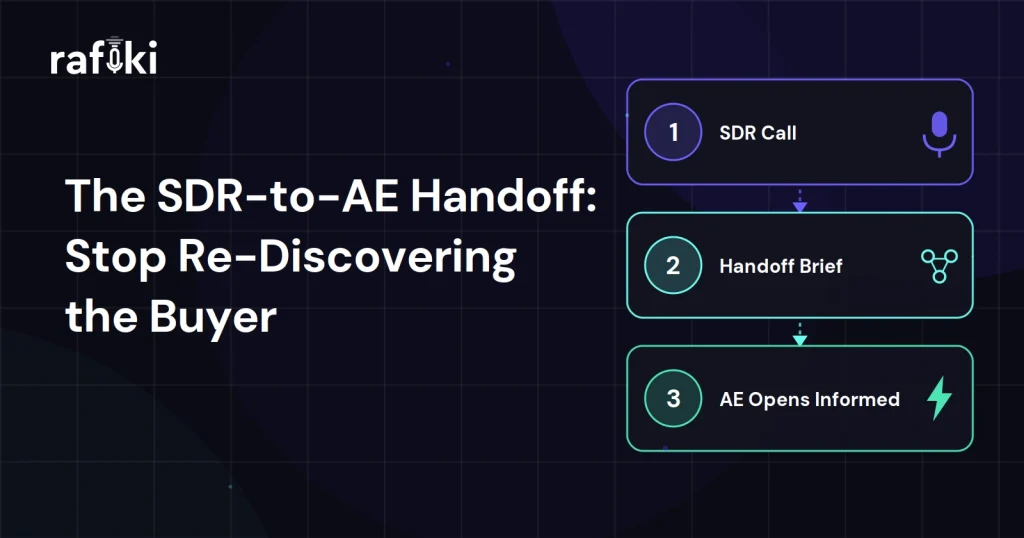
The buyer spent twenty minutes with the SDR on Tuesday explaining why their current renewal process is broken, who else is frustrated by it, and what they have already tried. On Thursday, the AE opens the first meeting with "So, tell me a bit about what's going on with your renewals." The buyer pauses, then repeats everything, a little flatter this time. The AE hears a slightly less engaged version of a great discovery call, while the buyer hears a company that does not talk to itself. The deal is not dead, but the SDR-to-AE handoff has started its life with the buyer doing the vendor's homework twice.
The SDR-to-AE handoff is the first handoff in the customer journey and, in our experience, the one revenue teams design least. By contrast, the sales-to-CS handoff gets a process because churn is expensive and visible. The SDR handoff gets a calendar invite and a CRM note, because the cost, a buyer who quietly re-evaluates whether this vendor listens, never appears on a dashboard. Yet the handoff happens on every single deal, and it shapes the buyer's first impression of the person who will actually sell to them.
This article is about designing that handoff around what the buyer already said. It covers what gets lost between the SDR call and the AE meeting, why CRM notes cannot carry it, how to build a handoff brief from the SDR conversation itself, the AE opening that proves continuity, and the feedback loop that makes SDRs better at qualifying because they see what happens next.
The SDR-to-AE handoff is the transfer of a qualified prospect from the sales development rep who sourced and qualified them to the account executive who will run the opportunity. Structurally it is a change of owner in the CRM and a meeting on the AE's calendar. Experientially, for the buyer, it is the moment a new person appears and either continues the conversation or restarts it.
The handoff carries three things, or should. First, the buyer's stated problem, in their words, with whatever detail the SDR drew out. Second, the context around the problem: who else is involved, what has been tried, what prompted the conversation now, and what the buyer expects from the next meeting. Third, the SDR's read on the buyer: their tone, their urgency, their skepticism, and the moment in the call where they became interested.
A handoff that carries all three lets the AE open the first meeting already inside the buyer's situation. A handoff that carries only the first, as a summary, forces the AE to rebuild the other two from scratch, in front of a buyer who has already supplied them once.
Why does a conversation that was recorded and qualified still arrive at the AE as a two-line note? The reasons are structural to how SDR and AE teams are run, and each one makes the next handoff worse.
The result is the double discovery the buyer experiences. Salesforce's State of Sales research has made disconnected systems a recurring theme, and the SDR handoff is the earliest and most frequent place a revenue team's systems fail to connect. The information exists. It does not move.
Asking a buyer to restate what they told the SDR costs more than a few minutes of the meeting. It changes what the buyer believes about the vendor, and it changes the quality of the discovery that follows.
First, credibility drops before the AE has said anything substantive. A buyer who has to repeat themselves concludes that the vendor's teams do not communicate, and they extend that conclusion to implementation, support, and everything else the AE will later promise. Second, the second telling is worse than the first. Buyers compress on repetition; the detail, the emotion, and the offhand remark that revealed the real driver come out once, to the SDR, and rarely again. Third, the AE anchors on the compressed version, so discovery starts from a shallower place than the SDR call reached, and the deal's understanding of the buyer goes backward at the handoff.
We described the same dynamic at the other end of the journey in our guide to the sales-to-CS handoff. The pattern is identical: context is captured, summarized into uselessness, and rebuilt at the buyer's expense. Harvard Business Review's work on using gen AI to discover what clients need explores how gen AI helps sales teams surface what clients have already said about their needs. The SDR call is the first place they say it.
The fix is a handoff brief generated from the SDR conversation itself rather than typed by the SDR after it. A conversation intelligence platform that records and structures every SDR call, on the dialer as well as on video, makes the brief a byproduct of the call rather than an extra task. The brief has five parts, each drawn from the recording.
The buyer's own description of what is broken, quoted, with the timestamp. Not the SDR's paraphrase. The AE will open with this, so it needs to be the buyer's language.
What prompted the buyer to take the call now: a lost account, a new leader, a budget cycle, a tool that stopped working. The trigger is the urgency, and it is often mentioned in passing rather than in answer to a question.
Everyone the buyer named: who else feels the problem, who would need to approve, who tried to fix it before. Stakeholder mapping starts on the SDR call, and the AE should not have to rediscover the committee.
Where in the call the buyer's engagement changed: the topic that made them lean in, the question that made them hesitate, the objection they raised and how it was handled. Sentiment and talk-pattern analysis surface these without the SDR having to remember them.
What the buyer was told the next meeting would be, and what they said they wanted from it. An AE who delivers the meeting the buyer was promised has already differentiated from the vendors who did not.
With the brief in hand, the AE's first two minutes change completely. Instead of asking the buyer to start over, the AE demonstrates that the conversation never stopped. A workable opening has three moves.
Run this way, the AE meeting starts where the SDR call ended, and discovery goes deeper than either conversation could have reached alone. The buyer's experience is of one continuous conversation with a company that listens, which is a rarer thing than any feature.
The handoff should run in both directions. SDRs qualify better when they can see what happens to the meetings they book, and the conversation record makes that visible for the first time.
Over a quarter, this loop changes what SDRs listen for on calls, because they know what the AE will need and they have seen what happens when it is missing. The handoff improves from both sides at once.
Rafiki AI is built to make the handoff brief automatic, because it captures every SDR conversation, including phone calls on Aircall and OpenPhone as well as video meetings, transcribes them in more than sixty languages, and structures them into the signals the brief needs. The SDR does not write the brief; the call produces it.
Smart Call Summary captures the problem, the trigger, the people, and the expectation from the SDR call, with the buyer's words linked to the moment they were said. Sentiment analysis and stakeholder participation mapping supply the moments and the committee. Smart CRM Sync writes the qualification fields into the opportunity, on Salesforce, HubSpot, Pipedrive, Zoho, or Freshworks, so the AE's record already contains what the buyer said rather than what the SDR typed.
Before the meeting, the AE asks Gen AI Search what this buyer said about their renewal problem and who they mentioned, and gets the cited answer in seconds instead of playing twenty minutes of a call. For the loop back, Smart Call Scoring scores SDR calls against qualification criteria that can be tuned to what actually predicts AE-meeting quality, and Gen AI Reports gives SDR and AE leaders a shared view of handoff quality by rep. Rafiki AI's autonomous AI agents move the context; the SDR and the AE each get to do the part only they can do.
| Dimension | Note-based handoff | Conversation-based handoff |
|---|---|---|
| What transfers | SDR's summary in a CRM field | Buyer's words, trigger, people, moments, expectation |
| Who produces it | SDR, after the call | The call itself, structured automatically |
| AE preparation | Read two lines | Read the brief, listen to the cited moments |
| AE opening | "Tell me what's going on" | "When you spoke with Priya, you said…" |
| Buyer's experience | Repeats themselves | Continues one conversation |
| Discovery depth | Restarts below the SDR call | Starts where the SDR call ended |
| Feedback to SDR | Meeting held or not | What the buyer said next and which signals held |
The meetings SDRs book in the last week of September become the AE conversations of early October, which become the Q4 pipeline. That makes now the moment to fix the handoff, before the volume arrives.
The sequence is short. Define the five-part brief and confirm the SDR calls that feed it are being captured, including dialer calls. Give AEs the brief for every meeting for two weeks and ask them to open with the buyer's words. Then compare those meetings to the previous month's on one signal: how quickly the buyer went deeper than the SDR call. That single comparison usually settles the question of whether the handoff was worth designing.
The SDR-to-AE handoff fails quietly, on every deal, by asking the buyer to repeat what they already said to someone who was supposed to be listening. The fix is not a better CRM note. It is a handoff brief built from the conversation itself, the buyer's problem verbatim, the trigger, the people, the moments, and the expectation, and an AE opening that proves the conversation never stopped. Rafiki AI makes that brief a byproduct of the SDR call, with autonomous AI agents that capture every conversation on phone and video, structure what the buyer said, and put it in front of the AE before the meeting starts. Give the buyer one continuous conversation, and Q4 discovery will start deeper than Q3's ever did.
It is the point at which a prospect the sales development rep sourced and qualified becomes the account executive's opportunity. In the CRM it is an owner change and a booked meeting. For the buyer it is the moment a new person appears and either continues the conversation or restarts it. A good handoff carries the buyer's stated problem in their own words, the context around it, including the trigger and the people involved, and the SDR's read on the buyer's engagement. A poor handoff carries a two-line summary and forces the AE to rebuild everything in front of a buyer who already supplied it.
Five things, all drawn from the SDR conversation rather than typed afterward: the buyer's problem quoted verbatim with the moment it was said; the trigger that prompted the buyer to take the call now, such as a lost account, a new leader, or a budget cycle; the people the buyer named, including who else feels the problem and who would approve; the moments where the buyer's engagement changed, such as the topic that made them lean in or the objection they raised; and the expectation the buyer was given for the next meeting. With a conversation intelligence platform capturing the SDR call, these are extracted automatically rather than remembered.
By proving the conversation continued. Quote the buyer's own description of the problem back to them, attributing it to the SDR call, so they hear their words rather than a question. Confirm the context rather than re-asking for it: name the people and the trigger the buyer mentioned and invite them to correct or add. Then ask one question the SDR could not have asked, going a level deeper into cost or politics, which signals that the AE is building on the earlier call rather than repeating it. The buyer's experience becomes one continuous conversation with a vendor that listens, and discovery starts where the SDR call ended instead of below it.
Close the loop. Let SDRs see the AE meeting that followed their handoff, not as a status but as the conversation, so they learn which of their assumptions held and where the AE had to backfill. Score SDR calls against qualification criteria and check which criteria actually predict a strong AE meeting, then tune the criteria to the evidence rather than to inherited checklists. Have SDR leaders coach from the handoff brief, which rewards drawing out the buyer's trigger and stakeholders, rather than from the meeting count alone. Over a quarter, SDRs start listening for what the AE will need, and the handoff improves from both ends.
Rafiki AI's conversation intelligence platform starts at $19 per seat per month with no minimums and no annual commitment. Start your free trial today or book a demo to give every AE the SDR call before the buyer has to repeat it.
Start for free — no credit card, no seat minimums, no long contracts. Just better sales intelligence.