Customer Success

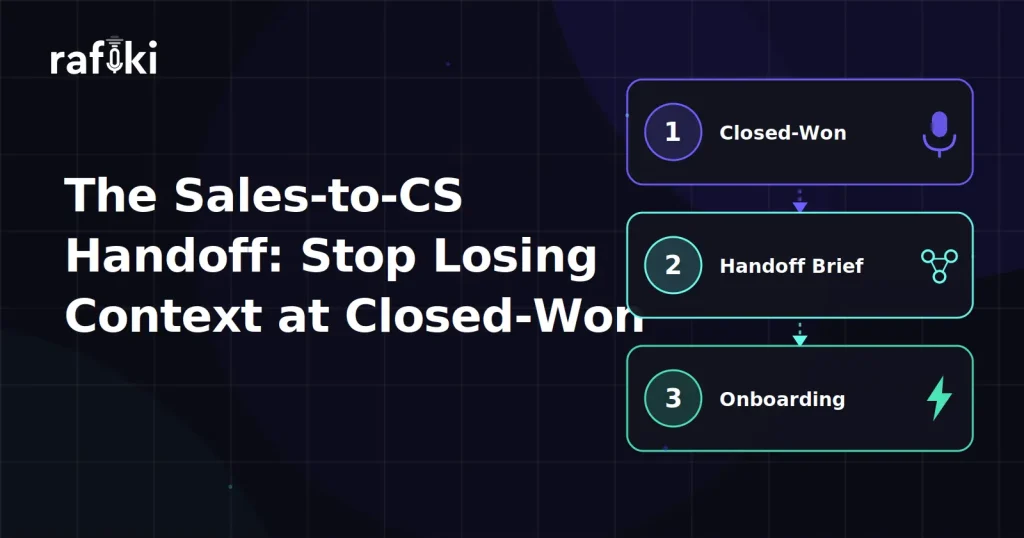
The Sales-to-CS Handoff: Stop Losing Context at Closed-Won
Jul 21, 2026
12 min read
Your buyer spent months briefing your sales team. They explained their goals, named the executive sponsor, admitted which internal process was broken, and negotiated exactly what success would look like. Then the deal closed, and the sales to CS handoff compressed all of that history into a two-line note in the CRM. At kickoff, the CSM smiled warmly and opened with, "So, tell me about your goals."
That moment costs more than a little embarrassment. The buyer realizes they are starting over with a stranger. Consequently, the trust your sales team spent two quarters building resets to zero. Meanwhile, the new customer success manager spends the first month of onboarding rediscovering facts your company already paid to learn.
Closed-won should feel like a baton pass. In practice, however, it is often a dropped baton — and the fix is not another template or another meeting. The fix is treating the handoff as an evidence problem, because the evidence already exists in your call history.
The sales to CS handoff is the moment ownership of a customer moves from sales to customer success. It is also the single point in the customer lifecycle where the most context disappears at once. Before closed-won, one person holds nearly everything the company knows about the buyer — their goals, their politics, their fears, their deadline. After closed-won, a different person needs all of it, and almost none of it transfers.
Think about what the buyer actually shared during the sales cycle. Across discovery calls, demos, and security reviews, they described the problem in their own words. They quantified what it costs them, and they revealed which stakeholders support or resist the project. In addition, they told sales exactly which outcomes would make the renewal automatic and which risks would kill it.
Very little of that survives the transition. What arrives in the CSM's queue is typically a closed-won notification and a contract value. Beyond that, there is only whatever the AE remembered to type into a handoff field on a Friday afternoon. As a result, the richest customer intelligence your company will ever collect gets abandoned at the exact moment it becomes most valuable.
Put yourself on the customer's side of the table. For months, you invested hours explaining your business to a vendor. Reasonably, you assumed the vendor was listening.
Then a new face appears after signature and asks you to repeat everything from the beginning. It feels less like a handoff and more like an erasure.
Buyer patience for this kind of amnesia keeps shrinking. Forrester's customer experience research has long argued that customers judge companies on the coherence of the entire journey, not on individual interactions. Similarly, Salesforce's State of Service research highlights the same expectation from the service side. Customers assume that sales, service, and success share context, and they resent repeating themselves.
A cold-start kickoff violates that expectation on day one of the relationship. More importantly, it burns onboarding time you cannot get back. Every week the CSM spends re-learning what sales already knew is a week added to time to value. Delayed value, in turn, is the quiet beginning of most churn stories.
Nobody designs a bad handoff on purpose. AEs genuinely want their customers to succeed, and CSMs genuinely want to arrive prepared. The process breaks anyway, because it depends on memory, timing, and effort at exactly the moment all three are scarce.
Consider the AE's position at closed-won. The deal is done, the commission is booked, and three other opportunities need attention before the quarter ends. Writing a thoughtful handoff document requires recalling six months of conversations from memory — and human memory is a lossy format. Consequently, even a diligent AE produces a summary that is thin, recency-biased, and missing the nuance that lived in the calls themselves.
Structured CRM fields do not solve this either. A dropdown for "use case" cannot carry a stakeholder's exact words about why they almost walked away. In contrast, the calls captured everything — verbatim, timestamped, and in the buyer's own voice. The problem was never missing context; it is context trapped in recordings nobody has time to re-watch.
The difference between the two approaches shows up in the very first onboarding conversation. One restarts the relationship from zero, while the other continues it mid-sentence.
| Dimension | Cold-Start Kickoff | Evidence-Based Handoff |
|---|---|---|
| Source of context | AE's memory and a CRM note | Full call history from the sales cycle |
| Kickoff opening question | "Tell me about your goals" | "Here's the success plan you described — did we get it right?" |
| Buyer experience | Repeats months of context | Feels remembered and understood |
| Success criteria | Reconstructed from scratch | Inherited in the buyer's own words |
| Stakeholder awareness | Signer's name only | Champions, skeptics, and executive sponsor mapped |
| Risk visibility | Surfaces later as surprises | Known objections tracked from day one |
| Time to value | Delayed by rediscovery | Protected by continuity |
Notice that the evidence-based column does not demand more heroism from anyone. Instead, it demands a different source of truth: the conversations that already happened.
A handoff brief is only as good as what it contains. Whatever your format, these five items are the non-negotiable inheritance. Every one of them already exists somewhere in the sales call history.
Somewhere in discovery, the buyer said a version of "this project works if..." That sentence is the most valuable artifact of the entire sales cycle. It defines the finish line for onboarding, the agenda for the first business review, and the standard the renewal will be judged against.
Consequently, CS should inherit it verbatim, not paraphrased. When the CSM opens kickoff by reading the buyer's own definition back to them, the relationship starts from alignment instead of archaeology.
Contracts name a signer, but deals are won by a cast. There is a champion who sold the project internally and an executive sponsor whose priority it serves. There is also an end-user team that will make or break adoption, and often a skeptic who lost the argument.
CS needs the whole map, because onboarding a champion and onboarding a skeptic are entirely different motions. Call history reveals this map naturally — who joined which calls, who asked hard questions, and whose concerns required a follow-up meeting.
Every objection raised during the sales cycle is a preview of a future escalation. If the buyer worried about migration complexity during the deal, that worry did not vanish at signature. Instead, it is waiting in onboarding.
Handing CS the list of objections, and the specific answers that overcame them, lets the team reinforce those answers proactively. On the other hand, a CSM who never learns about the objection will be blindsided. When it resurfaces, it arrives with an "I raised this before we even signed" attached.
Buyers remember promises with perfect clarity, especially the ones made late in negotiation. The integration the SE said would be straightforward is now a commitment the company owes. So is the report the AE offered to configure, and so is the training session mentioned on the pricing call.
CS must inherit the full promise ledger, because an unkept commitment the CSM never knew about reads as bad faith rather than bad process. Call transcripts make this ledger objective: the promise exists in the recording, in context, in exact words.
Deals close on deadlines — a fiscal-year initiative, a contract expiring with another vendor, a board commitment, a product launch. That pressure defines the customer's real onboarding clock, which rarely matches the vendor's standard playbook.
A CSM who knows the buyer must show results before an executive review in eight weeks will sequence onboarding differently. In contrast, one following a default plan will simply run the standard checklist. For that reason, the "why now" of the deal belongs in the brief right next to the "what."
Here is the shift that changes everything: stop asking people to write the handoff, and start generating it from the calls. This is precisely what modern conversation intelligence makes possible. Every discovery call, demo, and negotiation was recorded and transcribed. This means the raw material for a complete handoff brief already exists before anyone opens a document.
Rafiki AI turns that raw material into a usable brief. Its Smart Call Summary capability structures every conversation in the deal — key topics, stakeholder participation, commitments, and concerns. As a result, the full arc of the sales cycle becomes readable in minutes rather than hours.
In addition, autonomous AI agents work across the entire call history to surface what a CSM actually needs. That means who said what, what was promised, and what the buyer defined as success.
The AE's role changes from author to editor. Rather than reconstructing six months from memory, they review a generated brief and correct anything the calls missed. Then they add the human judgment only they possess. As a result, the handoff becomes faster for sales and dramatically richer for CS — the rare process change where both teams win.
Context that leaks at closed-won does not disappear quietly. Instead, it comes back months later wearing a disguise — usually labeled a "surprise" in the churn post-mortem. The executive sponsor who quietly departed was on the original stakeholder map nobody transferred. The unmet expectation that soured the renewal call was a promise made on a negotiation call nobody flagged.
We have written before about running a churn post-mortem from lost-customer calls, and the pattern repeats across accounts. Again and again, the warning signs were stated out loud early, then lost in the transition. In other words, many churn surprises are not new information. They are old information that changed owners without changing hands.
The same leak quietly attacks your leading indicators too. As we explored in our guide to time to value as the CS metric that predicts renewal, the clock on customer patience starts at signature, not at kickoff. Every week spent rediscovering context is a week of that clock spent producing nothing the customer can feel. Because of this, fixing the handoff is not an operational nicety — it is direct churn prevention, applied at the cheapest possible moment.
Ask most teams how handoffs work today and you will hear about heroics. Usually it is a long Slack thread, a rushed sync, or a doc written whenever someone had a quiet week. Heroic processes fail predictably, because they depend on the busiest people having spare time at the busiest moment. A workflow, in contrast, produces the same quality output whether the quarter ended calmly or in chaos.
An evidence-based handoff workflow looks like this. First, the moment a deal hits closed-won, a handoff brief is generated automatically from the full call history. It carries the success definition, stakeholder map, objections, promises, and timeline. Next, the AE reviews and annotates it in minutes instead of writing it in hours.
Then the CSM receives the brief, with linked call moments, before the internal handoff conversation ever happens. Finally, that conversation becomes what it should have been all along: a discussion of strategy, not a download of facts.
This is the standard that CS leaders should hold their tooling to. It is also why Rafiki AI treats the handoff as a core customer success software workflow, not a note-taking afterthought.
With Ask Rafiki Anything, a CSM can even interrogate the deal history directly. Ask "what did the buyer say about their Q4 deadline?" and the answer comes back grounded in the actual calls. Ready to see it against your own deals? Start your free trial today and generate a handoff brief from a real closed-won account.
A better handoff should show up in your metrics, not just in warmer kickoff calls. The most direct signal is time to value. When context transfers cleanly, first value lands sooner because onboarding starts at step three instead of step zero. Watch, too, for a drop in "repeat discovery" — customers should stop being asked questions they already answered during the sales cycle.
Onboarding milestone completion is the second lens. As covered in our breakdown of customer onboarding metrics and KPIs, early milestone slippage is one of the strongest predictors of downstream churn. An evidence-based handoff attacks slippage at its root. After all, most early delays trace back to relearning goals, chasing missing stakeholders, or discovering promises late.
Finally, listen for the qualitative tell. In a healthy motion, customers say things like "you clearly talked to the sales team" in the first onboarding call. That sentence means the baton pass worked — and it is the sound of a renewal getting easier eighteen months early.
Your buyers already told you everything you need to onboard them brilliantly. They defined success, mapped their politics, voiced their fears, and shared their deadlines — all on recorded calls, all before the contract was signed. The sales to CS handoff fails only when companies let that evidence die in the transition and force the relationship to restart from memory.
The fix is not more effort from AEs or more diligence from CSMs. It is a workflow where the handoff brief writes itself from call history and the AE edits instead of authors. From there, the CSM walks into kickoff knowing the account as well as sales did.
Do that, and closed-won stops being a context leak. It becomes what it was always supposed to be: the moment the promise made in sales starts getting kept.
A sales to CS handoff is the process of transferring ownership of a new customer from the sales team to the customer success team after a deal closes. A complete handoff transfers knowledge as well as ownership. Specifically, that means the customer's goals, success criteria, stakeholder map, objections raised during the sale, commitments made, and the timeline pressure behind the purchase. In many organizations, however, the handoff amounts to a CRM notification plus a short note, which forces the CSM to rediscover context the buyer already provided.
The strongest handoffs are evidence-based, built from the actual sales call history rather than from the account executive's memory. Consequently, the customer never has to repeat themselves, and onboarding starts with full context on day one.
At minimum, a handoff document should include five items. First, the customer's success definition in their own words — the outcomes that make the renewal automatic. Second, a stakeholder map covering the champion, executive sponsor, end users, and any internal skeptics. Third, the objections raised during the sales cycle and the answers that overcame them, since those concerns typically resurface during onboarding.
Fourth, a ledger of every promise made by the sales team, from integration help to training sessions. Fifth, the timeline pressure driving the purchase, such as a fiscal deadline or an expiring contract. In addition, linking each item to the specific call moment where it was said makes the document verifiable rather than anecdotal.
The formal handoff should happen immediately at closed-won, before the customer kickoff call — but preparation should start earlier. Many strong teams introduce the CSM late in the sales cycle, so the customer meets their future contact before signature. That way, the transition feels like an expansion of the team rather than a replacement.
Regardless of when the introduction happens, the context transfer itself should be complete before anyone from CS speaks with the customer. A kickoff scheduled before the CSM has absorbed the deal history produces the dreaded "tell me about your goals" opening. Automating the brief from call history removes the usual excuse for delay, because the context is ready the moment the deal closes.
AI removes the two weakest links in traditional handoffs: human memory and available time. Conversation intelligence platforms record and analyze every sales call. Because of this, the brief reflects what was actually said, not what the account executive recalls weeks later.
Autonomous AI agents extract the success criteria, stakeholder dynamics, objections, commitments, and deadlines across the full deal history. Structured summaries then let the CSM absorb months of conversations in minutes.
As a result, the AE shifts from writing the handoff to reviewing it. The CSM enters kickoff already fluent in the account, and the customer experiences continuity instead of repetition. The handoff becomes a consistent workflow instead of a best-effort favor between busy teams.
Rafiki AI's revenue intelligence platform starts at $19 per seat per month with no seat minimums and no annual commitment. Start your free trial today or book a demo to see how an evidence-based handoff protects every customer you close.
Start for free — no credit card, no seat minimums, no long contracts. Just better sales intelligence.