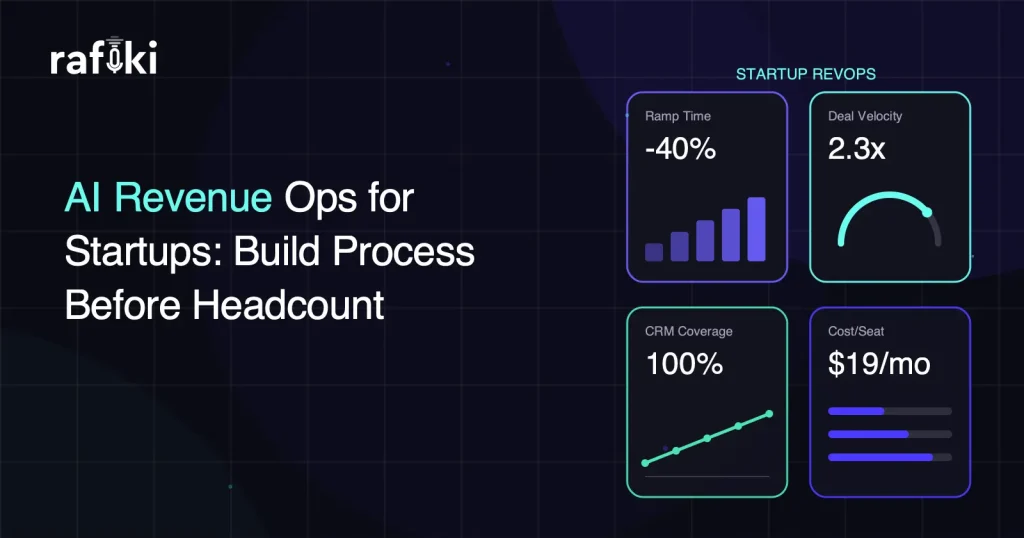
Your first five hires should not be reps — they should be repeatable processes that make every future rep productive from day one.
Most seed-to-Series-A founders get this backwards. They close a handful of deals on founder-led charm, interpret that traction as a signal to hire, and pour their runway into headcount before they understand what actually drives their wins. Six months later the pipeline is a mess, CRM data is unreliable, and nobody can explain why half the qualified opportunities went dark. The problem is not talent. The problem is that there was never a system capturing, scoring, and operationalizing the signals buried inside every buyer conversation.
In 2026, AI revenue ops startups have a fundamentally different option. Multi-model AI is no longer an enterprise luxury. It is accessible at startup price points, with no seat minimums and no bloated implementation cycles. The question is no longer whether early-stage teams can afford revenue intelligence — it is whether they can afford to scale without it. This article lays out the framework for building an AI-native revenue operations layer before you build headcount, so every dollar of ARR you chase is informed by data instead of guesswork.
Founder-led sales is the engine of every seed-stage company. Founders know the product cold, adapt the pitch on the fly, and close through sheer conviction. The danger is that none of that institutional knowledge gets codified. When the founder steps back and the first AE takes over, the playbook that "everyone knows" evaporates.
The result is a widening gap between reported pipeline and actual pipeline health. Founders tell their board one story; the conversation data tells another. B2B organizations that fail to align revenue processes before scaling sales teams consistently experience longer ramp times and higher attrition among early hires. The cost is not just lost deals — it is lost runway.
AI revenue ops refers to the practice of using autonomous AI agents — not manual dashboards or bolt-on analytics — to capture, structure, and act on every revenue-relevant signal across the buyer journey. For startups, this is not about replacing people. It is about building the operational backbone that makes people effective the moment they join.
Traditional platforms required a RevOps hire, a six-figure contract, and months of configuration before delivering value. In 2026, AI revenue ops startups can deploy the same capabilities in under an hour for a fraction of the cost. The barrier is no longer budget or headcount — it is awareness.
Hiring before you have process is like pouring water into a bucket with holes. Every rep you add inherits the same structural gaps. Here are the five operational layers every seed-to-Series-A company should have in place before the second sales hire.
If your calls are not being recorded, transcribed, and summarized automatically, you are losing your most valuable data asset. Conversation data is the single richest source of buyer intent, competitive intelligence, and deal risk. Manual note-taking captures a fraction of it and introduces bias.
Choosing a qualification framework — MEDDIC, BANT, SPICED, or otherwise — is table stakes. The breakthrough is having AI score every call against that framework automatically. This removes subjectivity from pipeline reviews and gives founders a leading indicator of deal health that does not depend on rep self-reporting.
Early-stage teams live and die by CRM accuracy, yet CRM hygiene is the first casualty of a lean team under quota pressure. The solution is not discipline — it is automation. Every contact, every next step, every deal-stage transition should flow from conversation data directly into your CRM.
The follow-up email after a discovery call is one of the highest-leverage touchpoints in B2B sales. It demonstrates listening, reinforces next steps, and keeps momentum alive. It is also the task most likely to slip when a rep is juggling fifteen open opportunities. AI-generated follow-ups — drafted from what was actually discussed, not a template — close this gap.
Individual call insights are valuable. Patterns across hundreds of calls are transformational. This is the layer where AI reveals which discovery questions correlate with closed-won outcomes, which competitor mentions appear in lost deals, and which objections stall deals at Stage 3. It turns your entire conversation history into a living playbook.
Not all AI is built the same. Many legacy tools added AI features on top of architectures designed around manual workflows. The difference matters enormously for startups.
For AI revenue ops startups, the distinction between bolt-on and AI-native is the difference between another dashboard to ignore and an autonomous revenue team that works around the clock. Organizations that embed AI into core workflows rather than layering it onto existing ones consistently capture more value from their AI investments.
This is exactly the problem Rafiki was built to solve. As an AI-native revenue intelligence platform, Rafiki deploys six autonomous AI agents that collectively handle the five layers described above — without requiring a RevOps hire, a six-month implementation, or enterprise-level budgets.
Rafiki integrates with Zoom, Microsoft Teams, and Google Meet, sets up in under fifteen minutes, and starts at $19/seat/month with no seat minimums and no annual contracts. This is enterprise-grade revenue intelligence priced for seed-stage budgets. It is not a call recorder with AI sprinkled on top — it is a complete revenue intelligence platform designed for teams that need process before they can afford headcount.
You do not need a quarter-long rollout. Here is a phased approach that gets your revenue operations layer running before your next board meeting.
By the end of two weeks, your revenue operations layer is live. Every future hire inherits a system that captures their conversations, scores their deals, updates the CRM, and feeds them data-backed coaching — from their first day.
Investors at the Series A stage are not just evaluating revenue — they are evaluating the machine that produces revenue. A startup with $1M ARR and a repeatable, data-driven sales process is worth more than a startup with $1.5M ARR built entirely on founder heroics.
The startups that build AI revenue ops infrastructure at the seed stage arrive at their Series A pitch with something most peers cannot match: a clear, data-backed narrative about why they win, how they will scale, and what each incremental hire is worth in pipeline capacity.
None of this argues against hiring. It argues against hiring prematurely. The right sequence matters.
Each hiring decision, informed by conversation data rather than intuition, carries lower risk and higher expected ROI. The AI layer does not replace the team — it tells you precisely when and where to grow it. Rafiki surfaces the signals that make these decisions defensible, turning qualitative hunches into quantitative hiring triggers.
We are past the early-adopter phase. In 2026, the expectation from investors, board members, and experienced sales hires is that conversation data is captured and operationalized. Startups that rely on spreadsheets, manual CRM entry, and anecdotal pipeline reviews are not "scrappy" — they are leaving winnable deals on the table and burning cash in the process.
The gap between startups that adopt AI revenue ops early and those that wait is no longer a matter of efficiency — it is a matter of survival. The teams with process beat the teams with more people, because process scales and heroics do not.
The playbook for seed-to-Series-A revenue growth has permanently changed. The old model — hire fast, figure out process later — produces bloated teams, unreliable pipelines, and wasted runway. The new model starts with an AI-native revenue intelligence layer that captures every signal, scores every deal, and automates every administrative task. Headcount follows process, not the other way around.
The startups that internalize this framework in 2026 will arrive at their Series A with something far more valuable than top-line revenue: a scalable, defensible, and intelligent revenue machine.
Rafiki gives seed-to-Series-A teams the full AI-native revenue intelligence stack — six autonomous agents, 60+ language support, enterprise-grade insights, and integrations with every major CRM and conferencing platform — starting at $19/seat/month with no seat minimums and no annual commitment. Setup takes fifteen minutes. Start free or book a demo and build the revenue process your next ten hires will thank you for.
Start for free — no credit card, no seat minimums, no long contracts. Just better sales intelligence.