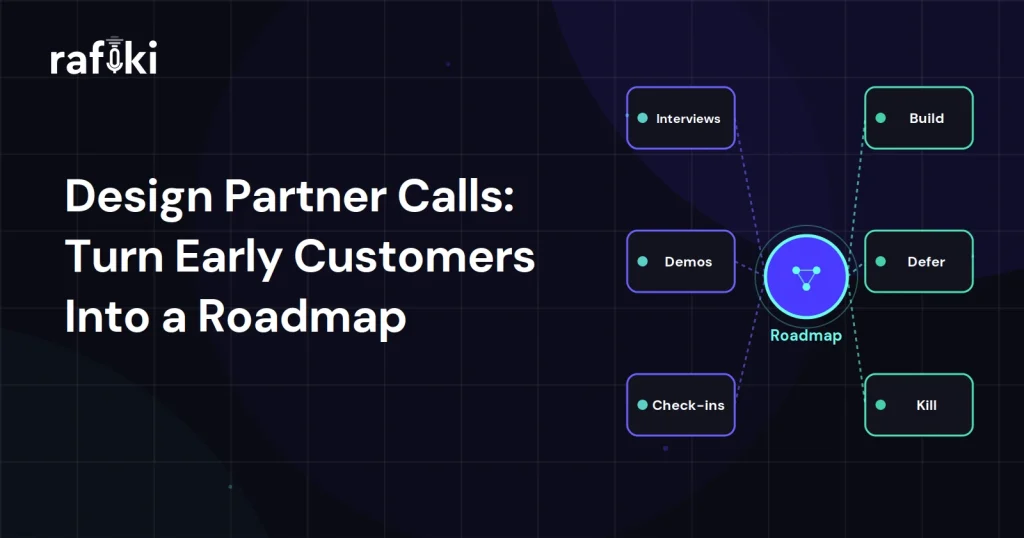
The founder has done thirty-one design partner calls since June. She can tell you, roughly, that "everyone wants the integration," that two people hated the onboarding, and that the big prospect from the Zoom in July said something important about procurement that she meant to write down. The roadmap for Q4 was decided on Tuesday, in a meeting where those thirty-one conversations were represented by her memory, a Notion page with nine bullet points, and the loudest opinion in the room. Every one of those calls was recorded. None of them were used.
This is the design partner paradox. An early-stage company runs a remarkable number of customer conversations for its size and extracts surprisingly little from each one, because the learning lives in the heads of two or three people who are also building the product, closing the deals, and raising the round. The design partner program is supposed to be the company's sensing organ. In practice, it becomes a stream of anecdotes that everyone half-remembers differently.
This article is about running the design partner program as an evidence system rather than a series of impressions. It covers what a design partner is and is not, why the calls produce so little durable learning, how to structure each call so it yields evidence instead of validation, the weekly synthesis that turns conversations into roadmap decisions, and the moment when a design partner should become a paying customer.
A design partner is an early customer who agrees to use an unfinished product and give structured feedback in exchange for influence over what gets built, early access, and usually favorable terms. The relationship is explicitly two-sided: the partner gets a product shaped around their problem, and the company gets proximity to a real user with a real workflow before it commits engineering time.
A design partner is not a beta user, who tries the product and reports bugs, and it is not a friendly advisor, who offers opinions without a workflow at stake. The defining features are that the partner has the problem the product solves, will actually use the product in their work, and has agreed to a recurring conversation about it. Those three conditions are what make the calls valuable, and dropping any one of them turns the program into theater.
For founders and early sales hires, the design partner call is the highest-leverage conversation in the company. It is where product-market fit is discovered or disproven, where the pitch gets sharpened against a real objection, and where the first reference customers are made. That is exactly why treating it casually is so expensive.
Why does a company with thirty recorded customer conversations still decide its roadmap by argument? The reasons are structural to early-stage life, and understanding them explains why "take better notes" is not the answer.
The pattern is familiar from larger companies too. Harvard Business Review's work on using gen AI to discover what clients need explores how generative AI helps sales teams surface what clients have already said about their needs. The design partner program is the startup version of that opportunity, and closing the gap is the difference between building the right thing and building the thing the last caller mentioned.
The obvious cost is wasted engineering: a quarter spent on the integration everyone "wanted" that nobody adopts, because the request was a proxy for a problem the integration did not solve. At an early-stage company, one wasted quarter is a meaningful share of the runway.
The subtler cost is to the fundraising and sales narrative. Investors and later customers ask the same question in different words: what have you learned from your early customers? A founder who can answer with patterns across thirty conversations, with the customers' own words attached, is telling a story about evidence. A founder who answers with three anecdotes is telling a story about hope. We explored how call data becomes diligence material in our piece on Series A diligence; the design partner program is where that data room begins.
Forrester's B2B marketing research returns often to how much buyers expect vendors to understand their situation. A design partner program run on evidence is how a small company earns that understanding early, before it has the scale to buy it.
A design partner call structured for evidence has a different shape from a friendly check-in. It is still warm, but it is designed so that the partner's actual behavior and actual problems come out, and so that the conversation can be compared to the other twenty-nine afterward. Five moves make the difference.
Open by asking the partner to walk through the last time they used the product, step by step. Behavior is evidence; opinion is noise. A partner who says the product is great but has not opened it in two weeks has told you the truth in the second half of that sentence.
When a partner asks for a feature, the next question is always "what were you trying to do when you wished you had that?" The answer is the problem, and problems are what get prioritized. Requests get logged as one possible solution among several.
Ask what the partner would pay for what exists today, and what would have to be true for that number to double. Partners on free or discounted terms will still answer, and the answer separates the delighted from the polite. This is a pricing conversation in miniature, and it deserves the same attention we gave the topic in our guide to pricing conversations.
Ask what the partner would do if the product disappeared tomorrow. The answer names your real competition, which is usually a spreadsheet, an intern, or doing nothing, and it tells you what the product has to beat.
Close by agreeing on one thing the partner will do before the next call, such as trying a workflow or introducing a colleague. Partners who never commit to anything are advisors, not design partners, and the program needs to know which is which.
The synthesis is the step that turns calls into a roadmap, and it is the step that early-stage teams skip because nobody has time. The fix is to make it small, weekly, and evidence-driven rather than a quarterly heroic effort. A workable ritual takes under an hour if the conversation record is searchable.
Done weekly, the synthesis also solves the recency problem. The roadmap reflects thirty conversations because thirty conversations were actually consulted, and the loudest voice in the room has to argue against a cluster of customer quotes rather than against a memory.
Rafiki AI is built to give a small team the evidence discipline that usually requires a research function, because it captures and analyzes every design partner conversation automatically. Calls across video and phone are recorded, transcribed in more than sixty languages, and structured into topics, blockers, sentiment, and participants, so the synthesis starts from data rather than from memory.
The weekly synthesis maps directly onto the platform. Gen AI Search pulls every moment where partners described a problem, a workaround, or what they would pay, across all thirty conversations, with the partner quoted and the timestamp cited. A founder can ask which partners mentioned alerting problems this month and get the answer in seconds rather than an afternoon of relistening. Gen AI Reports turns the recurring questions into a standing weekly view of problem clusters, partner engagement, and open commitments.
Because the design partner program feeds the sales motion, the same conversation intelligence foundation carries forward. Smart Call Summary records each partner call's problems, requests, and commitments without the founder taking notes, and Smart Follow Up drafts the recap that keeps partners engaged. When a partner converts, Smart CRM Sync writes the conversation-derived fields into the CRM, so the first paying customer arrives with their history attached. Rafiki AI's autonomous AI agents do the capturing and the extraction; the founder keeps the judgment about what to build.
| Dimension | Anecdote-driven program | Evidence-driven program |
|---|---|---|
| Call structure | Friendly check-in | Behavior, problems, willingness to pay, alternatives, commitment |
| What gets recorded | Feature requests | Problems in the partner's words, with citations |
| Synthesis | Quarterly, from memory | Weekly, from the conversation record |
| Roadmap input | Last three calls | Clusters across all partners |
| Prioritization signal | Who asked loudest | Who acts on it and what they would pay |
| Partner experience | Feedback into a void | Hears what was decided and why |
| Diligence value | Anecdotes | Patterns with customer quotes |
The program has a natural end for each partner: the point at which they should pay full price or leave. Most founders delay that moment because the relationship is comfortable and the feedback is useful. The evidence tells you when it has arrived.
Converting at that moment, on the terms the evidence supports, is how the design partner program pays for itself. A partner who never converts was an advisor all along, and the program should say so kindly and move on.
Design partner calls are the richest source of truth an early-stage company will ever have, and most of that truth evaporates the moment the call ends. Structure each conversation for behavior, problems, willingness to pay, and alternatives; synthesize weekly from the record rather than quarterly from memory; decide build, defer, or kill with the evidence attached; and tell partners what you heard. Rafiki AI makes that discipline possible for a team of three, with autonomous AI agents that capture every call, extract every problem statement, and answer the founder's questions across all thirty conversations at once. Your roadmap should be built from what your partners said. Go find out what that was.
A design partner is an early customer who agrees to use an unfinished product in their real workflow and to give structured, recurring feedback in exchange for influence over the roadmap, early access, and often favorable terms. The relationship differs from a beta user, who reports bugs without shaping direction, and from an advisor, who offers opinions without a workflow at stake. Three conditions make a design partner valuable: they have the problem the product solves, they actually use the product in their work, and they have committed to an ongoing conversation about it. Without all three, the program produces encouragement rather than evidence.
Enough that a problem stated by several of them becomes a pattern rather than an anecdote, and few enough that the founding team can hold a substantive recurring conversation with each. The right number depends on the team's capacity to synthesize, not just to talk. A small group of partners whose calls are recorded, searched, and clustered weekly will teach a company more than a large group whose feedback lives in scattered notes. Diversity matters as much as count: partners from different segments reveal which problems are universal and which belong to one type of customer.
Structure it for evidence rather than validation. Open by asking the partner to walk through the last time they used the product, because behavior is more honest than opinion. For every feature request, ask what they were trying to do when they wished they had it, so the problem gets recorded rather than one proposed solution. Ask directly what they would pay for what exists today and what would double that number. Ask what they would do if the product disappeared, to learn the real alternative. Close by agreeing on one specific thing the partner will do before the next call. Record the conversation so the synthesis works from what was said, not what was remembered.
When the evidence says they have already become a customer: usage is routine and embedded in their team's workflow, the willingness-to-pay figure they give has stabilized near your intended price, their feedback has shifted from whether the product works to how it could be polished, and they are introducing colleagues or peers. At that point, delaying the conversion costs revenue and blurs the program's purpose. Convert on the terms the evidence supports. A partner who never reaches that point was an advisor rather than a design partner, and the program should acknowledge that and reallocate the attention.
Rafiki AI's conversation intelligence platform starts at $19 per seat per month with no minimums and no annual commitment. Start your free trial today or book a demo to turn your design partner calls into the roadmap they were meant to be.
Start for free — no credit card, no seat minimums, no long contracts. Just better sales intelligence.