Your product-led funnel is generating qualified signals every hour, and your sales team is destroying half of them with poorly timed outreach.
The promise of product-led growth is elegant: let users experience value before a human ever intervenes. Free trials, freemium tiers, and self-serve onboarding create a pipeline of users who raise their hands through behavior, not form fills. These are product-qualified leads — PQLs — and they represent some of the highest-intent prospects your company will ever see. As McKinsey's research on the new B2B growth equation consistently underscores, buyers now expect the same fluid, low-friction experience across self-serve and sales-assisted motions. But between the moment a user hits a qualification threshold and the moment a rep reaches out, something breaks. The PQL handoff is where product-led growth meets sales-assisted growth, and for most teams in 2026, it is a mess.
The consequences are not abstract. A user who just invited three teammates to your platform does not want a cold discovery call asking about their "biggest challenges." A trial user who activated a premium feature does not want a pricing email twelve minutes later. The PQL handoff fails not because the signal was wrong but because the response was tone-deaf, mistimed, or routed to the wrong person entirely. And every botched handoff teaches your best prospects that your product experience and your sales experience belong to two different companies.
A PQL handoff is the process of routing a product-qualified lead — a user whose in-product behavior indicates readiness for a sales conversation — from the product or growth team to a sales rep. In theory, it is a warm, context-rich transition. In practice, it is a black hole.
The root cause is structural. Product teams instrument behavioral signals — feature adoption, usage frequency, team invitations, API calls, integrations activated — but these signals live in product analytics tools. Sales teams live in CRMs. The translation layer between those two systems is usually a webhook, a Zapier automation, or a Slack notification that tells a rep almost nothing about what the user actually did. Here is what breaks down:
The result is a system that generates leads but does not generate outcomes. Marketing and product celebrate PQL volume. Sales complains about lead quality. The user, who was genuinely interested, quietly churns because the experience felt disjointed.
A failed PQL handoff does not just lose a deal. It damages the entire product-led flywheel. Users who self-selected into your product — who found it, tried it, and saw value — are your most efficient acquisition channel. When a clumsy sales touch pushes them away, you are not just losing revenue. You are increasing your effective CAC by burning the cheapest leads in your funnel.
The downstream effects compound quickly:
The irony is thick. Companies invest heavily in product-led growth specifically to reduce friction. Then they introduce maximum friction at the exact moment the user signals buying intent. This is not a lead generation problem. It is an orchestration problem.
A high-fidelity PQL handoff preserves the behavioral context that qualified the lead, matches the user to the right sales motion, and maintains the experience continuity the user expects. It has five components, and all five have to work in concert.
The raw PQL trigger — "user activated Feature X" — is necessary but insufficient. Before a lead hits a rep's queue, the handoff system should enrich it with the full behavioral narrative: what the user tried, in what sequence, how long they spent, what they skipped, who else from the account is active, and what tier or segment the account maps to. The rep should receive a story, not a data point.
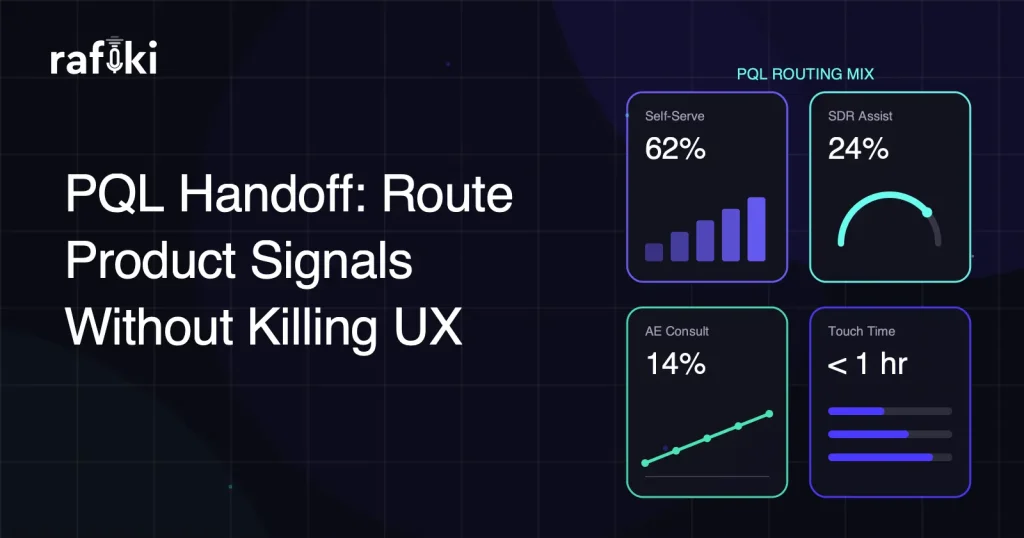
Not every PQL needs the same sales motion. A single user on a free plan who hits a usage ceiling needs a low-touch, self-serve upgrade nudge — possibly no human at all. A team lead who just invited eight colleagues and activated an integration needs a consultative AE who understands multi-seat expansion. Routing logic should match the PQL signal to the appropriate motion:
Round-robin assignment ignores all of this. It treats every PQL as interchangeable, which guarantees that high-value accounts get under-served and low-value accounts get over-touched.
The handoff window matters enormously. Reach out too fast and you feel like surveillance. Wait too long and the intent decays. The right timing depends on the signal type:
Timing calibration requires understanding where the user is in their activation journey, not just that they crossed a threshold.
The single biggest failure mode in PQL handoffs is the context gap. Product data tells you what a user did. It does not tell you why. And when a rep reaches out without understanding why, the conversation feels generic, intrusive, or both.
Bridging this gap requires merging behavioral data with conversational intelligence. If the user has had any interaction with your team — an onboarding call, a support chat, a webinar Q&A — the content of those interactions contains intent signals that product telemetry alone cannot capture. A user who asked about SAML configuration during onboarding is signaling enterprise procurement. A user who asked about API rate limits is signaling a technical integration play. A user who mentioned their "team is evaluating three options" is signaling competitive urgency.
This is where most PQL handoff systems fall apart. They route the lead but not the context. And a context-free handoff is just a cold call with extra steps.
A PQL scoring model is only as good as its feedback loop. If product teams define PQL thresholds in isolation and never learn which signals actually converted to revenue, the model drifts. Signals that correlate with curiosity get weighted the same as signals that correlate with purchase intent.
Closing the loop requires sales to report back — not just whether the deal closed, but what happened in the conversation. Did the user's stated need match the behavioral signal? Was the timing right? Did the rep have enough context? This qualitative feedback is gold, but it almost never flows back to the product team because it lives in call recordings no one reviews, in CRM notes no one reads, and in rep memories no one captures.
Without this loop, your PQL model is a static guess that degrades over time. With it, every sales conversation makes the next PQL handoff smarter.
This is the exact problem Rafiki AI was built to solve — not just recording what happens in sales conversations, but extracting the intelligence that makes every downstream motion smarter. As an AI-native revenue intelligence platform, Rafiki AI bridges the gap between product signals and sales execution by ensuring that every conversation, from onboarding calls to support interactions to sales demos, becomes structured, searchable, actionable data.
Here is how Rafiki AI's six autonomous AI agents map to the PQL handoff workflow:
Critically, Rafiki AI supports transcription and analysis in 60+ languages, which means global product-led companies can run the same PQL handoff playbook across every market without sacrificing conversational context. And because Rafiki AI starts at $19/seat/month with no seat minimums, growing teams can deploy it without enterprise procurement cycles — the same agility their product-led model demands.
You do not need to rebuild your entire go-to-market stack to improve PQL handoffs. A phased approach lets you capture quick wins while building toward a fully closed-loop system.
Each phase builds on the previous one. Teams that jump straight to automation without auditing their signals or mapping their motions end up automating a broken process faster — which is worse than not automating at all.
You cannot improve what you do not measure, and most teams measure PQL handoff performance with a single metric: conversion rate. That is like measuring engine health with only a speedometer. You need a dashboard that covers the full handoff lifecycle.
RevOps leaders who build this measurement framework — and you can learn more about this approach in our piece on RevOps leadership — gain the visibility to continuously tune the PQL handoff instead of letting it calcify.
In 2026, product-led growth is not a differentiator. Nearly every SaaS company offers a free trial or freemium tier. The differentiator is what happens when a user signals they are ready for more. The PQL handoff is the seam between self-serve and sales-assisted growth, and the companies that make that seam invisible will capture disproportionate share.
This is not just a revenue optimization play. It is a user experience play. B2B buyers increasingly expect consumer-grade experiences, and nothing violates that expectation faster than a sales rep who ignores everything the product already knows about you. The companies that win are the ones where the sales conversation feels like a natural extension of the product experience — contextual, relevant, and additive.
Legacy tools that bolt on basic lead routing and call recording cannot deliver this. It requires an AI-native architecture that was built from day one to extract, structure, and activate intelligence from every conversation across the revenue lifecycle. That is the difference between routing a lead and routing a complete context.
The PQL handoff is not a workflow to configure once and forget. It is a living system that sits at the intersection of product, marketing, sales, and customer success. When it works, your highest-intent users get a sales experience that feels personalized, timely, and informed by everything they have already shown and told you. When it breaks, you burn your cheapest, warmest leads and blame the scoring model.
The fix is not more signals. It is more context. It is ensuring that every behavioral trigger arrives in the rep's hands wrapped in the conversational intelligence that transforms a data point into a relationship. It is matching the right signal to the right motion, the right timing, and the right human. And it is closing the loop so that every sales conversation makes the next PQL handoff smarter.
Your product already earned the user's attention. The PQL handoff determines whether your sales team deserves to keep it.
Rafiki AI gives growing sales teams the conversational intelligence layer that makes PQL handoffs context-rich, well-timed, and continuously improving — with six autonomous AI agents working around the clock, support for 60+ languages, and enterprise-grade insights starting at $19/seat/month with no seat minimums. Start free or book a demo to see how Rafiki AI turns every product signal into a sales conversation your users actually want to have.
Start for free — no credit card, no seat minimums, no long contracts. Just better sales intelligence.