Your AI agent just logged a deal as "Closed Won" that the buyer never agreed to — and nobody caught it until the QBR.
This is not a hypothetical scenario. As sales teams rush to deploy autonomous AI agents that update CRM records, write follow-ups, and score deals, a quiet crisis is building in their pipelines. AI hallucinations — confident, plausible-sounding outputs that are factually wrong — are silently corrupting the data your revenue team relies on to forecast, coach, and close. A misattributed competitor mention. A fabricated next step. A budget figure that was never spoken aloud. Each bad field update compounds, eroding trust in your CRM, your forecasts, and ultimately your AI investment itself. Without robust AI hallucination guardrails, the very automation that promises to save your reps hours a week becomes a liability that costs you deals.
The stakes are higher than most revenue leaders realize. When a human rep forgets to update a field, that gap is visible — an empty cell everyone knows to distrust. When an AI agent fills that same cell with a wrong answer, it looks authoritative. Managers build coaching plans around it. RevOps builds forecasts on it. Executives commit numbers to the board based on it. The damage compounds silently until reality breaks through, usually at the worst possible moment.
Why AI Hallucinations in CRM Are a Unique Threat to Revenue Teams
AI hallucination refers to an AI model generating output that is fluent, grammatically correct, and contextually plausible — but factually inaccurate or entirely fabricated. In consumer applications, a hallucinated restaurant recommendation is an inconvenience. In a sales CRM, a hallucinated MEDDIC field or deal stage update is a revenue risk. The difference is that CRM data feeds downstream decisions with real financial consequences: pipeline commit calls, territory planning, compensation calculations, and board-level forecasts.
Several factors make the CRM context especially dangerous for hallucinations:
- High trust surface — sales teams already struggle to get reps to fill in CRM fields manually. When AI does it automatically, there is an implicit assumption that the data is correct, and human review drops dramatically.
- Cascading errors — a single wrong field (e.g., decision maker role, budget range, or close date) propagates into scoring models, forecasts, and automated workflows that trigger emails, alerts, and pipeline actions.
- Ambiguous source material — sales conversations are messy. Prospects hedge, contradict themselves, and use shorthand. Models that excel at summarizing clean text struggle with the nuance of a rambling discovery call.
- Low feedback loops — unlike a chatbot where a user immediately flags a bad answer, a wrong CRM update may go unnoticed for weeks until a deal review or lost-deal analysis surfaces it.
- Methodology-specific fields — populating MEDDIC, BANT, or SPICED fields requires not just extraction but interpretation. Confusing an "Economic Buyer" with a "Champion" is a hallucination that changes your entire deal strategy.
The bottom line: hallucinations in CRM do not just degrade data quality — they actively mislead the humans who depend on that data to make high-stakes decisions.
The Root Causes: Where and Why Sales AI Hallucinates
Preventing hallucinations starts with understanding where they originate. Not all errors are created equal, and the guardrails you need depend on the failure mode you are defending against.
- Transcription drift — if the upstream transcription is wrong (misheard name, garbled number, incorrect speaker attribution), every downstream extraction inherits that error. This is especially common in multilingual calls or poor audio environments.
- Over-inference — the model extrapolates beyond what was explicitly stated. A prospect says "we're evaluating options" and the AI logs a specific competitor name it inferred from context but that was never mentioned.
- Temporal confusion — the model conflates information from different parts of the conversation, or from different calls entirely, assigning a budget figure from Call 1 to a timeline discussed in Call 3.
- Schema forcing — when an AI agent is tasked with populating a required CRM field, it may fabricate a plausible value rather than leaving the field empty. This "completion bias" is one of the most dangerous failure modes because it produces outputs that look normal.
- Prompt brittleness — small changes in how a question is framed to the model (or how a prospect phrases something) lead to wildly different extractions. Without robust prompt engineering and validation, results are inconsistent across calls.
A Harvard Business Review analysis of generative AI risks underscores that organizations adopting AI without structured validation processes consistently underestimate the compounding cost of confident-but-wrong outputs. In a sales context, that cost is measured in blown forecasts, wasted coaching cycles, and deals that fall apart because the team was operating on fiction.
The Anatomy of Effective AI Hallucination Guardrails
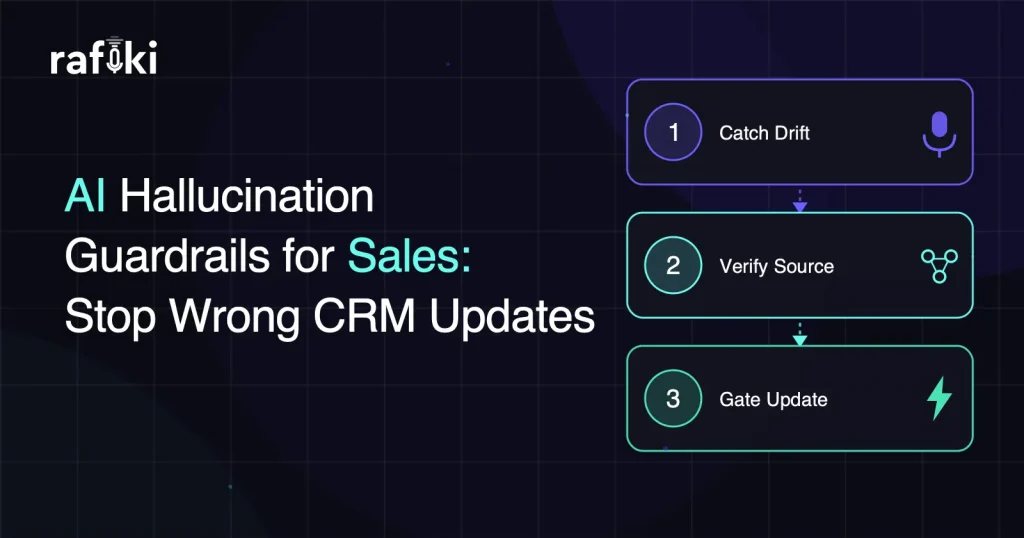
AI hallucination guardrails are the combination of architectural design choices, validation layers, and human-in-the-loop checkpoints that prevent wrong or fabricated data from reaching your CRM and downstream systems. Effective guardrails are not a single feature — they are a multi-layered defense system.
Layer 1: Source Grounding
The most fundamental guardrail is ensuring every AI output is grounded in a verifiable source — the actual transcript segment, the specific call timestamp, the exact words spoken. If the model cannot point to a source, the output should be flagged or suppressed.
- Every extracted field should link back to the transcript excerpt that supports it.
- Confidence scores should accompany each extraction so downstream systems can apply thresholds.
- Fields below a confidence threshold should be surfaced for human review rather than auto-populated.
Layer 2: Cross-Validation
A single model pass is inherently risky. Cross-validation means checking the extraction against multiple signals: the summary against the transcript, the CRM update against the summary, and ideally one model's output against another's.
- Multi-model architectures that compare outputs from different AI models catch errors that any single model would miss.
- Temporal validation ensures that data attributed to a specific call actually appeared in that call, not a previous one.
- Schema validation confirms that extracted values match expected formats and ranges (e.g., a deal amount should be numeric, a close date should be in the future).
Layer 3: Human-in-the-Loop Escalation
No guardrail system is perfect. The final layer is a well-designed escalation path that routes uncertain outputs to human reviewers without creating bottlenecks that negate the automation benefit.
- Flag-and-confirm workflows that let reps approve AI-suggested updates with one click rather than re-entering data.
- Exception dashboards for RevOps that surface all low-confidence or conflicting updates in one view.
- Audit trails that log what the AI suggested, what was approved, and what was overridden — building a feedback dataset for continuous improvement.
The goal is not to eliminate AI from the CRM update workflow. The goal is to build a system where the AI does the heavy lifting, humans handle the edge cases, and every update has a traceable chain of evidence.
Building a Guardrail Framework: Five Non-Negotiable Principles
If you are evaluating or building AI hallucination guardrails for your sales tech stack, these five principles separate robust implementations from checkbox features.
- Principle 1: Never auto-populate without a source citation. Every CRM field update should be traceable to a specific moment in a conversation. If the AI cannot cite its source, it should not write the data.
- Principle 2: Prefer absence over fabrication. An empty CRM field is less dangerous than a wrong one. Your guardrail system must be designed to leave fields blank when confidence is low, rather than inventing plausible-sounding data.
- Principle 3: Separate extraction from interpretation. Extracting "the prospect mentioned $500K" is a different task from interpreting "this deal's budget is $500K." Extraction should be high-confidence and literal. Interpretation should carry explicit uncertainty markers.
- Principle 4: Build for continuous calibration. Every human correction to an AI suggestion is a training signal. Your system should learn from overrides, not just log them.
- Principle 5: Make guardrails visible, not invisible. Users should know when an AI agent flagged low confidence, when a field was auto-populated versus human-confirmed, and when cross-validation disagreed. Transparency builds trust.
These principles apply whether you are working with a purpose-built revenue intelligence platform or stitching together general-purpose AI tools. But the effort required to implement them varies dramatically depending on your architecture — which brings us to the distinction between AI-native and AI-bolted systems.
AI-Native vs. AI-Bolted: Why Architecture Determines Guardrail Quality
Not all AI integrations are created equal when it comes to hallucination prevention. The architecture of your revenue intelligence platform dictates how effectively it can implement AI hallucination guardrails at every layer.
- AI-native platforms are built from day one with multi-model AI at the core. Every component — transcription, summarization, extraction, scoring, CRM sync — is designed to share context, cross-validate, and flag uncertainty. Guardrails are structural, not afterthoughts.
- AI-bolted platforms are legacy tools that added AI features on top of existing architectures. The AI layer often operates as a black box that passes data to the CRM without the deep integration needed for source grounding, cross-validation, or confidence scoring.
- DIY integrations using general-purpose LLM APIs give you maximum flexibility but zero built-in guardrails. You are responsible for prompt engineering, validation logic, error handling, and every edge case — a massive engineering lift that most sales teams underestimate.
A McKinsey analysis of generative AI in enterprise workflows highlights that organizations achieving measurable ROI from AI are those that embed validation and governance into their AI workflows from the start — not those that add guardrails reactively after errors surface. In a sales context, this means choosing platforms where guardrails are part of the product architecture, not a roadmap item.
This is exactly where Rafiki AI's approach differs fundamentally from legacy solutions. As an AI-native revenue intelligence platform built on multi-model architecture, guardrail capabilities are embedded in every agent, not bolted on as an afterthought.
How Rafiki AI Prevents Wrong CRM Updates With Built-In Guardrails
Rafiki AI operates six autonomous AI agents that work across the entire post-call workflow — from transcription to CRM update. Each agent is purpose-built with hallucination prevention as a core design constraint, not an optional setting.
- Smart CRM Sync auto-populates methodology-specific fields (MEDDIC, BANT, SPIN, SPICED, GAP, Challenger, Sandler) and custom CRM fields from call content. Every populated field links back to the transcript excerpt that supports it. When confidence is below threshold, the field is flagged for rep confirmation rather than silently written — embodying the "prefer absence over fabrication" principle.
- Smart Call Scoring scores every call against any methodology or custom scoring criteria, cross-referencing what was said against what a complete discovery or close call should include. This creates an independent validation layer: if the CRM fields say the deal is strong but the call score says key topics were never covered, the discrepancy is surfaced.
- Smart Call Summary generates structured summaries with source-grounded sections. Each summary element maps to specific conversation segments, making it trivial for a manager or rep to verify any claim.
- Smart Follow Up automatically drafts contextual follow-up emails grounded in what was actually discussed on the call, ensuring next steps and action items reflect the real conversation rather than AI-generated assumptions.
- Ask Rafiki Anything (Gen AI Search) lets reps and managers query across all calls to validate specific data points. "Did the prospect at Acme actually confirm a $200K budget?" returns the exact transcript moment, eliminating reliance on a single automated extraction.
- Gen AI Reports aggregate data across calls and deals, applying cross-validation at scale. When a pattern of low-confidence updates appears for a specific rep, deal, or account, Rafiki surfaces it — catching systemic hallucination patterns that individual field checks miss.
Critically, Rafiki AI achieves this across 60+ languages, which matters because hallucination rates increase significantly in non-English transcription and extraction. The multi-model architecture handles language-specific nuances that single-model systems routinely botch.
All of this is available starting at $19 per seat per month with no seat minimums and no annual contracts — making enterprise-grade guardrails accessible to growing sales teams that cannot afford the six-figure contracts that legacy platforms demand.
Practical Implementation: Rolling Out AI Hallucination Guardrails in Your Sales Org
Deploying guardrails is not a one-time configuration. It is a phased process that balances automation speed with data integrity. Here is a practical rollout sequence:
- Audit your current AI-to-CRM pipeline. Identify every field that AI agents currently auto-populate. For each, determine whether the update is grounded in a verifiable source or is inferred. Flag high-risk fields: deal amount, close date, decision maker, deal stage, and methodology-specific fields like Economic Buyer or Compelling Event.
- Establish confidence thresholds. Work with your RevOps team to define which fields can be auto-populated at high confidence and which require human confirmation. Not every field carries equal risk. A meeting date extraction is low risk. A budget figure is high risk.
- Activate human-in-the-loop for high-risk fields. Configure your platform to route uncertain updates to reps as one-click confirmations rather than auto-writing to CRM. This adds seconds, not minutes, to the workflow while dramatically reducing error rates.
- Build a feedback loop. Track every override where a rep corrects an AI suggestion. Aggregate these corrections weekly to identify patterns: specific call types, languages, or field types where hallucinations cluster. Use this data to refine prompts, adjust thresholds, or flag systemic issues.
- Run parallel validation for the first 30 days. During initial rollout, have the AI populate a shadow set of fields alongside manual rep entries. Compare the two. This gives you a concrete accuracy baseline and builds team trust before full automation.
- Review guardrail metrics in every QBR. Add AI accuracy and override rates to your quarterly business review. Treat data integrity as a revenue metric, not an IT metric. When leadership visibly cares about CRM data quality, teams follow.
The teams that execute this rollout systematically end up with a CRM that is both more complete (because AI handles the volume) and more accurate (because guardrails catch the errors) than any purely manual or purely automated approach.
Common Guardrail Failures: What to Watch For
Even with a solid framework, certain failure patterns recur. Knowing what to watch for helps you catch problems before they compound.
- Over-reliance on confidence scores alone. A high confidence score from a single model does not guarantee accuracy. Cross-validation across models and data sources is essential. One model being very sure about a wrong answer is not better than two models disagreeing.
- Guardrail fatigue. If every CRM update requires manual confirmation, reps start rubber-stamping approvals without reading them. The fix is tiered thresholds: auto-approve low-risk fields, flag only high-risk ones.
- Ignoring multilingual edge cases. Code-switching (mixing languages within a call), industry jargon in non-English languages, and accent-driven transcription errors all increase hallucination rates. Your guardrails need to account for language-specific risks.
- No audit trail. If you cannot see what the AI originally suggested, what was changed, and by whom, you cannot improve. Audit trails are not optional — they are the foundation of continuous calibration.
- Treating hallucination as binary. It is not just "right or wrong." There is a spectrum from verbatim accuracy through reasonable inference to outright fabrication. Your guardrail system needs to handle the grey zone where the AI is technically correct but misleadingly incomplete.
The most dangerous pattern is assuming that because your AI agent works well on English-language calls with clear audio and structured agendas, it works equally well everywhere. Real sales conversations are messy, multilingual, and unpredictable. Your guardrails need to match that reality.
The Competitive Advantage of Trustworthy AI Data
In 2026, the question is no longer whether to use AI in your revenue workflow. Every serious sales team does. The question is whether you can trust the data your AI produces — and whether your competitors can trust theirs.
- Teams with robust AI hallucination guardrails forecast more accurately, because their pipeline data reflects reality rather than AI-generated fiction.
- Managers on these teams coach more effectively, because deal intelligence is grounded in what actually happened on calls, not what a model hallucinated.
- RevOps leaders trust their dashboards, which means faster decisions and fewer "let me double-check that number" delays in executive reviews.
- Reps trust the system, which means higher CRM adoption and a virtuous cycle of better data feeding better AI outputs.
The inverse is equally true. Teams that deploy AI agents without guardrails experience a trust collapse: reps stop relying on AI-generated summaries, managers revert to manual deal reviews, and the organization gets the worst of both worlds — paying for AI tooling while doing the work manually anyway.
Rafiki AI is built for teams that refuse to accept that trade-off. An AI-native platform designed for RevOps leaders who need both the speed of autonomous AI agents and the reliability of enterprise-grade data validation — without the enterprise price tag.
Conclusion: Guardrails Are Not a Feature — They Are the Foundation
The rush to automate CRM updates with AI is understandable. Manual data entry is the single biggest tax on rep productivity, and the promise of autonomous AI agents is irresistible. But automation without validation is not intelligence — it is automated chaos.
- Every AI-generated CRM update should be traceable to a source.
- Every high-risk field should have a confidence threshold and a human escalation path.
- Every override should feed a continuous improvement loop.
- Every team should treat data integrity as a revenue metric, reviewed at the same cadence as pipeline and quota attainment.
The organizations that get this right in 2026 will not just have cleaner CRMs. They will have a compounding advantage: better data produces better AI outputs, which produces better decisions, which produces more revenue. The organizations that get it wrong will spend the next four quarters explaining forecast misses that trace back to AI hallucinations nobody caught.
AI hallucination guardrails are not a nice-to-have feature on a product roadmap. They are the foundation on which trustworthy AI-driven revenue operations are built. Choose your foundation accordingly.
Rafiki AI gives growing sales teams enterprise-grade AI hallucination guardrails — six autonomous agents, source-grounded CRM sync, multi-model validation, 60+ languages — starting at $19 per seat with no seat minimums and no annual contracts. Start free or book a demo to see how guardrails work in practice across your real calls and CRM.