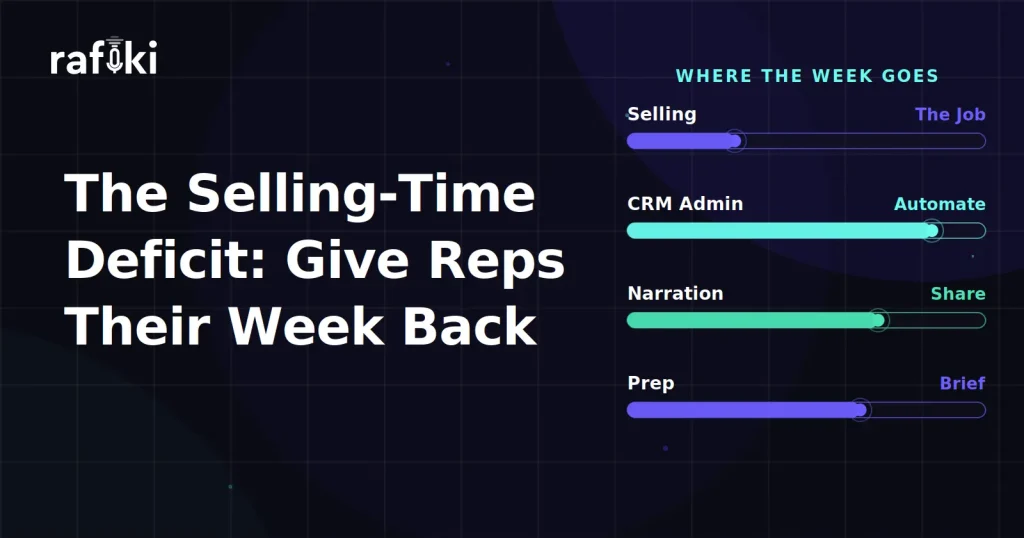
Ask any rep where their week went, and the honest answer is rarely "selling." It went to updating fields, retelling calls in meetings, hunting for context before a demo, and assembling numbers for a pipeline review. Selling time — the hours a rep spends actually talking with buyers, preparing for those conversations, and moving deals forward — has quietly become the scarcest resource on the revenue team. Everyone agrees it matters most. Almost nothing in the modern sales workflow protects it.
This is not a new observation. Salesforce's State of Sales research has shown, edition after edition, that sellers spend only a minority of their working week on actual selling. The rest disappears into administrative tasks, internal meetings, data entry, and tool wrangling. What should alarm leaders is not that the finding exists — it's that it keeps repeating. Teams have bought more software than ever, and the deficit has barely moved.
Here is the argument of this article: the selling-time deficit is a design problem, not a discipline problem. Reps are not lazy, disorganized, or allergic to process. They are working inside systems that generate administrative work faster than any human can clear it. Fixing the deficit means redesigning where the work goes — and in 2026, that redesign is finally practical.
The selling-time deficit is the gap between the hours a rep is paid to sell and the hours they actually spend selling. It is the difference between a forty-hour week and the fraction spent in live buyer conversations, deliberate preparation, or deal-advancing follow-up. Everything else — however necessary it feels — sits on the other side of the ledger.
The deficit matters because selling time is the one input that correlates directly with revenue. More conversations mean more at-bats. Better-prepared conversations mean higher win rates. Faster follow-up means shorter cycles. Consequently, every hour drained from selling into administration is an hour subtracted from the only activity that actually generates pipeline.
What makes the deficit dangerous is its invisibility. No single task looks like the problem. Each CRM update takes a few minutes. A status meeting feels reasonable. One more report seems justified. The deficit only becomes visible in aggregate, which is exactly why most leadership teams have never measured it honestly.
Before you can fix the deficit, you need to name its parts. Across most B2B teams, the non-selling week breaks into five recurring categories. Each is individually defensible. Collectively, they devour the calendar.
This is the work of reconstructing what already happened. Reps scroll back through email threads, replay last Tuesday's call from memory, and type it all into fields days later. The conversation occurred once, in full fidelity. Then the rep is asked to recreate a degraded copy of it by hand. Archaeology is the purest form of waste in the sales week, because the information already exists — the system just cannot see it.
Pipeline reviews, one-on-ones, forecast calls, deal desk syncs — much of this time is spent retelling conversations that already happened to people who were not in the room. The rep becomes a human API between the buyer and the org chart. Meanwhile, the manager hears a compressed, memory-filtered version of the deal, and makes coaching and forecast decisions on that basis.
Every meaningful call generates a follow-up: the recap, the answers to open questions, the next-step confirmation. Staring at a blank compose window, trying to remember exactly what the buyer asked about security review timelines, is slow and error-prone. Because it is slow, it slips. Because it slips, deals lose momentum in the quiet days between touches.
Before a second or fifth meeting, a diligent rep rebuilds context by hand: rereading old notes, skimming email chains, checking the CRM for whatever fragments made it in. The preparation is genuinely valuable — walking in cold loses deals. However, the assembly of that preparation is pure overhead. The rep is doing research on their own deal.
Finally, there is the work of feeding the organization: activity summaries, deal narratives for leadership, updates for the weekly forecast deck. In many companies, reps effectively file the same information three times in three formats for three audiences. None of those filings touches a buyer.
The standard organizational response to the deficit is a discipline intervention: time-blocking workshops, "power hours," calendar hygiene sessions, or a stern note about CRM compliance. These fail, and they fail for a structural reason. The system generates the work. Training the rep to process the work faster does not reduce the amount of work the system produces.
Think about what each anatomy category actually is. CRM archaeology exists because the system of record cannot observe conversations. Status narration exists because deal knowledge lives in one person's head. Prep from scratch exists because context is scattered across five tools. No amount of personal discipline changes any of those facts. A perfectly organized rep in a badly designed system is simply a rep who does administrative work efficiently — the deficit shrinks at the margins, then reasserts itself.
There is also a fairness problem. Blaming reps for a workflow problem corrodes trust, because reps can see the source of the work clearly. They know the fields were added by an ops decision, the status meeting by a leadership preference, the report by a board request. The teams pulling ahead, as Harvard Business Review's reporting on sales teams growing alongside AI suggests, are not exhorting sellers to try harder. Instead, they redesign the workflow so the administrative load lands somewhere other than the rep. In other words, the fix is architectural, not motivational.
Before redesigning anything, measure the deficit directly. The method is simple and slightly uncomfortable. Ask every rep to track one full week of work against a handful of categories: live buyer conversations, call preparation, follow-up writing, CRM updates, internal meetings, and internal reporting. No judgment, no performance implications — just honest logging in whatever tool is easiest.
Two rules make the audit work. First, leadership must promise, credibly, that the data will be used to fix the system rather than to grade the reps. Otherwise the logs get flattering and useless. Second, the categories must separate buyer-facing preparation from internal administration, because reps often mentally bundle them, and the bundle hides the problem.
The results are reliably embarrassing — not for the reps, but for every tool and process decision made in the last five years. Leaders discover that the "quick" fields added for forecast accuracy consume real hours across the team. They find that the weekly pipeline meeting is mostly recitation. They see their most expensive hires spending the largest share of the week on work that would never justify a hire. That discomfort is the point. You cannot defend the status quo once you have watched a week decompose into its parts.
The audit gives you the "before" picture. The design work gives you the "after." The contrast looks like this:
| Activity | The Admin-Heavy Week | The Selling-First Week |
|---|---|---|
| CRM updates | Rep reconstructs calls from memory and types fields by hand | Fields populate automatically from the conversation; rep reviews and confirms |
| Pipeline meetings | Reps narrate deal status verbally, one deal at a time | Managers arrive already briefed from shared call records; meeting time goes to decisions |
| Follow-up emails | Blank page, memory, and hope; sent late or not at all | Draft generated from the call within minutes; rep edits and sends same day |
| Meeting prep | Manual digging through notes, threads, and CRM fragments | Evidence brief assembled from prior conversations, ready before the meeting |
| Internal reporting | Same information re-filed in multiple formats | Reports generated from captured data; reps rarely involved |
| Rep's core job | Documenting selling | Selling |
Every row follows the same pattern. The admin-heavy column asks a human to move information between places. In contrast, the selling-first column lets the system carry it, asking the human only to verify and decide. That pattern is the design principle behind everything that follows.
The highest-leverage fix targets the biggest category of waste. If the system of record can hear the conversation, nobody has to reconstruct it. This is what modern conversation intelligence makes possible, and it is where platforms like Rafiki AI change the shape of the week rather than merely decorating it. Rafiki AI's Smart CRM Sync listens to every sales call. It extracts the fields your team actually tracks — MEDDIC criteria, BANT qualifiers, next steps, custom fields — and writes them to the CRM automatically. The rep reviews rather than types.
The distinction between capture and archaeology is worth dwelling on. Archaeology happens after the fact, from memory, under time pressure; capture happens at the source, in full fidelity, every time. We covered the downstream effects — cleaner forecasts, honest dashboards, no end-of-quarter data scrambles — in our piece on agentic CRM hygiene. For this article, the relevant effect is simpler: the hours reps spent excavating their own calls come back to the selling column.
The second fix attacks the meeting load. When every call is recorded, summarized, and searchable, managers no longer need reps to retell deals. They can read the deal, or ask questions of it, before the meeting starts. The one-on-one becomes a working session instead of a download session. Similarly, the pipeline review stops auditing whether the rep remembers the deal and starts deciding what to do about it.
Rafiki AI supports this with shared call summaries, deal-level timelines, and direct querying of any conversation. A manager preparing for a forecast call can check what the economic buyer actually said. As a result, meetings shrink or disappear. Some teams take this to its logical end and rebuild the forecast around continuously captured evidence — an approach we explored in continuous AI sales forecasting.
The cultural shift matters as much as the hours. Shared records put everyone on the same side of the table, looking at the same evidence. Coaching improves too, because the manager heard the actual call rather than a summary of a summary.
Follow-up is where deals are won quietly and lost silently, and the blank page is its enemy. Rafiki AI's Smart Follow Up drafts the recap email from the call itself: what was discussed, what the buyer asked, what both sides committed to, and what happens next. The rep's job shifts from composition to editing — adjusting tone, adding a personal line, hitting send while the conversation is still warm.
Speed is the visible benefit; accuracy is the underrated one. A draft built from the transcript does not misremember the buyer's question about implementation timelines or omit the stakeholder who asked for security documentation. Buyers notice this precision, and in a crowded evaluation it reads as competence.
This is one of the easiest fixes to test in your own pipeline. Start your free trial today and compare a week of drafted follow-ups against a week of blank pages.
The final fix restores preparation without the assembly overhead. Because every prior conversation is captured and structured, the context for the next meeting compiles automatically. The brief covers promises made, objections raised, stakeholders present, and budget and timeline signals. Instead of an hour of digging, the rep gets a document — and spends the saved time on strategy rather than fact-hunting.
Notably, this fix improves preparation quality, not just speed. Human digging is lossy; an evidence brief drawn from the full conversation history surfaces the comment from three calls ago that suddenly matters now. For sales leaders, the same briefs serve a second purpose: joining a deal mid-stream no longer requires a verbal download, because the deal's history is readable in minutes.
Skeptics ask whether reclaimed hours actually convert to selling or simply evaporate. In practice, they flow to three destinations, and all of them compound.
The compounding effect is what makes this a leadership priority. More at-bats generate more conversations; captured conversations generate better coaching; better coaching raises win rates. Each reclaimed hour earns interest — which is why the shift feels less like adding a tool and more like adding capacity, a theme we developed in From Copilot to Co-Seller.
Here is the discipline that prevents the deficit from regrowing: every new tool, field, meeting, or process must answer one question before adoption. Does this add selling time, or subtract it? Not "is this data useful" — that question has approved a decade of well-intentioned subtraction. The real question is who pays for the usefulness, and the honest answer is usually the rep.
Applied seriously, the test changes procurement and process design alike. A new required field subtracts selling time unless something fills it automatically. Another weekly meeting subtracts selling time unless it replaces two others. And a platform that generates insights while demanding manual input is a net subtraction wearing an ROI costume. Conversely, anything that captures, drafts, or briefs automatically passes — it converts machine effort into human selling hours.
Leaders should make the test public and let reps invoke it. When anyone can openly ask it about a proposed process, the organization has an immune system against creeping administrative load. The pressure to add work never stops arriving.
One caveat belongs in any honest version of this argument. Automation that reps don't trust does not eliminate work — it converts it into verification work. If auto-filled CRM fields are wrong often enough, reps will re-check every one, and the archaeology returns wearing a new badge. Badly built automation can leave a team slower than manual process, plus newly cynical.
The design response is oversight, not blind delegation. Every automated output should be traceable to its source, so verification takes seconds rather than minutes. A summary links to the moment in the call; a field shows the sentence it was extracted from. Reps review and approve before anything is sent or synced, and trust is then earned the only way it ever is: through an inspectable track record. Rafiki AI is built around this review-first pattern because reclaimed selling time only counts if the rep believes the work was done right.
The selling-time deficit was never a character flaw in your reps. It is the predictable output of systems that make humans carry information between tools, meetings, and formats. One defensible task at a time, selling becomes the residual activity of a sales job. Training reps to endure that system has failed for years, because the system generates the work.
The way out is design. Run the one-week audit and let the results speak. Then apply the fixes in order of leverage. Auto-capture ends CRM archaeology; shared records end status narration; drafted follow-ups end blank-page time; evidence briefs end from-scratch prep. Guard the reclaimed hours with one public test — does it add selling time or subtract it — and insist on automation transparent enough that reps trust it. Give reps their week back, and the week gives back.
The selling-time deficit is the gap between the hours a rep is paid to sell and the hours actually spent selling. Selling means live buyer conversations, deliberate preparation, and deal-advancing follow-up. Industry research, including Salesforce's State of Sales series, has consistently found that sellers spend only a minority of the week on those activities. The remainder goes to CRM data entry, internal meetings, reporting, and reconstructing context across tools. The deficit is dangerous because it is invisible in the moment: each task looks small until a full week is tracked by category. Because it is produced by workflow design rather than rep behavior, it has to be engineered out of the system.
Ask every rep to log one full week of work against a short list of categories: live buyer conversations, call preparation, follow-up writing, CRM updates, internal meetings, and internal reporting. Keep the logging lightweight — a simple spreadsheet works — and keep the categories honest by separating buyer-facing prep from internal administration. Two conditions determine success. First, leadership must commit publicly that the data will redesign the system, never evaluate individuals; otherwise the logs get flattering and useless. Second, review the results as a team, mapping each large category to the tool or process decision that created it. The output is a ranked list of design fixes, ordered by hours recoverable.
Because the system generates the work, and training only changes how fast the rep processes it. CRM archaeology exists because the system of record cannot observe conversations. Status narration exists because deal knowledge lives in one person's head. Prep from scratch exists because context is scattered across disconnected tools. Personal discipline changes none of those structural facts — a perfectly organized rep in a badly designed workflow is simply someone doing administrative work efficiently. Worse, framing the deficit as a discipline problem blames reps for decisions they didn't make, which corrodes trust. Durable gains come from removing the work at its source: automatic capture, shared records, drafted outputs, and assembled briefs.
The key is traceable, review-first automation. AI reclaims selling time by carrying the information-moving work. It populates CRM fields from calls, drafts follow-ups from what was said, summarizes deals, and assembles meeting briefs. The oversight risk is real — automation reps don't trust becomes verification work. Well-designed systems prevent this by making every output inspectable at the source: a field links to the sentence it came from, a summary links to the moment in the call, and reps approve drafts before anything is sent or synced. Verification then takes seconds, trust builds on a track record, and the reclaimed hours stay reclaimed.
Rafiki AI's conversation intelligence platform puts autonomous AI agents to work on capture, CRM sync, follow-ups, and deal briefs. Pricing starts at $19 per seat per month with no seat minimums and no annual commitment. Start your free trial today or book a demo to see how much of the week your team can take back.
Start for free — no credit card, no seat minimums, no long contracts. Just better sales intelligence.