AI

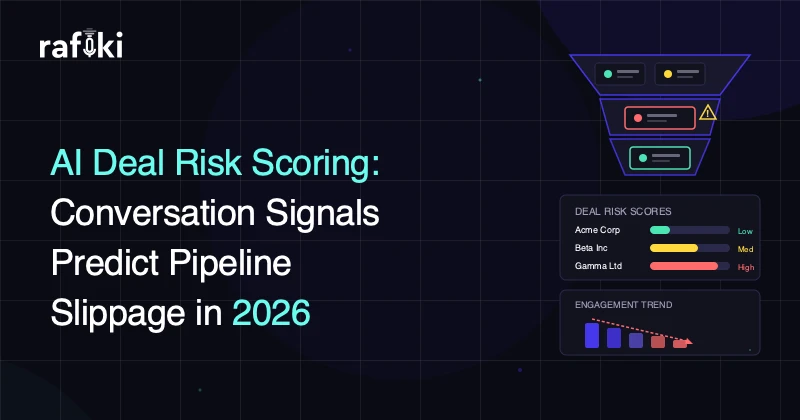
AI Deal Risk Scoring: How Conversation Signals Predict Pipeline Slippage in 2026
Apr 8, 2026
9 min read
Your pipeline isn't lying to you — you're just not listening to the right signals.
Every quarter, revenue leaders stare at a forecast and wonder which deals are real and which are wishful thinking. The CRM says "Verbal Commit." The rep says "Feeling good." Then the deal slips, the quarter misses, and everyone scrambles to figure out what went wrong. In 2026, this cycle is no longer acceptable — because AI deal risk scoring can detect the warning signs weeks before a deal actually stalls. The signals are already in your conversations. The question is whether you're extracting them.
Pipeline slippage isn't a sudden event. It's a slow accumulation of micro-signals: a champion who stops attending calls, a competitor name that appears in week six, next steps that get vague, or a procurement stakeholder who never materializes. Traditionally, these signals live in a rep's head — unstructured, unreported, and invisible to leadership. However, conversation data captures every one of them. The gap has always been the ability to analyze that data at scale and translate it into a quantifiable risk score. That gap is closing fast.
Sales leaders have always relied on a combination of CRM stage, rep confidence, and intuition to assess deal health. For decades, this worked well enough — when deal cycles were shorter, buying committees were smaller, and competitive dynamics were simpler. In practice, those conditions no longer exist.
Modern B2B deals involve multiple stakeholders across different departments, each with their own priorities and timelines. A deal can look healthy in the CRM because it advanced from "Discovery" to "Proposal" on schedule, while the actual conversations reveal a completely different story. The economic buyer hasn't joined a single call. Technical validation stalled after the security review. And the champion keeps deflecting questions about budget approval.
CRM data captures what happened — stages moved, tasks completed, emails sent. Conversation data captures how it happened — the tone shifts, the evasive answers, the enthusiasm that disappeared between call three and call five. Consequently, organizations that forecast based solely on CRM milestones are making decisions with half the picture.
Not all conversation signals carry equal weight. Research and operational experience point to four categories that most reliably predict deal risk. Understanding each one transforms how your team evaluates pipeline health.
Early in a deal, prospects are curious, responsive, and forward-leaning. They ask detailed questions. They share internal context voluntarily. They propose next steps without prompting. When a deal starts to slip, this energy changes — often subtly. Responses get shorter. Questions become more generic. The prospect starts deferring to "the team" instead of expressing personal advocacy.
These sentiment shifts are nearly impossible to detect across a pipeline of 50+ deals through manual call reviews. But they represent one of the most reliable early indicators that a deal is cooling.
Healthy deals tend to add stakeholders over time. Economic buyers join late-stage calls. Technical evaluators appear for security reviews. Legal asks for contract redlines. When stakeholders stop appearing — or when the same single contact attends every meeting — it often signals that the deal hasn't built internal consensus. In particular, the absence of an economic buyer past the midpoint of a typical sales cycle is one of the strongest slippage predictors.
Competitor mentions that appear early in a sales cycle are normal — prospects are evaluating options. Competitor mentions that appear late in a cycle are dangerous. They suggest the prospect is reopening the evaluation, seeking leverage for negotiation, or being influenced by a new internal advocate for an alternative solution. The timing and context of competitive signals matter enormously, and they're embedded in conversation data.
Every experienced rep knows the feeling: a call ends without a concrete next step, and both sides say they'll "circle back next week." This is the conversational equivalent of a deal entering hospice. When next steps shift from specific ("I'll send the security questionnaire to our CISO by Thursday") to vague ("Let's reconnect after the holidays"), the deal's momentum has broken. Tracking this pattern across every call in a deal's lifecycle reveals exactly when and where momentum died.
Identifying individual signals is useful. Combining them into a composite risk score is transformative. AI deal risk scoring works by ingesting every conversation in a deal's history, extracting the signals described above, and weighting them based on deal stage, historical patterns, and outcome data.
The process follows a consistent logic:
This approach fundamentally differs from traditional pipeline management because it's continuous, automated, and based on behavioral evidence rather than self-reported rep confidence.
To understand the shift, consider how most organizations evaluate pipeline health today versus what becomes possible with conversation-driven risk scoring.
| Dimension | Traditional Pipeline Review | AI Deal Risk Scoring |
|---|---|---|
| Data source | CRM fields, rep narrative | Conversation transcripts + CRM data |
| Frequency | Weekly or biweekly | Real-time, after every interaction |
| Coverage | Top 10-20 deals reviewed | Every deal scored automatically |
| Objectivity | Relies on rep judgment | Behavioral signals, independently verified |
| Leading indicators | Rarely captured | Sentiment shifts, stakeholder gaps, vague next steps |
| Intervention timing | After slippage occurs | Before slippage, based on signal trends |
The distinction isn't subtle. Traditional reviews are retrospective — they identify problems after deals have already slipped. In contrast, AI-driven scoring is predictive — it flags risk while there's still time to intervene. For RevOps teams responsible for forecast accuracy, this distinction is the difference between explaining a miss and preventing one.
This is where the concept becomes operational. Rafiki's revenue intelligence platform analyzes every conversation across your pipeline and surfaces deal risk signals automatically — without requiring managers to listen to recordings or reps to self-report deal health.
Rafiki extracts the specific signals that predict slippage:
With Rafiki's Gen AI Reports, RevOps leaders can generate pipeline risk summaries on demand, slicing risk data by rep, team, segment, or deal stage. These reports transform raw conversation intelligence into the structured insights that drive accurate forecasting and timely deal intervention.
A risk score that sits in a dashboard and gets ignored is worthless. The value of AI deal risk scoring materializes only when it changes behavior — when it triggers specific actions from specific people at the right time.
Effective operationalization follows a clear framework:
This operational layer is what separates a technology demo from a revenue impact. The intelligence is only as valuable as the action it drives.
For RevOps leaders, the appeal of AI deal risk scoring goes beyond individual deal management. It fundamentally improves forecast accuracy — the metric that determines credibility with the board and executive team.
Traditional forecasting relies on a chain of subjective inputs: reps estimate their deals, managers adjust based on experience, and RevOps applies historical close rates. Each layer introduces bias. Reps are optimistic. Managers overcorrect. Historical averages don't account for current market conditions. As a result, the final number is an educated guess dressed up in a spreadsheet.
Conversation-driven risk scoring breaks this pattern by introducing an independent, behavioral data layer. The AI doesn't care whether a rep "feels good" about a deal. It measures whether the conversations support that confidence. When the behavioral signals contradict the rep's assessment, RevOps has objective evidence to challenge the forecast — not just a hunch.
More importantly, this approach enables dynamic forecasting that updates continuously as new conversation data flows in. Instead of a static weekly number, leadership gets a living forecast that reflects the actual state of every deal in the pipeline.
Technology alone doesn't solve pipeline slippage. The teams that extract the most value from AI deal risk scoring are those that build a culture where risk identification is celebrated, not punished.
This requires a mindset shift. In most sales organizations, flagging a deal as at-risk feels like admitting failure. Reps hold onto shaky deals because moving them out of the forecast invites scrutiny. Managers avoid downgrading deals because it makes their pipeline look thin. The result is a forecast inflated by deals that everyone privately suspects won't close.
When AI provides the risk assessment, it depersonalizes the conversation. The score isn't an accusation — it's evidence. A rep can point to the risk score and say, "The data shows this deal needs executive sponsorship," without it feeling like a confession of incompetence. Similarly, a manager can use score trends to guide coaching conversations with specific, evidence-backed observations rather than vague intuition.
Organizations that embrace this transparency find that forecast accuracy improves, deal cycle times shorten (because at-risk deals get intervention earlier), and rep trust in the process increases. Transparency and accountability reinforce each other.
Not every platform that claims AI-powered pipeline management actually delivers conversation-level risk intelligence. When evaluating solutions, RevOps teams should look for these capabilities:
For years, revenue leaders have treated pipeline slippage as a discipline issue — reps need to update their deals more diligently, managers need to ask tougher questions, forecast calls need more rigor. But discipline can't solve a detection problem. The signals that predict slippage are embedded in conversations, and no amount of CRM hygiene or manual pipeline reviews can extract them at scale.
AI deal risk scoring changes the equation by making those signals visible, quantifiable, and actionable in real time. In 2026, the organizations that win are the ones that stop reacting to slippage after the fact and start detecting it before it happens. The conversation data is already there. The intelligence layer to analyze it exists. The only question is whether your team is using it.
Rafiki analyzes every conversation in your pipeline and surfaces the risk signals that predict slippage — before deals stall. Stop forecasting from gut feel and start forecasting from evidence.
Start for free — no credit card, no seat minimums, no long contracts. Just better sales intelligence.