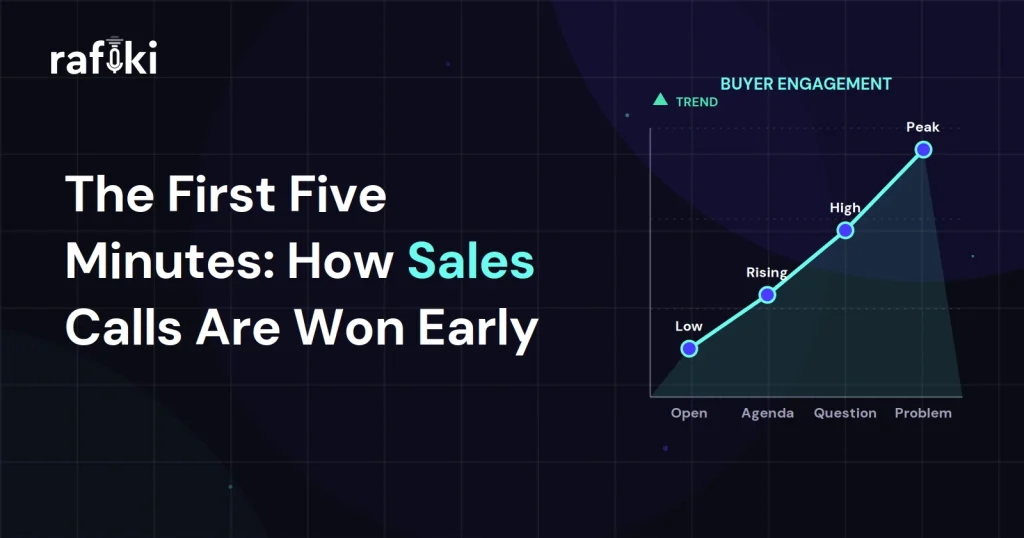
Two reps run the same discovery call on the same afternoon with similar prospects. Thirty minutes in, one is deep in a conversation about the buyer's broken renewal process, with the buyer doing most of the talking. The other is on slide seven of a deck, answering a polite question about integrations, and the buyer has already glanced at the clock twice. Nothing in the middle of those calls explains the difference. The calls were decided in the first five minutes, and neither rep knows it.
Sales teams spend enormous effort on the middle and the end of calls: discovery frameworks, objection handling, closing techniques, methodology scorecards. The opening gets a line in the playbook about rapport and an instruction to "set the agenda." However, the opening is where the frame gets set, where the buyer decides whether this is a conversation or a pitch, and where the rep either earns the right to ask hard questions or loses it. Everything after the first five minutes happens inside the frame those minutes created.
This article treats the opening as a skill in its own right. It covers what the first five minutes actually do, why they are so rarely coached, the four opening patterns that show up in call recordings, how to read an opening from the evidence, and how to coach it separately from the rest of the call, so that more of your team's conversations start the way the good ones do.
The first five minutes of a sales call establish the frame: who is leading, what the conversation is for, whether the buyer will speak candidly, and whether the rep has earned enough credibility to ask a real question. The frame is set quickly, mostly implicitly, and it is remarkably durable. A call that opens as a pitch stays a pitch even when the rep tries to pivot to discovery later, because the buyer has already settled into the role of audience.
Four things get decided in that window. First, agenda ownership: whether the rep proposes a purpose and gets the buyer to amend it, or the buyer waits to be presented to. Second, credibility: whether the rep demonstrates, in a sentence or two, that they understand the buyer's world before asking about it. Third, the talk ratio: whether the buyer speaks early and substantively, or listens. Fourth, the first real answer: whether the buyer's first substantive response is a problem they own or a polite deflection.
Once those four are set, the rest of the call inherits them. That is why the opening deserves to be coached on its own terms rather than as a prelude to the parts of the call the playbook cares about.
Why do teams that score every call against a methodology still leave the first five minutes to instinct? The reasons are structural, and they explain why the opening gets worse under pressure while everything else gets more polished.
The consequence is a coaching blind spot at the moment of highest leverage. As Harvard Business Review's reporting on sales teams growing alongside AI explores, the sales teams that are growing alongside AI are the ones using it to sharpen what their people do rather than to replace them. Understanding what the best openers do differently is exactly that kind of use. The opening is where that difference is most visible and most teachable.
A call that opens badly is rarely a disaster. It is worse than that: it is a mediocre call that looks fine. The buyer is polite, the rep covers the agenda, and the deal moves to the next stage with a note that says "good conversation." What was lost is invisible, because it is the conversation that would have happened if the buyer had spent the first five minutes talking about their problem instead of listening to a company overview.
Multiplied across a team and a quarter, the cost shows up in three places. Discovery is shallow because the buyer never got into the habit of speaking candidly. Deals stall later because the pain was never really established, so there is nothing urgent to return to when the process slows. And coaching downstream is frustrating, because the manager keeps fixing discovery questions when the real problem is that the buyer was never in a mode to answer them.
Salesforce's State of the Connected Customer research keeps finding that buyers expect vendors to understand their needs and context rather than deliver generic pitches. The first five minutes are where the buyer learns which kind of vendor they are talking to.
Listen to enough openings and they sort into four patterns. Each is recognizable within a minute or two, and each predicts a different kind of call. Naming them gives managers and reps a shared vocabulary for something that used to be described as "good energy" or "a bit flat."
The rep opens with the company, the product, or the deck. The buyer becomes an audience and stays one. Talk ratio tilts to the rep in the first minutes and rarely recovers. The buyer's first substantive contribution is a question about features, which the rep answers, confirming the frame. This is the default under pressure, and it is especially common in early-career reps.
The rep invests the opening in small talk and warmth, then transitions abruptly to questions the buyer has no reason yet to answer candidly. The call is friendly and shallow. Rapport without relevance buys goodwill but not permission; the buyer likes the rep and still deflects.
The rep skips context and begins qualifying immediately: budget, timeline, authority. The buyer feels processed. Answers are short and guarded, and the rep mistakes the guardedness for a weak lead. This pattern is common in teams that over-index on methodology scorecards, because it hits the checklist early.
The rep opens with a sentence or two that demonstrates understanding of the buyer's situation, proposes a purpose for the call and invites the buyer to change it, and asks one question the buyer actually wants to answer. The buyer speaks early and at length, and their first substantive answer is a problem they own. Everything downstream is easier, because the buyer has decided this is a conversation.
The four patterns are visible in the conversation record without listening to the whole call, which is what makes coaching the opening feasible at scale. A conversation intelligence platform that captures every call across meetings and phone provides the signals directly.
Across a rep's calls, these signals reveal their default pattern, and across the team they reveal which reps have a teachable opening that the rest could learn. That second finding often surprises teams, because the best openers are not necessarily the most charismatic reps; they tend to be the ones with the most consistent structure.
The opening improves fastest when it is coached as its own skill, in short cycles, with the recordings as the material. Folding it into general call feedback dilutes it.
Rafiki AI is built to make the first five minutes visible for every call, because it records and analyzes every conversation across video meetings and phone calls, transcribed in more than sixty languages, with talk patterns, participants, and topics structured automatically. The opening stops being the part everyone scrolls past.
Smart Call Scoring supports custom criteria alongside MEDDIC, SPICED, BANT, and the other methodologies, so a frontline manager can score the opening pattern on its own line: understanding shown, purpose proposed and amended, first question earned. The methodology score and the opening score sit side by side, which is how a team discovers that its qualification is strong and its openings are weak.
Gen AI Search finds every earned opening across the team's recent calls for the playlist, and answers coaching questions directly, such as which reps' buyers state a problem within the first few minutes and which reps open with a company overview. AI Role Play gives reps a simulated buyer to practice the first two sentences against until the structure is automatic. For SDR leaders running high volumes of short phone conversations, the same analysis applies to dialer calls, where the opening is most of the call. Rafiki AI's autonomous AI agents do the listening and the scoring; the manager coaches the five minutes that decide the rest.
| Pattern | Who talks first | Buyer's first real answer | Frame that results |
|---|---|---|---|
| Pitch | Rep, at length | A feature question | Presentation |
| Rapport-only | Both, about nothing | A polite deflection | Friendly and shallow |
| Interrogation | Rep, with questions | A short, guarded fact | Being processed |
| Earned | Rep briefly, then buyer | A problem they own | Conversation |
The opening is a sales skill that can change quickly, because the behavior is short, repeated many times a week, and easy to observe. A simple plan works.
Sales calls are decided earlier than most teams believe, in the minutes before the methodology kicks in, when the buyer decides whether they are in a conversation or an audience. The first five minutes set the frame, and the frame decides how candid the buyer will be, how deep discovery can go, and whether there is a real problem to return to when the deal slows. The four patterns are visible in every recording, the earned opening has a structure anyone can learn, and the evidence to coach it is already in your call archive. Rafiki AI puts that evidence in front of every manager, with autonomous AI agents that score the opening on its own terms, find the best examples on your team, and let reps practice until the structure is instinct. Coach the first five minutes this month. The rest of the call will follow.
Four things get established: who owns the agenda, whether the rep has credibility, who is doing the talking, and what the buyer's first real answer looks like. In a strong opening, the rep spends a sentence or two demonstrating understanding of the buyer's situation, proposes a purpose for the call and invites the buyer to amend it, and asks one question the buyer wants to answer. The buyer then speaks early and substantively, and their first real contribution is a problem they own. That frame persists through the rest of the call, which is why the opening deserves to be treated as a skill rather than a warm-up.
Because the opening handed the buyer the role of audience, and roles are sticky. Under pressure, reps default to what they control: the company overview, the deck, the product story. It feels professional, but it tilts the talk ratio toward the rep in the first minutes and turns the buyer's first contribution into a feature question, which the rep answers, confirming the frame. Attempts to pivot to discovery later usually fail because the buyer has already settled in to listen. The fix is to open by earning the conversation: understanding shown, purpose proposed, one question the buyer wants to answer.
Coach it separately from the rest of the call and in short cycles. Review only the first five minutes in a session and ask the rep to name the pattern they used; recognition changes behavior faster than instruction. Build a playlist of earned openings from the team's own best calls so reps hear the structure in several voices. Have reps rehearse the first two sentences in role play. Add a custom scoring criterion for the opening so it is measured independently of the methodology score, and track how quickly the buyer states a first problem as the progress measure. With that cadence, a rep's default pattern can shift in a matter of weeks.
Rapport is warmth; an earned opening is warmth with relevance. A rapport-only opening spends the first minutes on small talk and then transitions to questions the buyer has no reason yet to answer candidly, so the call is friendly and shallow. An earned opening uses a sentence or two to show the rep understands the buyer's world, sets a purpose the buyer can edit, and asks something the buyer genuinely wants to discuss. The buyer likes the rep in both cases; only in the second does the buyer decide the rep has earned a real answer. Rapport is a component of an earned opening, not a substitute for it.
Rafiki AI's conversation intelligence platform starts at $19 per seat per month with no minimums and no annual commitment. Start your free trial today or book a demo to see how your team's calls actually open, and how the best ones earn the conversation.
Start for free — no credit card, no seat minimums, no long contracts. Just better sales intelligence.