Your best rep's best call happened on a Tuesday in March, and nobody can find it.
Somewhere in your team's history is the perfect discovery call — the one where the questions landed in the right order, the buyer opened up, and the deal that followed closed in record time. There is a flawless handling of the security objection, a pricing conversation that held the line gracefully, a renewal save worth studying frame by frame. These moments happened. They were even recorded. And they are utterly lost, scattered across hundreds of hours of undifferentiated call recordings nobody will ever re-watch.
Meanwhile, the official playbook — the deck, the wiki, the battle-tested onboarding doc — describes how the company sold two product versions ago, in prose nobody fully believes. New hires learn from whoever happens to have time. Tribal knowledge walks out the door with every departing rep. The fix for all of it is the same asset: a sales call library — a curated, organized, searchable collection of your team's best real moments, maintained as deliberately as the product's documentation.
Written playbooks fail for a structural reason: they are descriptions of selling, produced at one moment in time, by someone summarizing. Every layer of abstraction loses fidelity — the talk track on the slide never quite matches what top performers actually say, and the gap widens every quarter as the product, market, and objections evolve.
Real calls do not have this problem:
The catch is that raw recordings are useless at scale. A folder of three thousand calls is not a library any more than a warehouse of unsorted books is. The value is entirely in the curation — which is exactly the work most teams never get around to, and the work this guide is about.
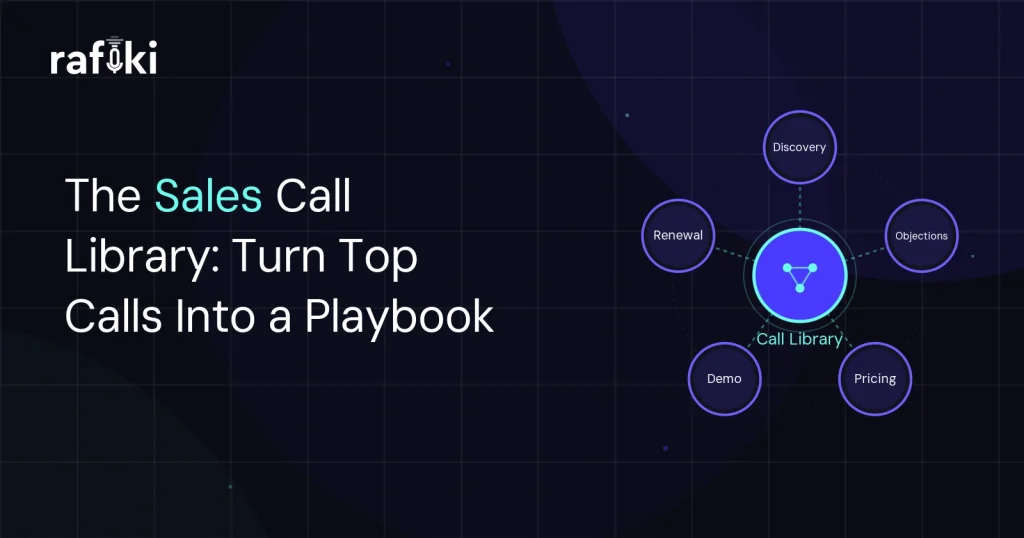
A sales call library is a curated collection of recorded sales conversations — and segments of conversations — selected because they demonstrate the team's best execution of specific, named situations: running discovery, handling a particular objection, presenting pricing, conducting a renewal. Each entry is tagged by situation, annotated with why it earns its place, and kept current by a deliberate refresh process.
Three properties separate a library from a recordings folder:
Done well, the library becomes the company's actual playbook — the written one becomes its index. As Salesforce's State of Sales research has documented across editions, the perennial enablement gap is between what organizations train and what sellers retain on live calls; learning from real recorded moments, attached to real situations, is the most direct attack on that gap.
Structure the collection around the situations reps actually face, not around deal post-mortems. A practical starter taxonomy:
Each entry carries a two-sentence annotation: what to watch for, and why this is the standard. The annotation is what turns a clip into a lesson.
The library does not require a quarter-long enablement project. With calls already being recorded and scored, a month of focused curation produces a working first version:
The build pairs naturally with onboarding — the 30-day ramp playbook we published in June assumes exactly this kind of curated call set as its week-one curriculum.
Because the two get conflated constantly, the contrast deserves its own table:
| Dimension | Recordings archive | Sales call library |
|---|---|---|
| Contents | Everything, automatically | The curated best, deliberately |
| Organized by | Date, account, rep | Teaching situation |
| Typical size | Thousands of calls | Dozens of moments |
| Primary user | Compliance, deal review | Reps learning a situation |
| Maintenance | None needed | Quarterly pruning, continuous nomination |
| Value over time | Flat | Compounds with every quarter of selling |
Teams need both; only one of them teaches. The archive answers "what happened on this deal?" — the library answers "how do we do this well?" Keeping the two questions separate is what keeps the library usable.
A library justifies its maintenance hours with observable effects, and the early indicators are behavioral rather than financial:
None of these require a measurement project; they fall out of the same scoring layer that built the library. What they buy the enablement leader is the budget conversation every content asset eventually faces, answered with evidence.
Most call libraries die the same death: an enthusiastic launch, six months of neglect, and a quiet return to tribal knowledge. The preventive governance is light but non-negotiable:
Connected to a weekly coaching rhythm — like the one in our frontline manager's coaching playbook — the library stops being a content asset and becomes the team's shared definition of good, continuously renegotiated with evidence.
Everything above was possible five years ago, and almost nobody did it, because every step was manual: someone had to listen to hundreds of calls to find candidates, clip them by hand, and remember to keep looking. Conversation intelligence collapses the cost of every step.
With calls automatically transcribed, summarized, and scored:
The curation judgment stays human — what represents the standard is a leadership decision. The expensive part, finding and preparing the material, stops costing anything.
Rafiki AI is an AI-native revenue intelligence platform, and the library workflow maps directly onto its capabilities:
Because Rafiki AI transcribes in 60+ languages, global teams can run regional libraries under one rubric — and at $19 per seat per month with no seat minimums, the library is buildable at a stage when most enablement tooling is out of reach. For sales enablement leaders, it is the rare asset that compounds: every quarter of selling makes it better.
Smaller than instinct suggests. A working library is a few entries per situation — call it thirty to fifty moments total for a typical team — because the selection pressure is the value. Past that size, reps stop trusting that any given entry is the standard, and the library drifts back toward being an archive. Grow the taxonomy as new situations emerge, not the entry count per situation.
Yes, loudly. Library inclusion is the cheapest meaningful recognition a sales org has — it says "this is what good looks like" in front of the whole team, attached to evidence. Teams that celebrate inclusions get a second-order benefit: reps start selling with the library in mind, which is to say, trying to be the standard. The failure entries are the exception; handle those privately and anonymize where the culture needs it.
Completely. An archive stores everything for legal and QA purposes and is organized by date and account. A library stores almost nothing — only the curated best — and is organized by teaching situation. They can share underlying infrastructure, but confusing the two produces the worst of both: an archive nobody learns from with a library's name on it.
Every sales team already owns the raw material of an exceptional playbook — it is sitting in their recorded calls, demonstrated rather than described, current as of yesterday. What separates teams that benefit from it is nothing more than curation: the decision to find the best moments, name what makes them the standard, and keep the collection alive.
That used to be expensive enough to skip. With every call scored and searchable automatically, the cost has collapsed to a few hours of judgment a month — and the asset it buys appreciates with every conversation the team has. The playbook that proves itself, maintained by the selling itself: that is what enablement has been trying to build all along.
Rafiki AI's autonomous AI agents score, summarize, and index every call your team makes — the library practically curates itself. Plans start at $19 per seat per month with no seat minimums and no annual commitment. Start your free trial today or book a demo and find your best call from last quarter in about thirty seconds.
Start for free — no credit card, no seat minimums, no long contracts. Just better sales intelligence.