The manager pulls up the dashboard, sorts the team by talk ratio, and finds her answer. Her rep at the bottom of the leaderboard also talks the most on calls. She considers the case closed and, in their next one-on-one, tells him to talk less and listen more. He follows the advice, and as his talk ratio falls, his calls get shorter and leave buyers worse off.
He talked so much in the first place because buyers kept asking him to explain the product. Now he leaves their questions half-answered so the number looks better. The ratio goes down, yet the calls themselves get no better. Nobody stopped to ask what each conversation actually needed from him.
Sales teams cite few conversation metrics as often as talk ratio, and few are as poorly understood. Because it takes no effort to compute, managers turn it into a rule, and that is where the misuse starts. One number cannot show whether a rep listened or whether the buyer opened up. Once managers treat it as a score, reps learn to game it.
The metric still says a lot about a call if you read it carefully and next to other signals. This article is about reading listening metrics as evidence for coaching, so the numbers stop working like grades. It starts with what talk ratio measures and why "talk less" is poor advice, then moves to five signals that matter more. Later sections cover reading ratio by call type and coaching listening so the conversation itself improves.
Talk ratio compares the share of a recorded conversation where the seller speaks with the share where the buyer speaks. Conversation intelligence software calculates it from the diarized transcript, which attributes each segment of speech to a participant. Most tools show the result as a percentage or a simple split. A call where the rep spoke two-thirds of the time has a high seller talk ratio.
The metric rests on a plausible intuition: engaged buyers tend to talk more, and sellers who ask good questions tend to talk less. Averaged over many calls, that rough tendency holds up. The trouble starts when a manager applies it as a rule to one call or one rep.
A demo has a high seller talk ratio by design, while a discovery call with a talkative buyer has a low one by luck. Picture a rep who spends six minutes answering a buyer's detailed technical question. That rep is responding to what they heard, so the high ratio on that call is no sign of failure.
Talk ratio describes the shape of a conversation, but it cannot tell a manager whether the rep actually listened. Judging that takes more signals. Because they come from the same recording, a manager can check them on any call that already has a talk ratio.
Why does such familiar listening advice so often make calls worse? It aims at the number and skips the behavior the number was supposed to indicate. Reps, reasonably enough, chase whatever their manager measures.
The deeper issue is that managers have promoted a proxy to a target. A Harvard Business Review article on gen AI myths in sales and marketing makes a related point. Its authors suggest that teams often struggle more with how they think about their tools than with the tools themselves. Treating a conversation analytics dashboard as a scoreboard is a small version of that same mistake.
Coaching to talk ratio damages a team in ways managers struggle to trace back to the metric. The number keeps improving while the calls decline. That damage builds slowly, and it usually starts with how reps behave on their calls.
Reps first learn to perform listening for the dashboard, and buyers spot the act faster than any dashboard does. The metric then crowds out better ones, since a number that feels objective stops managers from looking for signals that explain a call. Eventually reps stop trusting the analytics at all. Once the number misses calls a rep knows went well, every other number from that system looks suspect.
The loss of trust also spills into the coaching relationship between rep and manager. How reps experience their tools and data comes up again and again in Salesforce's State of Sales research. Adoption follows trust, so a listening metric that reps do not believe drags down the platform that produced it. Our guide to call scoring calibration looks at the same problem for call scores.
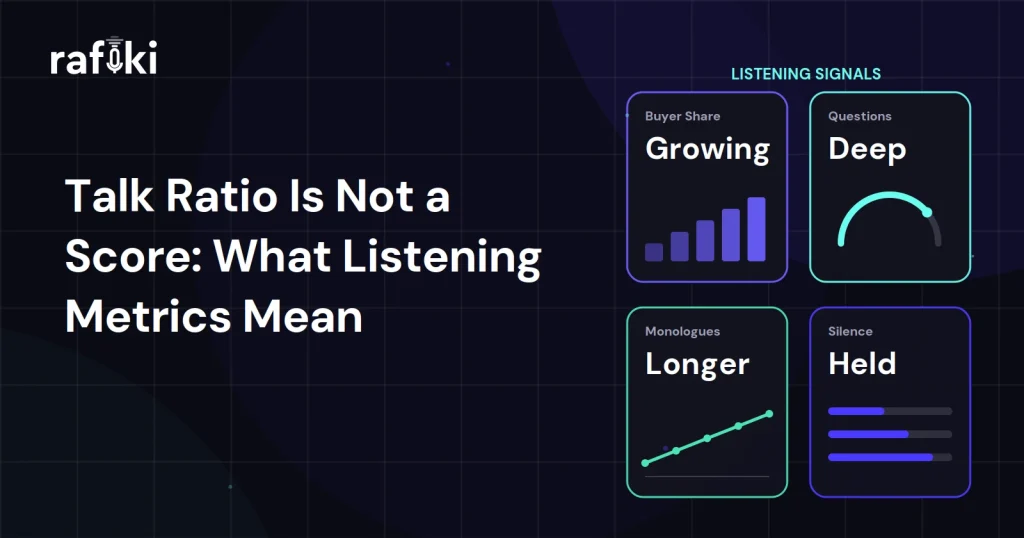
Listening shows up in a recorded conversation, but no single ratio captures it. When a conversation intelligence tool diarizes and analyzes every call, it can surface five signals. Together they describe what happened far better than the split of speaking time.
How long does the buyer speak without interruption when they answer a substantive question? Long buyer monologues are the clearest evidence that the rep asked something worth answering and let the buyer finish. A call can show an even talk ratio with no buyer monologue longer than fifteen seconds. On that call, the rep interviewed the buyer without really hearing them.
Do the rep's questions build on what the buyer just said, or do they move to the next item on a list? A follow-up that references the buyer's last answer proves listening, while a string of unrelated questions points to a script. You can see depth in the transcript, where the rep's questions reuse the buyer's own words.
How often does the rep start speaking before the buyer has finished? Interruptions are some of the most direct evidence of not listening, yet talk ratio hides them. An interrupted buyer and an uninterrupted one produce the same split. Diarization measures that overlap, and it is the first thing a manager should check when a rep's calls feel rushed.
How long does the rep wait after asking a question before speaking again? Some reps ask a good question and then fill the pause with a clarification or a suggested answer. That habit leaves the buyer no room to think about the question. Measured in seconds, the pause after a question separates reps who ask questions from reps who let them land.
Where in the call does the buyer talk? In a well-shaped call, the buyer speaks heavily in discovery and the rep speaks heavily during the demo. Another call can have the same overall ratio, with a ten-minute rep monologue up front and the buyer speaking only at the end, about pricing. Reading the ratio segment by segment shows where the conversation went, which one whole-call number cannot do.
Once the five signals are in view, talk ratio becomes useful again, as long as the manager reads it against the call type. Each type of call has a natural shape, and a deviation from that shape deserves attention.
A team that reads ratio this way stops asking whether a rep's number is too high. The manager asks instead whether the call has the right shape for its type, and where it went wrong if not. Unlike the leaderboard question, that one has an answer, and the manager can find it in the recording.
For managers who want to look behind the ratio, Rafiki AI records and diarizes every video meeting and phone call. Its transcripts cover 60+ languages, and the platform analyzes each call's talk patterns, participants, sentiment, and topics.
Smart Call Scoring lets a team score listening behaviors on its own criteria, next to MEDDIC, SPICED, or any other methodology. A team could score whether follow-up questions referenced the buyer's words and whether the buyer had room to answer. It could also score whether the demo paused for questions. Where the old dashboard showed a bare ratio, a frontline manager now sees a listening score with the reasons attached.
Managers can use Gen AI Search to ask the questions those signals raise in plain language. A manager might ask which discovery calls had buyers describing their problems at length, or which demos drew buyer questions. The same search also finds the calls where a rep left a buyer's concern unanswered.
Stakeholder participation mapping shows who on the buyer side spoke and for how long. With it, a manager reads a group call person by person instead of treating "the buyer side" as one block. Gen AI Reports turns those questions into a standing report by call type, so the team tracks listening against the right shape. The autonomous AI agents in Rafiki AI gather that evidence, and the manager still decides what good listening looks like on their team.
| Dimension | Talk ratio as a score | Listening signals as evidence |
|---|---|---|
| Unit | One number per call | Five signals, each read by segment |
| Target | A single ideal split | The natural shape of each call type |
| Coaching instruction | "Talk less" | "Wait after the question" or "reference their answer" |
| What reps optimize | The dashboard | The conversation |
| Interruptions | Invisible | Visible in overlap data |
| Demos | Score badly for a high ratio | Show up through buyer questions and rep pauses |
| Rep trust in analytics | Erodes when the number lies | Grows when the evidence matches the call |
The practical change is small: retire the talk ratio leaderboard and coach from one moment on a call. Ask the rep for one change at a time, and use the four steps below to keep that coaching specific enough for a rep to act on.
Talk ratio turned into a score because it was easy to compute and looked like a measure of listening. What it really captures is the shape of a conversation. That shape only helps a manager who reads it against the call type and next to the signals that show attention.
This week, pick one rep and open their most recent discovery call. Find the longest buyer monologue and the first moment the rep cut in. Play that moment in your next one-on-one, agree on one change, and check the same signal on the rep's next calls.
Rafiki AI puts that evidence in front of every manager by transcribing and attributing every call and scoring listening on the team's own criteria. Its autonomous AI agents also mark the moment a conversation changed shape, so you can skip straight to it in the recording.
Talk ratio is the split of speaking time between seller and buyer on a recorded call. Software calculates it from a transcript that tags each stretch of speech by speaker. The idea behind it is that engaged buyers tend to talk more and good questioners tend to talk less. On its own, though, it says little about listening, since a demo is rep-heavy by design and a talkative buyer lowers the ratio by luck.
There is no single good number, and a manager who treats one as a target makes the metric harmful. The right shape depends on the call type, so discovery should lean heavily toward the buyer with long, uninterrupted answers. Demos lean toward the rep, and the test is whether the buyer asks questions and the rep pauses to answer.
Negotiations tend to be roughly even, with the buyer's share around terms and concerns. On brief phone and SDR calls, the opening dominates the ratio. Read ratio by call type and by segment, and treat any deviation from the natural shape as the signal.
The advice targets the number and ignores the behavior behind it. A rep told to talk less cuts the explanations and answers buyers valued and keeps the habitual opening monologue. The advice also swaps the productive pause after a good question for awkward silence and penalizes reps for running demos. Reps then learn to perform listening for the dashboard, which buyers notice, and the team's trust in the analytics erodes.
Look at five signals from the diarized conversation, starting with buyer monologue length. Question depth shows whether follow-ups built on the buyer's previous answer, and overlap shows whether the rep cut in early. Silence after questions reveals whether the rep let questions land, while buyer share by segment shows when the buyer had the floor. Coach one signal per rep per month from a specific moment, and check that signal on the next calls.
To see the listening signals behind your team's talk ratios, try Rafiki AI's conversation intelligence platform, priced from $19 per seat per month. You can start your free trial today, or book a demo if you would rather have someone walk you through it first.
Start for free — no credit card, no seat minimums, no long contracts. Just better sales intelligence.