Customer Success

Churn Save Offers: When Discounts Work and When They Backfire
Aug 18, 2026
13 min read
The renewal call takes a turn. Your customer says the words every CSM dreads — "we've decided not to renew" — and within minutes, someone on your side reaches for the discount lever. It feels decisive. It feels like fighting for the account. But most churn save offers fail for a simple reason: they treat every cancellation as a pricing problem, when price is rarely the real reason a customer leaves.
Here's the uncomfortable truth. By the time a customer says they're leaving, they've already told you why — across months of QBRs, support escalations, and check-in calls. The cancellation conversation is the last signal, not the first. If your only save play is a discount, you're answering a question the customer never asked, and you're paying for the privilege.
This article lays out a better approach: a taxonomy of churn causes, the save play that matches each one, why discounts backfire on non-price problems, and how to measure saves honestly. It's written for CS leaders, CROs who own NRR, CS Ops, and the finance partners who approve every concession.
Churn save offers are the concessions, interventions, and commercial adjustments a vendor deploys when a customer signals intent to cancel. Done well, they address the specific reason the customer is leaving. Done reflexively, they collapse into a single move: cut the price and hope.
The discount becomes the default for understandable reasons. It's fast, it requires no diagnosis, and it produces an immediate answer for the forecast call. In contrast, a real save requires understanding why the customer is actually leaving — and that takes work most teams haven't structured.
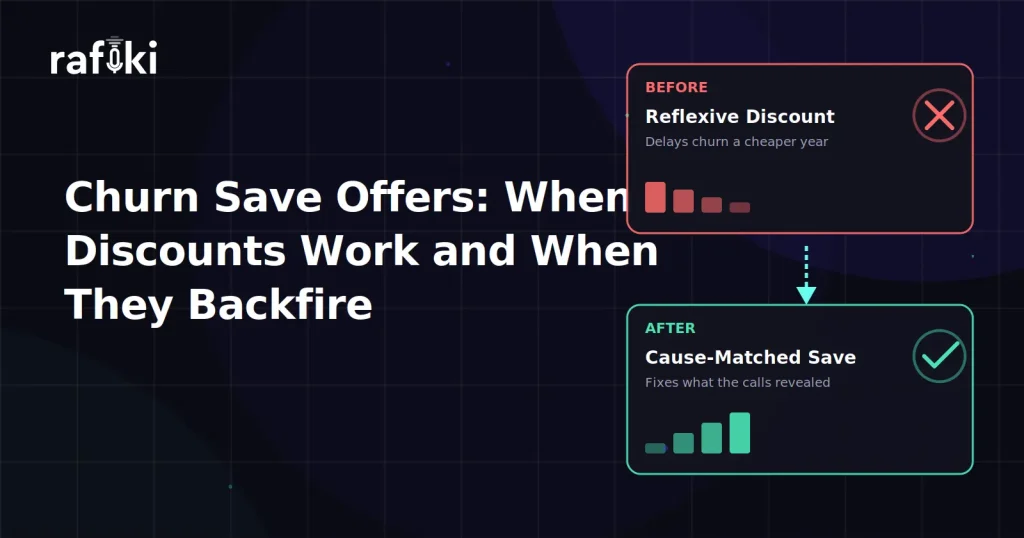
But a discount is only the right medicine for one disease: a genuine budget constraint. Every other churn cause — value gaps, champion departures, product limitations, service fatigue — gets worse when you respond with price, because you've confirmed the product isn't worth what they paid while leaving the underlying defect untouched. Discounting a value problem doesn't save the account. It just delays the churn a cheaper year.
No customer decides to leave on the renewal call. The decision forms slowly — a stalled rollout here, an unanswered escalation there, a QBR where nobody from their side asks a single question. As we detailed in our guide to renewal risk signals hiding in conversations, the red flags show up in calls months before they show up in the CRM.
This matters for save offers because the evidence you need to diagnose the churn cause already exists. It's sitting in your recorded calls. Teams using conversation intelligence can trace the arc of an account's sentiment across every interaction, which means the save conversation starts from evidence rather than guesswork. Forrester's customer experience research has long emphasized that retention outcomes are shaped by the accumulated quality of interactions, not by any single moment — and your call history is the most complete record of those interactions you own.
The practical implication: before anyone proposes a save offer, someone should review what the customer has actually been saying. Those words contain the diagnosis, and the diagnosis determines the play.
Nearly every cancellation traces back to one of five root causes. Each has a distinct verbal signature that appears in calls long before the notice arrives. Learn the signatures and you can classify a churn threat in minutes.
Notice that only the last one is about price. Salesforce's State of Service research consistently finds that customers judge vendors on the quality of the entire service experience — which is why four of the five causes have nothing to do with what the customer pays and everything to do with what they experience.
Once you've classified the cause, the save play writes itself. Effective churn save offers are cause-matched: each root cause gets a response designed for that cause, and the discount is reserved for the one situation where it belongs.
If the customer never reached their outcomes, the save is a credible plan to reach them — not a cheaper price for continued failure. Rebuild the success plan from scratch, name the specific outcomes and dates, and attach an executive sponsor from your side who owns the result. The message: "We didn't get you there, and here is exactly how we will." Skipping this and offering a discount instead tells the customer that failure is now available at a lower rate.
When the sponsor leaves, your contract survives but your consensus doesn't. Treat the new stakeholder as a prospect, because functionally they are one. Run discovery on their priorities, rebuild the business case in their language, and demo the product against their goals rather than their predecessor's. A discount is useless here — the new stakeholder doesn't think the product is overpriced; they don't yet think it's theirs.
If a missing capability is driving the exit, the save has two parts: an honest answer about whether and when the gap closes, and a concrete workaround that reduces the pain now. Honesty matters more than optimism. Customers forgive "not this year, and here's how we'll bridge it" far more readily than a vague "it's on the roadmap" that quietly expires. If the gap will never close, say so — a clean loss beats a resentful renewal.
Support-fatigued customers don't want money. They want to stop chasing. The save is a named owner for every open issue, a committed resolution timeline, and a reset cadence with proactive status updates. In practice, the most powerful sentence is: "You will never have to follow up on this again — that's now my job." A discount, by contrast, reads as compensation for continued bad service, which implies the bad service will continue.
Only now does money enter the conversation — and even here, a raw discount is the weakest option. Structured flexibility protects value while acknowledging the constraint: a pause with a defined restart date, a downgrade to a smaller tier that preserves the relationship, a term swap that trades a longer commitment for near-term relief, or a payment schedule change. Each of these has a built-in story ("we restructured around your budget cycle") that a naked price cut lacks. Structure signals partnership; a discount signals panic.
A mismatched discount doesn't just fail to save the account. It actively damages three other things, and the damage compounds over time.
It reprices your whole book. Discounts don't stay secret. Customers talk to each other at industry events, procurement teams benchmark aggressively, and your own reps mention concessions in negotiations. Consequently, every discount granted to a churning account becomes negotiation leverage for a healthy one. The concession you made to save one renewal quietly resets the anchor for dozens.
It trains customers to threaten churn. If the fastest path to a lower price is a cancellation notice, rational customers will send cancellation notices. You've built an incentive system where the reward for expressing dissatisfaction dramatically exceeds the reward for loyalty. Meanwhile, your calmest, happiest customers pay the most — which is exactly backwards.
It masks the real defect so it never gets fixed. This is the subtlest cost. When a discount "saves" an account with a value problem, the account stops appearing in churn reports, so the onboarding failure that caused the value problem never gets escalated. The defect stays in the system, quietly producing the next dozen at-risk accounts. As a result, the discount didn't just fail one account — it suppressed the signal that would have protected many.
The two approaches differ at every stage, from diagnosis to what gets measured afterward. Here's the side-by-side.
| Dimension | Reflexive Discount Save | Cause-Matched Save |
|---|---|---|
| Starting question | "How much will it take?" | "Why are they actually leaving?" |
| Evidence used | Renewal date and contract value | Call history, escalation record, stakeholder map |
| Treats churn as | A pricing problem | A value, champion, product, service, or budget problem |
| Typical offer | Price cut on the renewal | Replan, re-sell, roadmap bridge, escalation reset, or structured flexibility |
| Effect on price integrity | Erodes it across the book | Preserves it; concessions carry structure and story |
| Customer behavior trained | Threaten churn to get discounts | Raise problems early to get solutions |
| Root defect | Masked and repeated | Surfaced and fixed |
| Success metric | Renewal signed this cycle | Retention and expansion through the next cycle |
Cause-matching only works if it's enforced, and enforcement means gates. A decision tree turns the framework into an operating procedure that survives quarter-end pressure.
The tree runs in order, and each step must be completed before the next unlocks:
The gates exist because under deadline pressure, everyone reverts to the discount — and the gates make reverting more expensive than diagnosing.
A save that churns next cycle wasn't a save. It was a deferral — and a paid one, since the concession cost real margin. Yet most CS dashboards count both identically: the renewal signed, the logo retained, the number went green.
Honest save measurement requires following the account past the save. Specifically, track three things for every saved account: whether it renews again at the next cycle, whether usage and engagement recover after the save, and whether the account ever expands. A cause-matched save should produce recovering engagement within a quarter and a clean renewal at the next cycle. A deferral shows the opposite pattern — engagement stays flat, the discount becomes the new baseline expectation, and the same churn conversation repeats a year later with less leverage.
Finance partners should insist on this distinction, because the two outcomes have completely different economics. A real save preserves full lifetime value. A deferral converts a churn event into a discounted-revenue year followed by a churn event. When you run a churn post-mortem on the calls of a lost customer, include your "saved-then-churned" accounts in the analysis — they're the clearest evidence of which save plays actually work and which merely postpone.
Everything above depends on one capability: knowing why the customer is leaving before you respond. That knowledge lives in your calls, and this is where Rafiki AI changes the mechanics of the save motion.
Rafiki AI acts as the intelligence layer between your customer conversations and your save decisions. Its autonomous AI agents analyze every call across the account's history — QBRs, support escalations, check-ins — and surface the patterns that classify the churn cause. Smart Call Summary captures the blockers, sentiment shifts, and stakeholder changes from each conversation, so the record exists without anyone taking notes. When a cancellation threat lands, Gen AI Search lets the CS leader ask directly: "What has this account complained about in the last two quarters?" or "When did our champion last join a call?" — and get answers grounded in the actual transcripts.
That evidence is what powers Gate 1 of the decision tree. Instead of a CSM's recollection, the diagnosis rests on what the customer actually said, quoted and timestamped. For CS leaders running save reviews, this collapses the diagnostic step from days of call-archaeology to minutes. And because Rafiki AI works as customer success software across the whole team's conversations, the same evidence base feeds your risk detection upstream — as we explored in conversation intelligence for churn prevention, the best save offer is the one you never have to make. Start your free trial today and see the diagnosis your calls have been holding.
Generic save playbooks fail because saves are context-specific. Fortunately, the best source material already exists: the saves your team has actually pulled off.
Go back through your genuinely saved accounts — the ones that renewed again after the save — and study the calls where the save happened. What did your best CSM offer, in what order, and in what words? How did they frame the replan, and what did they say when the customer pushed for a discount anyway? In addition, study the failed saves with equal attention: the concessions that didn't land, the phrasing that hardened the customer's position.
Then codify what you find. For each root cause, document the matched play, the talk track that worked, the concession sequence, and the approval gate it passed through. Review the playbook quarterly, because causes drift — a product gap that drove churn in 2025 may be closed in 2026, while a new service-fatigue pattern emerges. The playbook is a living record of what your team's best retention conversations actually sound like.
The reflexive discount survives because it's easy, not because it works. It answers every churn threat with the same move, misdiagnosing most of them — repricing your book, training customers to threaten, and burying the defects that produce the next wave of churn. Cause-matched churn save offers demand more: a diagnosis from the customer's own words, a play built for the actual problem, gates that hold under pressure, and measurement honest enough to distinguish a save from a deferral.
The good news is that the diagnosis is already sitting in your call recordings. The customer told you why they're leaving long before they told you they're leaving. Teams that listen systematically get to choose the right save play; teams that don't are left choosing a discount. Choose the diagnosis.
A discount belongs in a save offer only when the root cause is a genuine budget constraint — and even then, as the last option after structured alternatives. If the customer praises the product but cites a funding cut, a tool-consolidation mandate, or a spending freeze, commercial flexibility is appropriate. Start with structure: a pause with a restart date, a downgrade to a smaller tier, or a term swap that trades commitment length for near-term relief. These preserve price integrity because they exchange value for value. A raw discount should require executive approval, a documented rationale, and an explicit expiration so it never silently becomes the new baseline. For every other churn cause — value, champion, product, or service — a discount is a mismatch that delays the churn rather than preventing it.
Listen to the full arc of the account's conversations, not just the cancellation call. A genuine budget problem usually arrives with specifics — a named budget cycle, a company-wide mandate, an org change — and is paired with continued engagement: the customer keeps using the product and speaks well of it. A negotiating tactic, in contrast, tends to appear suddenly at renewal time without prior signals, often alongside vague dissatisfaction that shifts when questioned. Review the call history: did anyone mention budget pressure in the preceding two quarters? Has usage stayed healthy? If the "budget problem" appears only when pricing is on the table and evaporates when a discount is floated, you're negotiating, not saving — and the decision-tree gates should treat it accordingly.
Track the account past the renewal it just signed, because the renewal itself proves nothing yet. Three signals matter most. First, next-cycle retention: does the account renew again at the following cycle without another save intervention? Second, engagement recovery: do usage, meeting cadence, and stakeholder participation rebound within a quarter of the save? Third, expansion behavior: does the account ever grow again, or does it stay frozen at the discounted level? A genuine save shows recovering engagement and a clean subsequent renewal. A deferral shows flat engagement, a customer who now expects the concession as standard, and a repeat churn conversation a year later. Reporting saves and deferrals as one number overstates retention and hides which plays are actually working.
Conversation intelligence gives the save motion its missing ingredient: evidence. The root cause of churn — a value gap, a departed champion, a product limitation, service fatigue, or budget pressure — shows up in the customer's own words across months of calls before the cancellation notice arrives. AI-powered analysis captures and structures those conversations automatically, so when a churn threat lands, the CS leader can query the account's entire call history and classify the cause in minutes instead of relying on a CSM's memory. That diagnosis determines which save play to run and which concession, if any, is justified. The same conversation record then powers honest post-save measurement and the post-mortems that turn individual saves into a durable, team-wide playbook.
Rafiki AI's conversation intelligence platform starts at $19 per seat per month with no seat minimums and no annual commitment. Start your free trial today or book a demo to see how cause-matched saves protect your NRR in 2026.
Start for free — no credit card, no seat minimums, no long contracts. Just better sales intelligence.