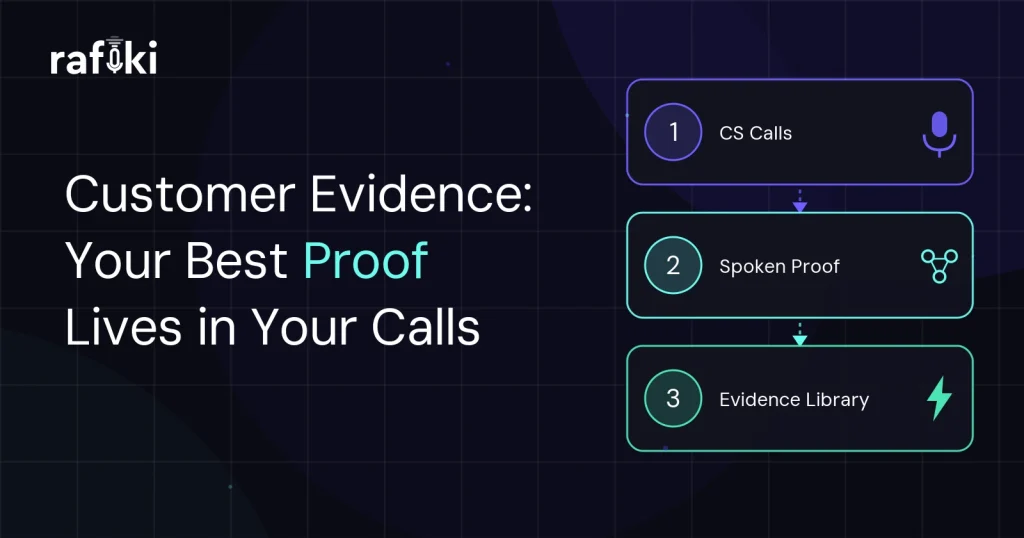
Your customers have been giving testimonials for years. They just gave them in meetings nobody mined.
Somewhere in last quarter's QBRs, a customer said your product cut their reporting time from days to hours. On a renewal call in March, a VP told her team — with your CSM listening — that the rollout was the smoothest vendor onboarding she'd seen. A champion explained to his own procurement group exactly why the spend was justified, in language sharper than anything your marketing team has ever shipped. All of it was spoken, recorded, and forgotten.
Meanwhile, the customer marketing team is running the traditional gauntlet: begging CSMs for referenceable accounts, scheduling testimonial interviews months out, and pushing case-study drafts through approval cycles so long the product has changed by publication. The disconnect is almost comic. The evidence program is starving while the evidence accumulates daily, unharvested, in the call record.
B2B buyers stopped believing polished marketing some time ago; in 2026 they increasingly discount the classic case study too. The format's weaknesses are structural. It is broad where buyer questions are specific, dated the moment it publishes, and so visibly curated that skeptical readers mentally subtract half its claims. Today's evaluation questions sound like "has this worked for a 200-person fintech with a lean ops team?" — and a glossy two-pager about a different company in a different segment does not answer them.
What is replacing the case study is best described as customer evidence: smaller, more specific, more verifiable units of proof, deployed at the moment of need. For example:
Evidence in this form answers situational questions, stays current because it is continuously harvested, and reads as credible precisely because it was not produced for marketing. The strategic question for 2026 is not whether to make this shift — buyer behavior has decided that — but where the evidence supply will come from.
Most customer-evidence programs source proof through surveys and structured asks: send questions, collect responses, verify, publish. That works, and it has a place. But it shares a limitation with the case study — the customer is performing for the record, answering questions they know will be quoted.
The call record is different in kind. In QBRs, renewals, and success reviews, customers describe value spontaneously, to advance their own agenda — justifying the renewal to their boss, explaining the rollout to a new stakeholder, pushing for budget to expand. That speech has properties no solicited testimonial can match:
As Forrester's B2B marketing research has long argued, buyer trust concentrates in peer voices rather than vendor claims. The call record is where the peer voice already exists, in volume — the program's job shifts from generating it to finding, clearing, and deploying it.
Not every kind word is evidence. A working taxonomy for what to extract:
"We closed our books four days faster last quarter." The gold standard — a named result, in the customer's framing. These cluster in QBRs and renewal justifications, where customers quantify value for their own purposes.
"We used to spend Mondays reconciling; now it's done before standup." Less precise than metrics, often more persuasive — prospects recognize their own 'before' in them.
The champion explaining to their CFO or procurement why the spend makes sense. This is rare, precious material: it is literally the script a prospect's champion needs, written by someone who already won the argument.
"Compared to what we did before, this is night and day." Handle with care — never extract anything naming a competitor — but category-level contrasts ("versus our old manual process") are clean and powerful.
The customer who once worried about adoption describing how adoption actually went. Evidence that maps one-to-one onto a live objection in a current deal is the most deployable proof a seller can hold.
| Dimension | Traditional case study | Call-mined customer evidence |
|---|---|---|
| Unit | One long narrative | Many small, specific proof points |
| Production time | Months, with approval cycles | Continuous; clearance per item |
| Freshness | Dated at publication | Renewed weekly by normal CS calls |
| Coverage | The few accounts that agree | The whole book, including the long tail |
| Credibility read | Visibly produced | Spoken in a working meeting |
| Deployment | Attached to everything generically | Routed to the matching objection or criterion |
The two formats are complements, not rivals — the case study still earns its place at the top of the funnel and on the website. What changes is the workhorse role: in the middle of a live deal, the routed, specific, recently spoken proof point does the persuading.
One sourcing note: the mining should include churn calls and tough renewals, not just happy accounts. The customer who stayed after a rocky patch produces the most credible evidence in the library — "we almost left, and here is why we didn't" answers the skeptical buyer's real question better than any unbroken success story. The same final-quarter record we described in the churn post-mortem serves double duty here, on its happier endings.
Everything above operates inside a hard rule: spoken-in-a-meeting is not approved-for-marketing. A customer describing value in a QBR has not consented to appearing in your pitch deck, and treating the call record as a free quote farm is how an evidence program destroys the trust it depends on.
The workable pattern separates discovery from deployment:
Run this way, the program strengthens customer relationships rather than straining them: the approval ask itself tells customers their words mattered.
An evidence library nobody queries is a museum. The payoff comes from routing: matching evidence to the live moment where it changes a buyer's mind. The highest-value routes:
Notice what routing requires: evidence tagged by industry, size, use case, and objection — which is exactly the metadata a conversation-intelligence layer attaches naturally, and a folder of testimonial PDFs never has.
Rafiki AI is an AI-native revenue intelligence platform built on exactly the layer this program needs: every customer conversation captured, transcribed, summarized, and searchable. This piece is the marketing-side sibling of our voice of customer intelligence guide — same source of truth, different harvest.
Applied to evidence mining:
With 60+ language transcription, the program extends to every region's customer calls — evidence from the LATAM book serves LATAM prospects in their own language. For customer success leaders, the practical effect: the CS team stops being the bottleneck for "referenceable customers" and starts being the supplier of a continuously refreshed evidence stream.
The program proves itself fastest as a contained pilot run by one customer-marketing owner with CS's blessing:
The pilot's output is not just a library seed — it is the internal proof that turns the evidence program from a marketing initiative into a revenue workflow sales asks for.
Measurement follows the same routing logic. Track evidence items cleared per month (supply), routes into live deals (deployment), and seller pull-through — how often sales reaches for the library unprompted (adoption). Deal-level attribution will always be soft; supply, deployment, and pull-through are concrete, and they trend within the first quarter.
Customer evidence is granular, verifiable proof of customer outcomes — quotes, metrics, before/after statements — deployed in small units matched to a buyer's specific question. A case study is one long-form, heavily produced narrative. Evidence is faster to produce, easier to keep current, more credible to skeptical buyers, and coverable across the whole customer base rather than the handful of accounts willing to star in a case study. Most programs in 2026 run both, with evidence carrying the volume.
For any external use — yes, always. The workable pattern is mine-internally, clear-before-deploying: discovery inside your own call record is analysis, but every externally used quote gets a specific approval ask, and anonymized framing ("a mid-market healthcare customer told us…") is the default for anything in the gray zone. The specific ask is also good relationship practice — customers consistently respond well to hearing their words mattered.
Specificity, attribution context, and match-ability. "We love the product" is sentiment, not evidence. "We closed our books four days faster in Q1" is strong because it names an outcome, carries a timeframe, and can be matched to prospects who care about close speed. When curating, prefer items that name a workflow, a metric, or a contrast — and always preserve the speaker's role and company profile in the metadata, because an outcome statement from an ops manager lands differently than the same words from a CFO. If an item can't be routed to a specific buyer question, it belongs in the brand pile, not the evidence library.
Customer marketing owns the program; CS owns the relationship; the conversation layer serves both. In practice the division is clean: customer marketing runs discovery queries, manages clearances, and curates the library, while CSMs make the approval asks inside relationships they own. The mistake to avoid is making CSMs responsible for spotting evidence manually — that is exactly the work the search layer eliminates.
Customer marketing has spent years treating proof as scarce — rationing references, celebrating each completed case study, apologizing to sales for thin coverage. The scarcity was an artifact of the harvesting method, not the supply. Customers describe value constantly, in their own words, on recorded calls, for their own reasons. The program that mines that record — with real consent discipline and sharp routing — turns proof from a quarterly artifact into a renewable resource.
The case study had its run. The transcript is the new archive of trust — and yours is already full.
Rafiki AI's autonomous AI agents make every customer conversation searchable, summarized, and evidence-ready. Plans start at $19 per seat per month with no seat minimums and no annual commitment. Start your free trial today or book a demo and run your first evidence query against last quarter's QBRs.
Start for free — no credit card, no seat minimums, no long contracts. Just better sales intelligence.