Twice a year, the calendar invite goes out: "Executive Sync." Your VP joins, their VP joins, and for thirty minutes two senior people exchange pleasantries over a slide deck that summarizes usage, lists a few wins, and ends with a roadmap teaser. Their VP says "great partnership." Your VP says "let us know how we can help." Everyone logs off feeling that the relationship is in good shape. Four months later, the renewal comes in flat, the expansion never materializes, and the account team is told that the executive sponsor "was not really engaged." Nobody can say what the executive actually wanted, because nobody designed the call to find out.
Executive sponsor programs are among the most common customer success initiatives and the least examined. Nearly every enterprise-facing CS organization has one, and few can point to what it changed. The sponsor relationship is treated as a courtesy, the call is treated as a status update, and the outcome is treated as inevitable. That is a waste of the scarcest resource in the account: the attention of the person who signs the renewal.
This article rebuilds the executive sponsor program around evidence. It covers what a sponsor is actually for, why most programs default to ceremony, how to build the sponsor brief from the account's own conversations, how to run an executive call that is not a status update, how to read the executive's questions as signals, and how to turn one call into renewal and expansion outcomes.
An executive sponsor program pairs a senior leader from the vendor with a senior leader at the customer, with the stated purpose of maintaining alignment above the day-to-day relationship. The vendor executive is meant to be an escalation path, an advocate inside their own company for the customer's needs, and a peer the customer's executive can speak candidly with. The customer's executive, in turn, is the person whose priorities determine whether the product stays strategic or slides into a line item.
The program exists because the operational relationship, however strong, does not reach the people who make renewal and expansion decisions. A CSM can have a superb relationship with an admin and still lose the account when the admin's VP decides the budget goes elsewhere. The sponsor program is the mechanism for keeping the vendor visible and relevant at the level where those decisions are made.
That purpose is clear. What is missing in most programs is any connection between the purpose and the content of the calls. If the sponsor call does not surface what the executive cares about, test whether the product is delivering it, and produce a commitment, it is a networking event with a renewal attached.
Why do programs designed to secure the most important relationships in the book drift into pleasantries? The forces are structural, and they explain why "make the exec calls more strategic" never sticks as an instruction.
The pattern is not unique to customer success. Salesforce's State of Service research keeps returning to the expectation that vendors know a customer's history and context before every interaction. Executive sponsors are the vendor's most senior interaction, and they are routinely the least informed people on the call.
The direct cost is a renewal decided without the vendor's most senior voice in the room, because that voice never said anything the customer's executive needed to hear. The larger costs are quieter.
Expansion opportunities go unspoken. The customer's executive often has a broader initiative that the product could serve, and they would mention it to a peer who asked the right question. Nobody asks, so the expansion lives in the customer's head until a competitor asks first. Risks stay hidden too. An executive who is quietly unhappy will not volunteer it in a status review, but will answer honestly when asked directly by a peer who has done their homework. The sponsor program is the one place that question can be asked, and it is usually skipped.
Finally, the program consumes executive time with nothing to show for it, which is how it eventually gets cut. As Harvard Business Review's reporting on sales teams embracing agentic AI describes, successful sales teams are embracing agentic AI as a way to equip their people rather than replace them. Context before a customer interaction is the clearest example. The executive call is the interaction where context matters most and is supplied least.
The sponsor brief is the document the vendor executive reads before the call, and it is where most programs fail. A brief built from usage dashboards and ticket counts produces a status update. A brief built from what the customer's people have actually said, across every conversation with the account, produces a peer who arrives knowing more about the executive's priorities than the executive expects.
The evidence for that brief exists in the account's conversation history, captured by a conversation intelligence platform across every CSM call, QBR, support escalation, and sales conversation. The brief pulls five things from it:
A brief built this way takes minutes when the conversation record is searchable and hours when it is not, which is why programs without the evidence infrastructure default to dashboards. The difference shows up immediately on the call. An executive armed with the customer's own words can open with a specific question, and a specific question is what pulls the customer's executive out of polite mode. The dashboard-based brief, by contrast, gives the vendor executive nothing to ask, so the call settles into the presentation both sides expected. In that sense the brief is not preparation for the call; it is the call, decided in advance.
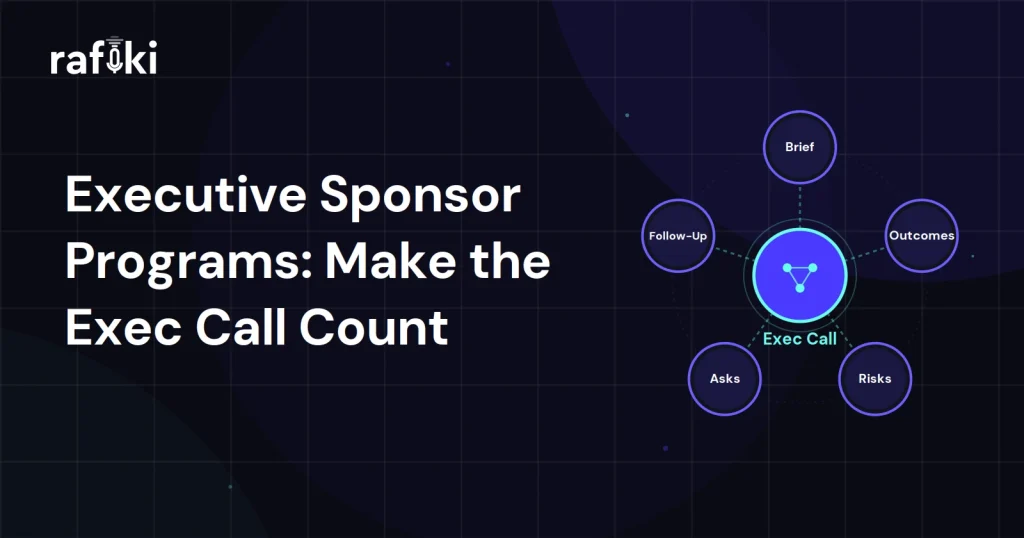
With the brief in hand, the call itself changes shape. The vendor executive's job is not to present; it is to ask, listen, and commit. A workable structure has four movements.
State the outcome the customer bought and quote something their team said recently about progress toward it. Then ask the executive whether that is still the priority. Their answer, in the first five minutes, tells you whether the account is strategic or drifting.
Raise the unresolved blockers from the brief, say what has been done, and ask whether the executive sees others. Naming risks first converts the vendor executive from a presenter into a partner, and it makes the customer's executive far more likely to share the risk they were not going to mention.
Ask what the executive is trying to accomplish in the coming year that the vendor might not know about. This is the expansion question, asked peer to peer. The answer is often something no CSM has heard, because nobody at that level was asked.
End with one thing the vendor will do, one thing the customer will do, and a date. "Let us know how we can help" is not a commitment. "We will have the integration scoped for your ops team by the fifteenth, and you will introduce us to the finance lead running the reporting initiative" is.
What the executive asks is often more revealing than what they say, and a recorded call makes it possible to read those questions afterward rather than reconstructing them from memory. A few patterns recur:
Read across the whole portfolio, executive questions become a leading indicator of renewal health that no usage dashboard provides, because they come from the person who decides.
Rafiki AI is built to give executive sponsors the context they never have, because it captures and analyzes every conversation with the account, across CSM calls, QBRs, escalations, and sales meetings, on video and phone, transcribed in more than sixty languages. The sponsor brief becomes a query rather than a research project.
Gen AI Search answers the brief's questions directly: what did this customer say they wanted to achieve, what has their team said about the product this quarter, which blockers remain open, and what did their executive ask last time. Each answer is cited to the moment in the call where it was said, so the executive can hear the customer's own voice before the meeting. Gen AI Reports turns that into a standing sponsor brief that a customer success leader can generate for every executive call in the program, formatted the same way each time.
During and after the call, Smart Call Summary captures the executive's questions, stated priorities, and the mutual commitment, and Smart Follow Up drafts the recap that puts the commitment in writing the same day. Stakeholder participation mapping records whether the executive attended themselves or sent a deputy, and sentiment analysis flags the call where the tone shifted. Smart CRM Sync writes the commitments and expansion signals into the account record so they reach the people who act on them. Rafiki AI's autonomous AI agents supply the context; the executives supply the relationship.
| Dimension | Ceremonial program | Evidence-based program |
|---|---|---|
| Pre-read | Usage dashboard and ticket list | Brief built from the account's conversations |
| Vendor executive's role | Present | Ask, listen, commit |
| Opening | "Here is your usage" | "Last time you said…" |
| Risks | Avoided | Named by the vendor first |
| Expansion | Roadmap teaser | "What are you trying to do next year?" |
| Close | "Let us know how we can help" | Mutual commitment with a date |
| What is tracked | That the call happened | Questions asked, commitments kept, attendance |
Executive sponsor calls are most valuable well before the renewal, when the executive's answers can still change what the vendor does. Scheduled six months out, the call surfaces risks with time to fix them and expansion initiatives with time to scope them. Scheduled the month before renewal, it is a negotiation in disguise, and both sides know it.
For a January renewal cohort, that means the sponsor calls belong in September and October, which makes now the moment to rebuild the briefs. Run the program on evidence this fall, and the January renewals arrive with the executive already on record about what they wanted, what was delivered, and what comes next.
Executive sponsor programs fail when they treat the most senior relationship in the account as a courtesy and the call as a status update. They work when the vendor executive arrives knowing what the customer bought, what their team has been saying, what remains unresolved, and what the executive themselves said last time, then asks rather than presents, names risks first, asks about the next initiative, and leaves with a mutual commitment. Rafiki AI makes that preparation automatic, with autonomous AI agents that capture every conversation with the account, build the brief from the customer's own words, and record what the executive asked so the whole team can act on it. Make the executive call count this fall. The renewal will show it in January.
An executive sponsor is a senior leader at the vendor who is paired with a senior leader at the customer to maintain alignment above the operational relationship. The vendor sponsor serves as an escalation path, an internal advocate for the customer's needs, and a peer the customer's executive can speak candidly with. On the customer side, the executive is typically the person whose priorities decide whether the product remains strategic at renewal. The program exists because even an excellent day-to-day relationship with admins and users does not reach the level where renewal and expansion decisions are actually made.
Build a brief from the account's conversation history rather than from usage dashboards. Capture the outcome the customer said they wanted when they bought, in their words; what the executive's own team has said recently, with names attached; unresolved blockers from past calls; expansion signals such as mentions of other teams or upcoming initiatives; and what the executive themselves said and asked last time, verbatim. A vendor executive who opens with "last time you mentioned…" and quotes the customer's team back to them signals that the relationship is real. With a searchable conversation record, the brief takes minutes; without one, it defaults to the dashboard.
Four movements, none of them a status update. Open with the outcome the customer bought and a recent quote from their team about progress, then ask whether that is still the priority. Name the unresolved risks before the customer does, say what has been done, and ask what else the executive sees. Ask what the executive is trying to accomplish in the coming year that the vendor may not know about, which is the expansion question asked peer to peer. Close with one thing the vendor will do, one thing the customer will do, and a date. Usage numbers belong in the pre-read, not the meeting.
Often enough that the vendor executive can act on what they hear before the renewal, which usually means well before the final quarter of the contract. For a renewal cohort in January, sponsor calls in September and October surface risks with time to fix them and expansion initiatives with time to scope them. A call scheduled the month before renewal becomes a negotiation in disguise. Beyond timing, consistency matters: an executive who attends in person, asks questions, and keeps commitments is engaged, while one who sends a deputy or asks nothing is signaling something the account team needs to hear before the renewal conversation begins.
Rafiki AI's conversation intelligence platform starts at $19 per seat per month with no minimums and no annual commitment. Start your free trial today or book a demo to give every executive sponsor the brief they never had.
Start for free — no credit card, no seat minimums, no long contracts. Just better sales intelligence.