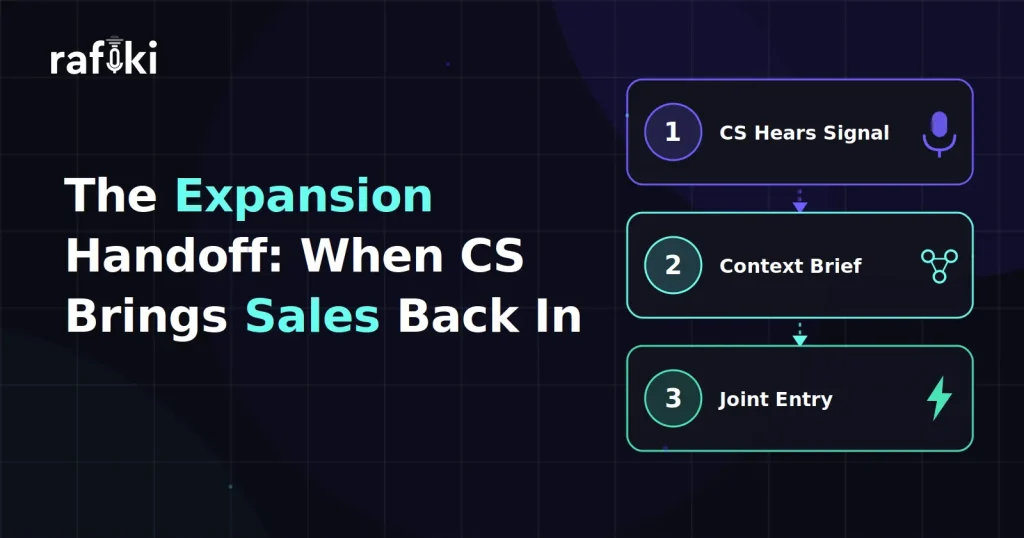
Most SaaS companies have spent years polishing the sales-to-CS handoff at closed-won. The expansion handoff — the return trip, when customer success brings sales back into an account — barely exists as a designed motion. A customer voices a need beyond their current contract, and what happens next is usually improvised. In revenue terms, improvisation is where expansion goes to die.
Picture the moment. In a quarterly business review, a customer mentions another department keeps borrowing logins, or asks whether the product "could also" handle a workflow it was never bought for. The CSM hears it, nods, and moves on — because selling isn't their job, or because they fear going commercial will poison a year of hard-won trust. Alternatively, the signal does reach sales, and an account executive calls the customer cold, re-running discovery and asking questions the customer answered months ago — burning in one meeting a relationship CS spent quarters earning.
Both failure modes trace to the same root cause: nobody designed the handoff. This article maps the return trip — when CS should bring sales back in, what context must transfer, how the entry gets choreographed, and how to instrument the loop so expansion signals stop dying in the gap between org charts.
Expansion moments die because the person who hears the signal and the person who can act on it sit in different organizations, with different goals, tools, and definitions of success. CS hears the signal but doesn't sell. Sales sells but never hears the signal. The moment falls into the seam between them.
Consider how each side experiences it. The CSM is measured on retention, health, and adoption; a mention of a new use case registers as an interesting data point, not a commercial event. Meanwhile, the account executive who closed the deal has moved on to new logos, and the expansion seller — if one exists — has no visibility into the conversations where these signals surface. As a result, the most qualified expansion lead a company can get — a happy customer describing a new need in their own words — routinely goes nowhere.
The pressure to fix this is growing. Service and success teams are increasingly expected to contribute to revenue, not just protect it — a shift documented in Salesforce's State of Service research, which tracks how service organizations are taking on growth responsibilities alongside support. That expectation lands hard on CS teams who were never given a mechanism for it. Telling CSMs to "surface expansion opportunities" without designing the handoff is like telling reps to "do better discovery" without a methodology — the intent is fine, but the operating model is missing.
NRR makes the stakes explicit. When net revenue retention is the number the board watches, every fumbled expansion moment is a direct hit to the growth story — and most fumbles are invisible, because nobody logged the signal in the first place.
An expansion signal is a customer statement that implies a need beyond the current contract — more seats, a new product, a new team, or a bigger scope. The challenge is that these signals almost never arrive labeled. They surface mid-sentence, in passing, inside conversations that are officially about something else.
In practice, the highest-value signals cluster into four patterns:
Not every question is a signal, and treating polite curiosity as buying intent is how CS teams learn to distrust the whole motion. The difference usually shows up in specificity and repetition. A customer with real intent describes a concrete problem, names the people who have it, and returns to the topic across multiple conversations. In contrast, polite curiosity is abstract and singular — "oh, interesting, you do that too?" — and never resurfaces. Customer experience researchers at Forrester have long argued that customers reward companies that act on what they've already said — and punish those that make them repeat themselves. Chasing every idle question annoys customers; ignoring repeated, specific need statements leaves money on the table. The skill is telling them apart, and that skill can be systematized.
Once a real signal exists, the next question is ownership: does CS run the expansion themselves, or does the moment call for an expansion handoff to sales? Getting this boundary explicit — in writing, agreed by both leaders — matters more than where exactly you draw it.
A useful default: CS handles expansions that extend the existing decision, and sales handles expansions that require a new decision.
CS can typically run solo:
Bring sales back in when the moment involves:
The split protects both sides. Asking a CSM to negotiate enterprise terms forces them to become an adversary at the exact moment they should remain an advocate. Conversely, routing a routine seat add through a full sales cycle adds friction to something the customer just wants done. Match the weight of the motion to the weight of the decision.
When sales does come back in, the handoff lives or dies on context. At closed-won, good teams hand CS a brief: why the customer bought, who the champion is, what was promised. The expansion handoff needs the mirror image — a brief from CS to sales that makes re-discovery unnecessary.
That brief should contain, at minimum:
Without this brief, sales re-enters blind, and blind entry produces B2B's most trust-destroying experience: the customer repeating things they already told your company.
How sales re-enters the account matters as much as when. The fumbled version is familiar — an unexpected calendar invite from someone the customer has never met, titled "Growth Opportunities Discussion." The choreographed version has three moves.
First, CS asks permission. The CSM names what they heard and offers the introduction: "You've mentioned the ops reporting problem a few times — would it be useful if I brought in a colleague who handles that product? I'll stay involved." Framed that way, the introduction is a service, not a sales play. Customers almost never refuse an offer to solve a problem they raised themselves — and if they do refuse, that's signal too: the intent wasn't real yet.
Second, sales enters knowing everything. No re-discovery of facts the customer already gave CS. The account executive's opening move should demonstrate context — "I know your ops lead is rebuilding that report manually every week" — and go deeper from there. Discovery still happens, but it starts from what's known instead of from zero.
Third, CS stays in the room. This is the piece most teams skip. Trust doesn't transfer from CSM to AE through an email intro; it extends only while the trusted person remains present. By joining the expansion conversations, the CSM vouches implicitly and protects the customer from anything that smells like a bait-and-switch — and once the deal closes, they're the continuity that makes the new promise real.
The contrast between the default motion and the designed one is stark enough to tabulate:
| Stage | Fumbled Expansion Moment | Choreographed Expansion Handoff |
|---|---|---|
| Signal capture | Lives in the CSM's memory or private notes | Logged verbatim, visible to both CS and sales |
| Qualification | Gut feel, or every mention treated as a deal | Intent separated from curiosity via specificity and repetition |
| Ownership decision | Ambiguous; signal sits while everyone assumes someone else owns it | Explicit CS-solo vs. bring-sales-in boundary, agreed in advance |
| Context transfer | One-line Slack message: "Acme might want more seats" | Written brief: verbatim quotes, temperature, renewal timing, stakeholders |
| Sales entry | Cold outreach; re-runs discovery from zero | Warm introduction with customer's permission; builds on what's known |
| CS role after entry | Steps out; hopes for the best | Stays in the room; trust extends rather than transfers |
| Customer experience | "Why am I repeating myself to a stranger?" | "They heard me, and they brought the right person" |
| Incentives | CS has no reason to surface signals | CS gets credit and visibility when signals convert |
Read the left column as a diagnostic: if more than a couple of rows describe your motion today, your NRR problem may really be a handoff problem.
Every CS leader eventually discovers that process design can't outrun incentive design. If surfacing an expansion signal creates work, risk, and zero upside for the CSM, signals will stay buried — however elegant the playbook.
The fix is qualitative and structural, not a formula. A few principles hold across most teams:
Sales leaders have a mirror obligation: expansion sellers who treat CS-sourced signals as low-status leads, or who freeze CS out after the intro, will find the signal flow drying up within a quarter. Reciprocity is the currency of this loop.
Everything above assumes the signal gets captured in the first place — and that's precisely where human-only systems fail. A CSM running back-to-back calls cannot reliably notice, log, and route every "can it also..." moment. This is where conversation intelligence changes the economics of the expansion handoff.
Rafiki AI listens to every customer conversation — QBRs, check-ins, support escalations, renewal calls — and its autonomous AI agents flag expansion signals as they occur: new use cases described, other teams mentioned, capacity complaints, adjacent-product questions. Instead of depending on a CSM's memory, the signal is captured with the exact quote, the speaker, and the moment in the call. We covered the detection side in AI Account Expansion: Finding Upsell Signals in Conversations; the handoff is where that detection becomes revenue.
The context transfer, in particular, stops being a chore. A Smart Call Summary of the conversation where the signal surfaced gives the account executive the verbatim moment, the stakeholders present, and the surrounding discussion — the closed-won brief's mirror image, generated automatically. Before the entry call, the AE can use Gen AI Search to ask questions across the account's entire conversation history: What has this customer said about budget? Who mentioned the EMEA team? How did the last pricing discussion go? Re-discovery becomes unnecessary because nothing the customer said was ever lost.
For CS leaders, this doubles as customer success software that protects the team from the "going commercial" fear: CSMs aren't selling, they're routing — and the system does the paperwork. Start your free trial today and see what signals are already sitting in last month's calls.
Tooling captures signals; cadence converts them. Two operating rituals close the loop.
The shared signal queue. Every flagged expansion signal lands in one queue visible to both CS and sales, with the quote, the account context, and a disposition: CS-solo, handoff, monitor, or dismissed. The queue kills the two classic failure states — signals trapped in one team's tooling, and signals everyone assumes someone else is working — and creates the ledger that makes credit-giving honest.
The monthly CS-sales expansion review. Once a month, CS and sales leadership walk the queue together: what was surfaced, what was worked, what converted, what stalled, and — most instructively — what was dismissed and shouldn't have been. Over time this meeting calibrates the whole system: both teams converge on what real intent sounds like, the solo-versus-handoff boundary gets refined against actual cases, and fumbles get diagnosed while the account can still be recovered. Teams that run this review consistently, as we explored in AI for Expansion Revenue, stop treating expansion as a happy accident and start treating it as an operated pipeline.
None of this requires new headcount — only that signals be visible, ownership be explicit, and the two org charts look at the same list once a month.
The sales-to-CS handoff at closed-won gets a playbook, a template, and a kickoff meeting. The expansion handoff — the return trip that actually grows NRR — gets improvisation, and improvisation gets fumbles: CSMs sitting on signals they don't feel licensed to act on, and sellers walking cold into relationships they didn't build.
The fix is not cultural exhortation; it's design. Define what a real signal sounds like. Draw the CS-solo versus bring-sales-in boundary explicitly. Standardize the context brief so sales enters knowing everything, with the customer's permission, while CS stays in the room. Give CS credit for surfacing without turning them into sellers. Then instrument the loop so no signal depends on anyone's memory — a queue both teams see and a monthly review that keeps it honest.
Your customers are already telling your CS team what they want to buy next. In 2026, the companies winning on NRR are simply the ones that built the machinery to hear it, route it, and act on it without breaking trust. That machinery is the expansion handoff.
An expansion handoff is the designed transition in which customer success brings sales back into an account after a customer signals a need beyond their current contract — a new product, a new team, more capacity, or renegotiated terms. It's the mirror image of the closed-won handoff: instead of sales briefing CS on why the customer bought, CS briefs sales on what the customer now needs, what they said verbatim, the relationship's temperature, and the renewal timing. A well-run expansion handoff includes a permission-based introduction, a full context transfer so the customer never repeats themselves, and continued CSM involvement through the deal. Without a designed handoff, expansion signals typically die in the gap between the CS and sales org charts.
A useful rule: CS runs expansions that extend the existing decision, and sales runs expansions that require a new decision. Seat additions, standard tier upgrades, and renewal-time adjustments at published pricing usually stay with CS, because adding a sales cycle there only creates friction. Bring sales back in when the opportunity involves a new product or module, a new business unit or geography with new stakeholders and budget owners, negotiated or custom terms, or a competitive evaluation. Those situations need real discovery, commercial negotiation, and deal management — work CSMs weren't hired for and shouldn't be forced into, since negotiating adversarially can damage the advocate relationship that makes CS effective. The exact boundary matters less than making it explicit and agreeing on it across both teams in advance.
Direction and trigger. The closed-won handoff moves a new customer from sales to CS at a scheduled moment, usually with a standard template. By contrast, the expansion handoff moves from CS to sales, and it's triggered by an unpredictable event: a customer voicing a need mid-conversation — which makes it harder to operationalize, because the signal must first be noticed and captured. The content also inverts: the brief covers what the customer said verbatim, relationship temperature, renewal timing landmines, and who on the customer side signaled the need. And unlike closed-won, the original owner doesn't exit — CS stays in the room, because the customer's trust extends through their presence rather than transferring to the new face.
AI-powered conversation intelligence listens to every CS conversation — QBRs, check-ins, escalations — and flags expansion-signal patterns a busy CSM can miss: new use cases described, other teams mentioned, capacity complaints, and "can it also..." questions. Each signal is captured with the verbatim quote, the speaker, and the call context, then routed to a shared queue both CS and sales can see. When a handoff happens, an automatically generated call summary gives the account executive the full context brief, and searchable conversation history answers discovery questions before the first meeting. As a result, no signal depends on memory, the context transfer takes minutes instead of meetings, and sales enters already knowing everything the customer has said.
Rafiki AI's conversation intelligence platform captures expansion signals from every customer conversation and starts at $19 per seat per month with no seat minimums and no annual commitment. Start your free trial today or book a demo to see how the expansion handoff works when nothing your customers say gets lost.
Start for free — no credit card, no seat minimums, no long contracts. Just better sales intelligence.