The deal is in legal, the buyer's CFO wants to talk to "someone who's actually using it," and the AE sends the request to customer success at four on a Thursday: "Need a reference call by Monday, enterprise, ideally finance." So CS scrolls the list of customers who said yes to being a reference eighteen months ago, finds one who might still be happy, and sends a hopeful email. Then the call happens. The customer says nice things, the CFO asks about implementation, the customer tells a story about their implementation that has nothing to do with the CFO's concern, and everyone hangs up feeling that it went fine. Whether the deal closes or not, nobody connects the outcome to the call. That is how many reference calls go.
Reference calls are among the most persuasive assets in the sales process and among the least prepared. A buyer who has heard the pitch, seen the demo, and read the case study still wants to hear a peer say it, and what that peer says carries more weight than anything the vendor has produced. Yet the call is typically arranged in a panic, staffed by whoever will say yes, and run with no idea what the buyer actually needs to hear. The customer's goodwill is spent on a conversation nobody designed.
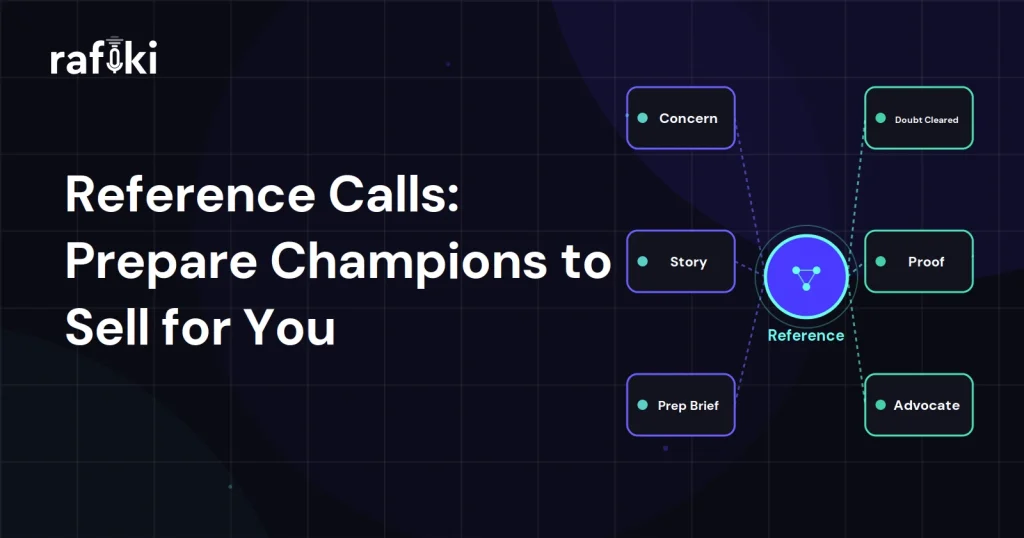
This article treats reference calls as a program rather than a favor. It covers what a reference call is for, why most of them underperform, how to match the reference to the buyer's stated concerns, how to prepare the champion with what the prospect actually said, what to listen for on the call itself, and why a well-run reference program pays a renewal dividend on the customer side too.
A reference call is a conversation between a prospective buyer and an existing customer, arranged by the vendor, in which the customer speaks about their experience so the buyer can validate the vendor's claims from a source with no stake in the sale. It usually happens late in the buying process, after the buyer has decided the product could work and before they commit, and its purpose is to resolve the specific doubts that remain.
That last clause is the one many programs miss. A reference call is not a testimonial; it is a targeted answer to what the buyer is still worried about. The CFO who asked for a reference is not asking whether the product is good in general. They are asking whether the implementation will be as painless as promised, or whether the reporting will satisfy their auditors, or whether the vendor will still pick up the phone in year two. The call is valuable to the extent that the reference speaks to that concern, and useless to the extent that it does not.
Seen that way, the reference call is a matching problem and a preparation problem before it is a scheduling problem. The right customer, briefed on the right concern, will close the doubt in fifteen minutes. The wrong customer, or the right one unbriefed, will produce a pleasant call that changes nothing.
Why does a conversation with this much persuasive power so often produce so little? The reasons are structural to how references are managed, and each one is fixable.
The pattern reflects a broader truth about B2B buying. Forrester's B2B marketing research has long treated peer validation as a central force in B2B buying. The reference call is where that validation happens live, and it is a part of the process many vendors leave to chance.
A wasted reference call costs more than the half hour. It spends a customer's goodwill, which is finite, and it leaves the buyer's doubt intact at the moment the deal could have closed.
On the customer side, every reference request is a withdrawal from the relationship. A champion asked to do three calls a quarter with no preparation, no feedback, and no visible outcome begins to say no, and the reference list shrinks to the customers who are too polite to refuse. On the buyer side, an unfocused reference produces a strange effect: the buyer hears positive things and comes away no more certain, because the specific worry they brought was never addressed. The deal continues with the doubt still in it, and the doubt often resurfaces at the negotiation table as a request for a concession or a pilot.
Salesforce's State of the Connected Customer research has made the link between trust and a vendor's understanding of the customer a recurring theme. A reference call is the vendor's chance to demonstrate that understanding through a third party. When the reference does not know the buyer's situation, the demonstration fails.
The match starts with the buyer's own words. Somewhere in the recorded sales conversations, the buyer said what they are worried about, usually more than once and usually in passing. A conversation intelligence platform that captures every call makes those concerns findable, and they define what the reference needs to be able to speak to.
Matching this way also builds a better reference list over time. Instead of a list of names, it becomes an index of customers by the concerns they can credibly address, drawn from what they have actually said.
A prepared champion is the difference between a testimonial and a targeted answer. The preparation is short, respectful of the customer's time, and built from what the prospect said.
Tell the champion, specifically, what the prospect is worried about, quoting the prospect where appropriate. "Their CFO said she has been burned by tools that promised a six-week implementation and took six months." The champion now knows exactly which of their experiences matters.
Customers forget the details of their own journey. Pull from their CS conversations what they said at kickoff, what went wrong, what was fixed, and what they said once it was working. Offering it back to them, in their words, refreshes the story and signals that the vendor has been listening to them too.
Buyers trust references who admit something went wrong. A champion who says "the first month was rough and here is how they handled it" is more persuasive than one who says everything was perfect. Give the champion permission to be candid; it makes the positive parts believable.
Fifteen minutes, one concern, and a specific thank-you afterward with the outcome. Champions who learn that their call helped close a deal do the next one gladly. Champions who hear nothing stop answering.
When the buyer consents to the call being recorded, or when the buyer debriefs the vendor afterward, the reference call becomes a source of the most candid buyer signal in the deal. The buyer asks the reference what they would not ask the AE. Three things are worth reading closely.
Read this way, the reference call feeds back into the deal and into the company's understanding of why customers buy, which is the same loop we described in our guide to customer evidence.
Rafiki AI is built to make reference matching and preparation practical, because it captures both sides of the evidence: the prospect's concerns from the sales conversations and the customer's story from their CS conversations, across video and phone, transcribed in more than sixty languages.
On the prospect side, Gen AI Search pulls the buyer's unresolved concerns and the questions they kept returning to, cited to the moments they were raised, so the reference request names the concern rather than the segment. Blocker detection and sentiment analysis flag which stakeholder holds the doubt. On the customer side, the same search finds which customers have spoken, in their own calls, about the concern the prospect has, and stakeholder participation mapping shows whether the account is currently warm enough to ask.
For preparation, Smart Call Summary supplies the champion's own story from their kickoff and CS calls, and Smart Follow Up drafts the thank-you after the call, with the outcome included. When the buyer consents to recording, the reference call joins the deal record, and Gen AI Reports gives customer success leaders a standing view of the evidence behind the program: which customers have described which outcomes on their calls, and how recently each account's conversations have been positive. Rafiki AI's autonomous AI agents do the matching and the preparation; the champion supplies the credibility only a customer has.
| Dimension | Ad-hoc reference calls | Evidence-based reference program |
|---|---|---|
| The request | "Need an enterprise reference" | The buyer's concern, quoted from the call |
| Reference selection | Whoever said yes once | Customer whose own calls address that concern |
| Relationship check | None | Account temperature from recent conversations |
| Champion preparation | Company name and time | The concern, their own story, permission to be candid |
| Vendor learning | None | Buyer's real questions, unresolved doubts, customer language |
| Champion experience | Repeated asks, no feedback | Small asks, specific thanks, visible outcomes |
| Program view | A list of names | An index of customers by what they can prove |
A reference program run this way pays the customer success team back directly. Champions who are prepared, thanked, and shown outcomes become more invested in the vendor, not less; the act of telling their story reminds them of the value they get. The preparation step itself, in which CS pulls the customer's own journey from their conversations, is also a health check: it surfaces the customers whose story has gone stale or whose recent calls have cooled, which is exactly the signal a renewal-season CS team needs.
The strongest reference customers tend to be the ones most likely to expand, and the concerns prospects raise are a preview of the questions existing customers will ask at renewal. Treated as a shared asset between sales and CS, the reference program becomes one of the few motions that improves win rates and retention at the same time.
Reference calls carry more persuasive weight than anything a vendor can say, and most of that weight is wasted on calls arranged in a hurry, staffed by the willing, and run without the buyer's concern in the room. The fix is evidence on both sides: the prospect's doubt, in their own words, from the sales conversations, and the customer's story, in their own words, from the CS conversations. Match on the concern, prepare the champion with what the prospect said, listen to what the buyer asks, and thank the champion with the outcome. Rafiki AI makes that matching and preparation automatic, with autonomous AI agents that surface the concern, find the customer who can answer it, and put the champion's own story back in their hands. Send the right customer with the right story, and the reference call closes the doubt instead of filling the calendar.
It is a conversation the vendor arranges between a prospective buyer and an existing customer, so the buyer can hear about the product from someone with no stake in the sale. It typically happens late in the buying process, after the buyer believes the product could work and before they commit. Its real purpose is narrower than a testimonial: it exists to resolve the specific doubts the buyer still holds, such as implementation effort, ongoing support, or total cost. A reference call that addresses the buyer's actual concern can close the deal; one that does not is a pleasant conversation that changes nothing.
Start from the buyer's concern, not from the reference list. Find, in the recorded sales conversations, what the buyer is still worried about and which stakeholder holds the doubt. Then search the customer base for customers who have talked about that exact concern in their own conversations, because a customer who lived through the problem and saw it resolved is more credible than one whose experience was uneventful. Match the persona: a finance leader's concern needs a finance-side reference. Finally, check the relationship's current temperature from recent CS calls, since a customer in an escalation or a renewal negotiation is a risk regardless of past willingness.
Briefly and specifically. Tell the champion what the prospect is worried about, quoting the prospect where appropriate, so they know which part of their experience matters. Remind them of their own story by pulling what they said at kickoff, what went wrong, how it was resolved, and what they said once it worked, drawn from their own CS conversations. Give them explicit permission to be candid about the hard parts, because admitted difficulty makes the positive parts believable. Keep the ask to about fifteen minutes and one concern, and follow up afterward with a specific thank-you that includes the outcome, which is what makes champions say yes next time.
Only with the buyer's and the customer's consent, and many buyers prefer the call to be private. When recording is agreed, the call becomes the most candid buyer signal in the deal, because the buyer asks the reference what they would not ask the vendor. The questions they ask reveal the real concerns, their follow-up questions mark the doubts still unresolved, and the language the reference uses to describe value often belongs in the vendor's own talk track. When recording is not appropriate, a short debrief with the champion afterward captures much of the same signal. Either way, the point is to learn from the call rather than simply hold it.
Rafiki AI's conversation intelligence platform starts at $19 per seat per month with no minimums and no annual commitment. Start your free trial today or book a demo to match every reference call to the concern that decides the deal.
Start for free — no credit card, no seat minimums, no long contracts. Just better sales intelligence.