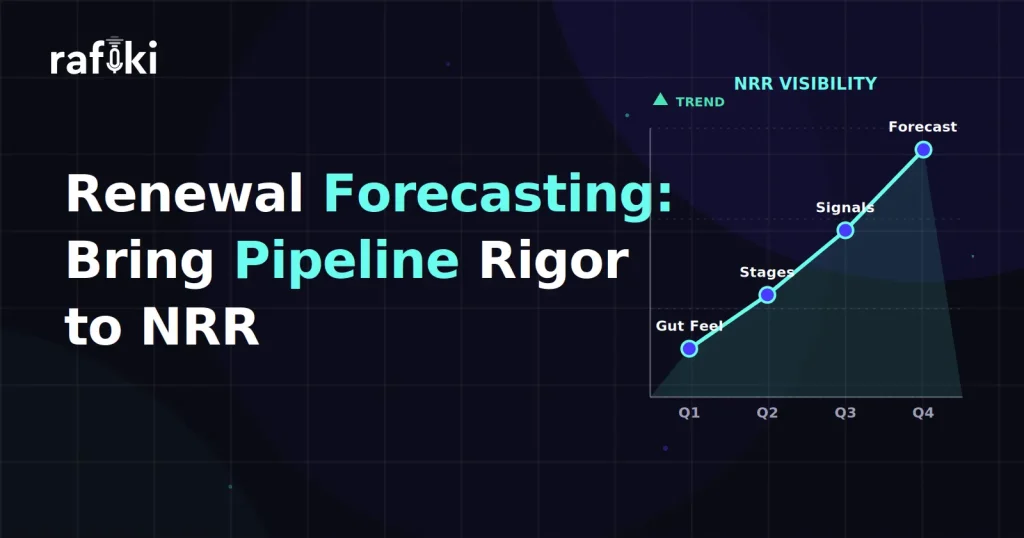
Ask a CRO how they forecast new business and you'll hear a system. There are committed, best-case, and pipeline categories with strict entry criteria. Stage gates demand evidence, and a weekly forecast call inspects every material deal. Ask the same CRO how the company forecasts renewals, and the answer is usually a spreadsheet, a color-coded health column, and a CSM's gut feeling. Renewal forecasting — predicting the revenue you supposedly already own — rarely receives a fraction of the rigor applied to revenue you haven't earned yet.
That asymmetry has a predictable cost. When a renewal slips or churns, it lands as a surprise, because nothing in the process was designed to surface evidence early. Meanwhile, the board scrutinizes net revenue retention more closely than almost any other metric, since NRR compounds into valuation, burn efficiency, and growth durability.
The fix is not another dashboard. Instead, it's a transplant. Take the forecasting discipline sales teams have refined over decades — evidence-based stages, honest categories, weekly inspection — and apply it to the renewal book. This article lays out exactly how, piece by piece.
Renewal forecasting is the practice of predicting which contracts will renew, at what value, and with what confidence. It relies on defined stages, category criteria, and inspection cadences rather than intuition. Most organizations skip that definition entirely. Because a renewal feels like revenue already won, teams treat it as an administrative event rather than a deal that must be re-earned.
The history explains the gap. Sales forecasting matured under pressure. Missed quarters embarrassed CROs in front of boards, so the discipline hardened into stage gates, category definitions, and forecast calls. Renewals, by contrast, grew up inside customer success organizations that were measured on satisfaction and adoption, not on revenue prediction accuracy. As a result, the renewal "forecast" became a spreadsheet column labeled green, yellow, or red — with no shared definition of what any color means.
Consider how differently the two motions handle uncertainty. A new-business deal cannot enter the commit category without a signed-off business case, a mapped buying process, and a confirmed timeline. A renewal enters "green" because the CSM had a pleasant call three weeks ago. Customer expectations keep rising, as Salesforce's State of Service research explores, which means a pleasant call is an ever-weaker proxy for a secured renewal.
Gut-feel renewal forecasts fail in a specific, repeatable way: they are accurate right up until they aren't. For most of the quarter, the spreadsheet looks fine, because optimism is the default state of a relationship-oriented CSM. Then, in the final weeks, an "on-track" account reveals a budget freeze, a departed champion, or a consolidation mandate. From there, the number moves in one direction only.
Three failure modes recur. First, there's no shared language: one CSM's "green" means a signed order form, while another's means "they haven't complained." Second, risk surfaces too late to act on, since a 90-day renewal window leaves no room to rebuild a business case or re-recruit a champion. Third, nobody inspects the reasoning. A sales leader would never accept "the deal feels good" in a forecast call, yet CS organizations accept the renewal equivalent every week.
The strategic cost compounds beyond the misses themselves. When finance can't trust the renewal forecast, it discounts NRR projections, pads churn assumptions, and under-invests in the CS function that owns the number. In contrast, a CS organization that calls its renewals accurately earns credibility with finance. With that trust comes the investment that owning a predictable revenue line deserves. Forrester's customer-experience research similarly explores how retention outcomes trace back to operational discipline, not sentiment.
Seeing the two motions side by side makes the double standard hard to defend. The table below contrasts how a mature sales organization forecasts pipeline with how the same company typically "forecasts" renewals. We made the broader case for treating the renewal book as pipeline in Renewals Are the New Pipeline. This table shows the operational gap in detail.
| Dimension | New-Business Forecast Discipline | Typical Renewal "Forecast" |
|---|---|---|
| Stages | Defined gates with exit criteria | Green / yellow / red, undefined |
| Categories | Committed, best case, pipeline — with entry rules | One "expected" number, no rules |
| Evidence standard | Buyer-verified: paper process, budget, timeline | CSM sentiment and last-call vibes |
| Inspection cadence | Weekly forecast call, deal-by-deal | Quarterly review, portfolio-level |
| Time horizon | Rolling multi-quarter pipeline view | 90-day renewal window scramble |
| Risk detection | Stalled stages trigger escalation | Risk discovered at renewal notice |
| Accountability | Rep defends every commit | Nobody defends a health color |
Every row of that table is a portable practice. The rest of this article walks through porting them, starting with the foundation: stages defined by evidence instead of optimism.
A renewal stage should advance only when the customer says something that proves the advance — not when the CSM completes an internal task. This is the single most important transplant from sales methodology, where frameworks like MEDDIC insist on buyer-verified evidence. In practice, four conversation-evidence gates cover the renewal journey, and modern conversation intelligence makes each gate auditable rather than anecdotal.
The first gate requires the customer — not the CSM — to articulate the value they're receiving. A QBR slide claiming ROI doesn't count; the economic stakeholder saying "this is how we hit our reporting deadline every month" does. Until that sentence exists in a transcript, the renewal sits in the earliest stage regardless of usage metrics. Consequently, CSMs learn to ask value-confirmation questions deliberately instead of hoping goodwill implies value.
The second gate tests whether a champion is doing champion work: joining calls, responding within normal cadence, and advocating internally. Silence is evidence here, too. For example, a champion who attended every monthly check-in and then delegates two in a row has generated a signal, even though no dashboard turns red. Stage advancement requires recent, active engagement — not an org chart entry from onboarding.
Sales teams would never commit a deal without knowing who signs and how. Renewals deserve the same map. That means knowing which budget line funds the contract, whether procurement has new vendor-consolidation rules, and who must approve at the renewal price. This gate passes only when someone on the customer side has confirmed the path aloud. Otherwise, the renewal stays in best case at most.
The final gate is explicit: the customer acknowledges the renewal date and agrees to a decision process ahead of it. A renewal with a verbally agreed signature window is fundamentally different from one whose date lives only in your CRM. Only after this acknowledgment should a renewal be eligible for the committed category.
With evidence gates in place, renewal forecasting can adopt the category system that makes sales forecasts defensible. Each category needs entry criteria strict enough that two different CSMs would classify the same account identically. Here is a working set:
Two rules keep the system honest. First, downgrades happen the moment evidence regresses, not at the next quarterly review. Second, category changes require citing the conversation that justified them — "moved to committed after the CFO confirmed budget on the March 12 call." That citation habit turns the forecast from opinion into an audit trail. As a result, the NRR number you roll up to the board is built from verifiable units, the same way a sales commit is.
Categories without inspection decay back into vibes within a quarter. Therefore, the renewal book needs its own forecast call — weekly for the current quarter's renewals. It should carry the same interrogative energy a CRO brings to pipeline review. A working agenda looks like this:
The tone matters as much as the agenda. The call inspects evidence, not effort. CSMs should leave knowing precisely which sentence to elicit from which stakeholder, while leaders leave knowing the number they can defend upward.
Usage dashboards catch loud risk: logins collapse, tickets spike, seats go dormant. Quiet risk is different — the account that looks healthy on every telemetry chart while the relationship hollows out underneath. Conversations are where quiet risk shows first, which is why conversation evidence belongs at the center of renewal forecasting rather than at its edges.
Three quiet-risk patterns deserve standing attention. Polite disengagement comes first: meetings still happen, but they shorten, agenda items get deferred, and "this is great, thanks" replaces substantive questions. Champion-turnover mentions come second. An offhand "I may be moving teams next quarter" often hides in minute forty of a check-in — few signals carry more renewal consequence, and few are easier to miss. Budget-language shifts come third: "when we renew" becomes "if we renew," and casual references to a "tooling review" or "vendor consolidation" start appearing.
None of these trip a usage threshold. However, each one is detectable in transcripts, and each maps cleanly onto the gate system. Polite disengagement regresses Gate 2, while budget-language shifts regress Gate 3. We cataloged these patterns in depth in Renewal Risk Signals: Conversation Red Flags. The operational point is simpler. A forecast built on conversation evidence reclassifies these accounts to at-risk automatically, while there is still time to respond.
Most renewal motions run on a 90-day fuse. The CRM fires a task, the CSM books a "renewal kickoff," and everyone discovers together whether the account is actually safe. That window is long enough to process paperwork and far too short to change an outcome. Rebuilding a business case, re-recruiting a champion after turnover, or navigating a new procurement regime each take a quarter or more on their own.
Pipeline-rigorous teams solve the equivalent problem with rolling views, and renewals should borrow the practice directly. A rolling two-quarter renewal forecast means every account entering its final two quarters gets a category, a gate status, and — where needed — a save plan. Each of these is reviewed on the weekly call's early-warning segment. In effect, the renewal "sales cycle" starts six months out, with the last 90 days reserved for execution rather than discovery.
The shift also changes what CSMs do day to day. Instead of a frantic renewal sprint, the two-quarter horizon creates a season for value confirmation, a season for stakeholder mapping, and a season for commercial close. In other words, it mirrors how disciplined sellers work a deal through stages. This is the operating posture we described in NRR in the Agentic Era: retention as a continuously managed motion, not a calendar event.
Everything above works on paper, but it demands something scarce: a reliable record of what customers actually said. No CSM can re-listen to every call to verify gates, and no leader can audit categories against memory. This is where Rafiki AI enters as the evidence layer — customer success software that turns every customer conversation into forecast-grade data.
Rafiki AI captures and analyzes each renewal-relevant call, so the gate system runs on transcripts instead of recollection. Its Smart Call Summary extracts the sentences that matter — the value statement in the customer's words, the champion's turnover hint, the shift from "when" to "if." Each one attaches to the account record automatically. Consequently, when a CSM claims a renewal is committed, the supporting quote is one click away. When budget language shifts, the account surfaces as at-risk without anyone re-watching a recording.
Roll-up becomes equally automatic. Gen AI Reports assembles the weekly renewal forecast view: category movements, gate regressions, and quiet-risk flags across the rolling two-quarter window. As a result, the forecast call starts from shared evidence rather than competing spreadsheets. Autonomous AI agents keep watching between calls, flagging disengagement patterns the moment they emerge. Ready to see your renewal book with pipeline-grade clarity? Start your free trial today.
Discipline survives only if the rhythm is realistic, and CS leaders should sequence the rollout rather than launch everything at once. Start with category definitions, because shared language delivers immediate value even before stages exist. Within a month, add the four conversation gates as the entry criteria behind those categories. The weekly forecast call comes next, initially covering only the current quarter's renewals.
Expect friction at two points. CSMs will initially experience gate evidence as bureaucracy, so leaders must frame it as protection. A committed renewal backed by quotes is one nobody second-guesses. Similarly, an at-risk flag backed by transcript evidence gets executive help instead of blame. Finance will initially double-check the new categories against its own model. Let it, because the fastest way to earn trust is a quarter or two of forecasts that hold.
Measure the system on forecast integrity, not just outcomes. Track how often committed renewals close as committed and how early at-risk accounts were flagged before their renewal date. Also track what share of category changes cite a specific conversation. When those inputs trend well, NRR accuracy follows — and the CS organization graduates from reporting a number to owning one.
Renewal forecasting fails not because renewals are unpredictable, but because most organizations never tried to predict them with real machinery. New business earned stage gates, honest categories, weekly inspection, and rolling visibility; renewals got a spreadsheet and a feeling. Porting the discipline closes the gap. Stages advance only on conversation evidence, and forecast categories carry real entry criteria. A weekly call inspects renewals like deals, while a two-quarter horizon replaces 90-day panic.
The raw material for all of it already exists in your customer conversations. Teams that systematically capture that evidence will call their NRR with the confidence of a great CRO calling the quarter. Consequently, the surprises that once defined renewal season simply stop arriving.
Renewal forecasting is the practice of predicting which contracts will renew, at what value, and with what confidence, using defined stages, category criteria, and regular inspection. A health score is an input, not a forecast. It blends usage and engagement signals into a single indicator, yet it carries no entry criteria, no accountability, and no commercial judgment. In practice, the difference shows up in defensibility. A forecast category like "committed" asserts something falsifiable — value confirmed, champion engaged, budget path mapped, timeline acknowledged. That assertion can be audited against conversation evidence. A green health score asserts only that telemetry looks normal, which is exactly why quietly disengaging accounts churn while their dashboards stay green. Mature teams use health scores as one signal feeding a forecast, never as the forecast itself.
A renewal belongs in committed only when buyer-verified evidence exists for all four gates. The customer has articulated the product's value in their own words, and a champion is actively engaged in the current cycle. In addition, someone on the customer side has confirmed the budget and procurement path aloud, and the customer has acknowledged the renewal timeline and decision process. The standard is deliberately strict, because the committed number is what leadership carries to the board. Importantly, evidence must come from customer conversations, not internal activity. Completing a QBR does not pass a gate, whereas the CFO confirming next year's budget on that QBR does. Any expansion revenue in the committed line needs its own verbal confirmation from the economic buyer, not an assumption layered onto the base renewal.
Weekly, for renewals landing in the current quarter — the same cadence sales applies to its pipeline. A useful agenda runs roll-up first, then a spot-audit of committed renewals and deep dives on every at-risk account. After that come advancement plans for best-case renewals and, finally, an early-warning scan of next quarter's book. The weekly rhythm matters because renewal risk moves in weeks, not quarters. A champion resignation or a budget freeze announced on Tuesday changes the number immediately. Quarterly reviews, by contrast, guarantee that leaders learn about regressions after the response window has mostly closed. Teams running a rolling two-quarter view typically give further-out renewals a lighter monthly pass. Any account showing gate regressions escalates into the weekly call regardless of its renewal date.
Yes, for an entire class of risk that usage data structurally cannot see. Telemetry detects behavioral collapse — dormant seats, falling logins — which usually appears late in the churn arc. Conversation signals surface intent and context much earlier. Consider polite disengagement in shortening meetings, an offhand mention that a champion may change roles, or budget language drifting from "when we renew" to "if we renew." None of those trips a usage threshold, yet each one predicts commercial outcomes. The strongest renewal forecasting systems treat the two as complementary, pairing usage data with conversation evidence. That pairing reclassifies quiet-risk accounts to at-risk while there is still a full quarter to respond. Accounts flagged this early get save plans instead of post-mortems.
Rafiki AI's conversation intelligence platform brings pipeline-grade evidence to your renewal forecast, starting at $19 per seat per month with no seat minimums and no annual commitment. Start your free trial today or book a demo to see how autonomous AI agents turn every customer conversation into NRR you can defend.
Start for free — no credit card, no seat minimums, no long contracts. Just better sales intelligence.