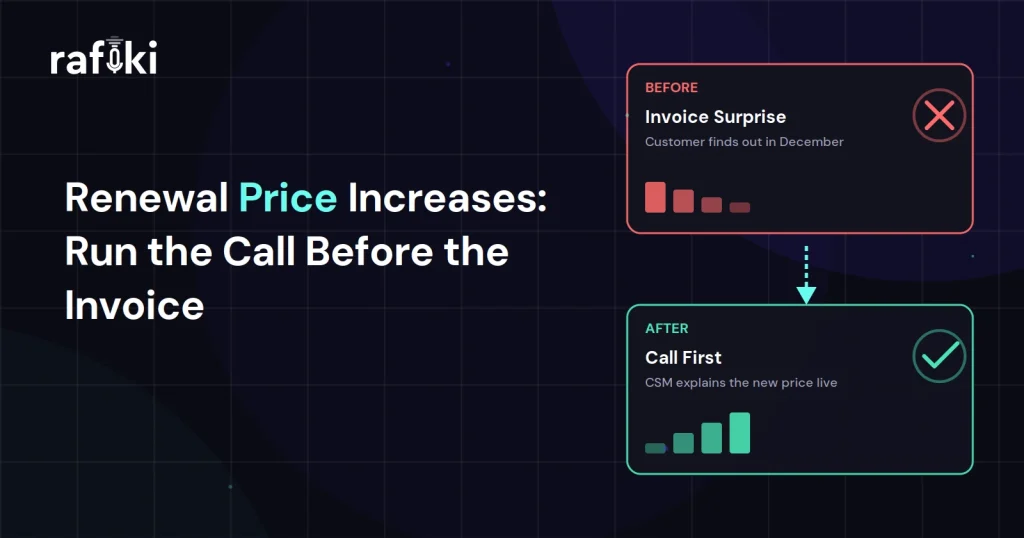
The billing system sends the December renewal quote on a Monday morning, with the 2027 price already applied. Over in accounts payable, the customer's finance contact spots a renewal price increase that nobody mentioned. She forwards the quote to the champion with a one-line question about whether she knew, and the champion did not.
The CSM finds out two days later, when a routine check-in email comes back asking to add someone from finance to the next call. That call will not cover adoption or next year's roadmap. The champion wants to know why nobody warned her, and her CFO wants to know what the extra money buys.
Most CS teams still handle a price increase as a billing event with a notice clause attached. The clause may protect the vendor, but it gives the champion nothing to say when her CFO asks about the new line. She needs one reason she can repeat in a budget meeting, and she needs it in October, weeks before any quote goes out.
A renewal price increase call is a scheduled conversation where the CSM shares the new price before any quote arrives. It usually starts with the champion, and the economic buyer sometimes joins a later conversation. For a January renewal, the call belongs in October or early November, while the customer can still budget for it.
Plenty of contracts require written notice of a price change, and many CS teams treat sending that letter as the whole job. Someone on the customer side skims it and files it, and nobody ties it to a budget line until the quote shows up. The call puts a person and a reason behind the number while the champion can still act on it.
The CSM is not asking permission on this call, and an opener about wanting her thoughts on pricing invites a negotiation nobody planned. Finance has already set the price, and the call delivers it early. In return, the CSM hears the first reaction weeks before it could show up in a cancellation email.
An invoice goes to whoever pays the bills, and that person almost never chose your product. The finance contact has no context on usage or results, so she can only question a higher number. When her question reaches the champion, it reads like an accusation that she let a cost slip past her.
Timing makes the problem worse, because many customers lock their 2027 budgets in the fall. A higher number that shows up in December lands after the spreadsheet has closed. So the champion has to go back to her CFO and ask for money that nobody planned to spend.
The CFO reading that quote is also under pressure to cut. In its October 2025 CFO survey release, Gartner reported that CFOs plan to trim overhead in 2026. The same release says they want to protect revenue growth while they cut. A tool that the CFO cannot tie to revenue looks like overhead, and a surprise increase invites a review.
A surprise increase also does damage that reaches well past this one renewal. Salesforce's State of the Connected Customer research tracks how much customers trust the companies they buy from and what they expect in return. An unexplained line on a December quote tells the champion that her vendor never once thought about the meeting she now has to sit through.
Your champion is the person who sells the renewal price internally when you are not in the room. Standard advice says to take a price increase straight to the economic buyer, and for most mid-market accounts it is wrong. If the CFO hears the number first, you have made your best internal ally look uninformed.
Call the champion first, and give her enough material to carry the conversation upstairs. Before she walks into her own budget meeting, she needs each of these from the CSM:
For a large account, that list can eat most of a CSM's afternoon, and nearly all of it comes from past calls. Once she has it, the champion can put the number into her own budget request. A CFO who sees the increase inside a planned budget line asks far fewer questions than one who meets it cold.
If the champion has left or gone quiet, the CSM should fix that before any price conversation. CS leaders reviewing January renewals should flag those accounts early and help the CSM find a new sponsor.
A CSM with a full book of January renewals cannot hold a careful price call with everyone in three weeks. Most teams sort by contract value and call the biggest logos first, which feels responsible and gets the order wrong. A large account with an engaged champion can usually absorb the news in one conversation. Sort by how hard the champion's internal conversation will be, because that decides whether the renewal survives.
| Account situation | Who has the conversation | When | What to prepare |
|---|---|---|---|
| Cost or budget came up on recent calls | CSM with the champion, AE if expansion is open | This week | The exact concern, in the customer's words |
| Champion left or went quiet | CSM and CS leader, economic buyer if reachable | This week | Who has joined calls in the past six months |
| Large account with an active champion | CSM with the champion | Late October | Results the team named on past calls |
| Open support escalation | CSM, after the escalation closes | Once the fix ships | A short record of the problem and the fix |
| Small account with steady usage | CSM by email, with an offer to talk | Early November | A short note with the reason and the date |
The escalation row trips up a lot of teams, and it deserves a firm rule. A price call during an open escalation tells the customer you care more about the invoice than the problem. So the CSM should finish the fix first, confirm with the customer that the problem is gone, and then talk about price.
Accounts that raised cost on earlier calls go first for a practical reason. Those customers already put the question on the table, so they will hear the new number as proof of their suspicion. The small-account row is a judgment call, and a CSM who knows an account well can move it up.
Many CSMs prepare for a price increase by opening the company's ROI deck and swapping in the customer's logo. The customer's CFO has seen that deck from every vendor, and it carries almost no weight with her. What does carry weight is the champion's own team saying what the product changed for them.
Go back through the past year of calls for each high-risk account. The kickoff call usually contains the customer's own definition of success, and each QBR adds what they said about progress against it. Support calls matter as well, since they show what frustrated the team and what the CFO may already have heard about. With a conversation intelligence platform, a CSM can search a full year of an account's calls in an afternoon.
Look for results the customer named in their own words, like a weekly report that now takes an hour. Note anything they complained about too, because the CFO will ask, and the CSM should know the answer first. Our earlier piece on mining calls before the 2027 reprice showed pricing teams how to study those calls. The CSM runs the same exercise for a single account, with one champion's budget meeting in mind.
Avoid reading quotes back to the customer as if you were building a legal case. Paraphrase the result and name the team that got it, then give the champion room to confirm or correct it on the call.
The opening minutes decide whether the champion hears a partner or a vendor collecting money. A lot of CSMs bury the number under ten minutes of product news and small talk. Meanwhile the customer spends that whole stretch waiting for the catch, and she hears little of the product news anyway.
Tell her the new price and the effective date right after the greeting. A line like "Before anything else, here is your 2027 renewal price and the date it starts" works well. Every extra minute of warm-up before the number sounds like nervousness to the person on the other end.
Pick the single real reason and say it once, without a string of supporting arguments. If the price reflects new capabilities her team uses, name them, and keep the explanation to a sentence. Vague lines about rising costs sound like excuses, and she cannot repeat them to her CFO with a straight face.
Next, bring up the results her team described on earlier calls and ask whether they still hold. Her answer tells the CSM whether the value case is as strong as it looked in the prep notes. When she corrects a detail, the CSM should write down her version and use it in the follow-up email.
After the reason and the results, the CSM should ask what she thinks and then stay quiet. Nervous CSMs fill the silence with a discount or a defensive explanation, and both cost them information. Her first unprompted reaction is the most honest risk signal the CSM will get before renewal.
An irritated champion is often a safe one, because anger usually means she plans to keep the product. The reactions that should worry a CSM tend to be quieter and easy to miss without a call review. On the call itself, the CSM should listen for these moments:
Any one of these should move the account up the list and bring the CS leader into the next conversation. Two or more on one call usually mean the renewal is already in danger, whatever the champion says at the end. The CSM should log the exact words that day, because a paraphrase entered a week later loses most of the signal.
Some reactions sound alarming and turn out fine once the call goes on. A champion who calls the number steep and then asks about next year's roadmap is working her way toward a yes. The CSM should note whether her questions after the price stay on the product or shift to the contract.
Most CSMs discount too early, and they usually do it in the first price conversation. That early concession teaches the customer that the number was never real, and every later renewal starts there. On that first call, the CSM should hear the objection in full and promise a written answer within days.
That promise only works if the CS leader and finance agree on a concession policy before the calls begin. The policy should list the options, such as a longer term at a locked price or a phased increase. It should also name who approves each option, so no CSM has to improvise on a live call.
Save real concessions for accounts that showed churn signals and are worth keeping at a lower margin. We covered when discounts keep customers and when they only delay the loss in our piece on churn save offers. On a price call, a concession the champion never asked for tells her the first number had padding in it.
Within a day of the call, the CSM should send a short email written as much for the CFO as for the champion. She will forward it, so it has to make sense to someone who never heard the conversation.
Put the new price and the effective date in the first two lines of the email. After that, give the one reason from the call and the results her team confirmed, in plain sentences. Close with the next step, whether that is a written answer by a specific date or a meeting with finance.
Keep the email under one screen, and skip attachments unless she asked for one. If it reads like a sales pitch, the champion looks like she fell for one, and her CFO will notice. On smaller accounts, an account executive who owns the renewal can use the same format, usually in fewer lines.
Rafiki AI handles the two slow parts of this playbook: finding the value case and reviewing each price call. It transcribes customer calls in over 60 languages, which helps CS teams whose January renewals span several regions.
For preparation, Gen AI Search lets the CSM search an account's past calls for named results or cost concerns. Stakeholder participation mapping shows who from the customer has joined calls, including whether finance ever has. A CSM who inherited the account can catch up through Smart Call Summary, which summarizes each earlier call.
Once the price call ends, Smart Call Scoring scores it against custom criteria, such as the four opening steps above. Sentiment analysis and blocker detection give the CS leader a way to choose which price calls to review first. Smart CRM Sync fills in the custom CRM fields a team chooses, including one for the customer's reaction.
For the written piece, Smart Follow Up drafts the follow-up email, and the CSM edits it into something forwardable. After the renewal cycle, a RevOps leader can use Gen AI Reports to review what customers raised across the price calls. New CSMs can rehearse the opening with AI Role Play before they call a real champion.
This week, export every renewal due in January and February and sort the list with the table above. For accounts in the top two rows, pull the value quotes and cost concerns from the past year of calls. Write the one-sentence reason for each account, and meet with finance before Halloween to settle the concession policy.
Then book the champion calls for the first two weeks of November, ahead of the December quote run. At the end of November, count how many quotes reached a customer who had already heard the number. Track that count into the first quarter, and compare it against which accounts ask about cancellation terms.
Rafiki AI's conversation intelligence platform starts at $19 per seat per month and scores each customer call against criteria your team writes. Open a free trial account before the November price calls, and use the four opening steps above as the scoring criteria for each CSM's first champion call. A CS leader who wants a walkthrough of the scoring setup can book a demo with the team first.
Start with the notice clause in the contract, since it sets the legal minimum. Hold the conversation well before that written notice, early enough for the customer to budget for it. For a January renewal, that usually means a call in October or early November.
Whoever owns the day-to-day relationship should deliver it, which in most companies is the CSM. If an expansion deal is open on the account, bring the AE so the customer hears one story. Splitting the price news and the expansion pitch across two people tends to confuse the champion.
Listen to the full objection, ask what would need to change, and hold the price on that call. Bring in the CS leader afterward and answer in writing within a few days, using the approved concession policy. Log the customer's exact words, because they show whether the threat is a negotiating move or a plan.
Yes, but give one real reason in a sentence and skip the long justification. Customers care much more about what they get for the money than about your cost structure. Tie the reason to results their own team described on past calls, so the champion has something to repeat.
Start for free — no credit card, no seat minimums, no long contracts. Just better sales intelligence.