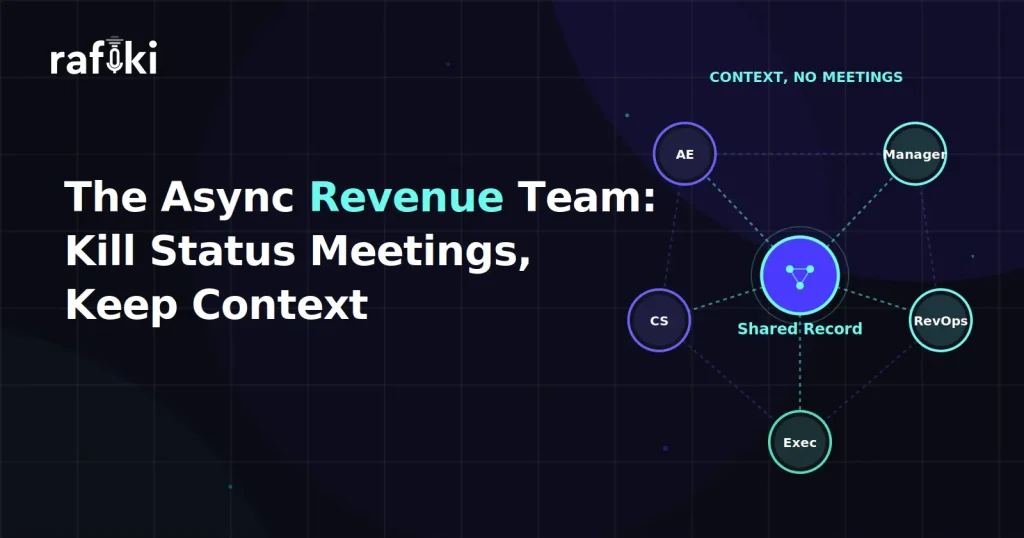
Count the hours your revenue organization spends in meetings each week, then ask how many of those minutes produced an actual decision. The honest answer is what makes the case for an async revenue team so urgent: most synchronous time in sales, customer success, and RevOps goes to narrating things that already happened. Think of the deal review where the AE recaps last Thursday's call, the pipeline meeting where reps read statuses aloud one by one, or the 1:1 that is mostly catch-up. In 2026, every one of those calls was recorded, transcribed, and summarized the moment it ended — yet teams still pay people to repeat, from memory, information that already exists in searchable form.
To be clear, this is not an argument against meetings. It is an argument against one specific kind of meeting: the status meeting, whose only output is information transfer. When deal context lives in a shared, searchable call record, status transfer no longer requires a room full of people. Consequently, synchronous time can be reallocated to the things that genuinely need humans together — coaching, negotiation strategy, and real decisions.
This guide covers the narration tax you are currently paying, the async operating model that replaces it, a simple test for which meetings deserve to survive, and a 30-day migration plan for making the switch without breaking your team's rhythm.
The narration tax is the synchronous time a team spends transferring information that already exists in recorded, summarized, searchable form. Every recorded call generates a complete account of what happened. When an AE then spends ten minutes of a deal review retelling that call from memory, the team pays for the conversation twice — once when it happened, and again when it gets narrated. Worse, the second version is a lossy copy, filtered through recall, optimism, and the natural urge to look good in front of a manager.
The tax shows up in three familiar places:
None of this narration changes a deal's outcome. Meanwhile, the actual work of selling — talking to buyers, advancing deals, removing blockers — waits outside the meeting room. As Harvard Business Review's reporting on AI in sales and marketing describes, the organizations pulling ahead are the ones using AI to shrink the lag between what happened and what gets decided. Status meetings do the opposite: they institutionalize the lag.
If status meetings are so wasteful, why does every revenue org still have them? Because they solve real problems — just badly. Managers need visibility, and asking people to talk is the oldest visibility tool there is. Teams need shared context, and a standing meeting guarantees at least one moment each week when everyone hears the same story. Leaders need accountability, and public status updates create social pressure to have something to report.
The trouble is that each of these needs is now better served asynchronously. Research from McKinsey's people and organizational performance practice has long emphasized that how organizations spend collective time is a strategic choice, not an administrative default. A status meeting is a default. It persists because, historically, there was no reliable substitute: CRM notes were sparse, memories were fallible, and the only complete record of a customer conversation lived in the rep's head.
That constraint is gone. Every buyer conversation can now be captured and summarized automatically, which means the meeting is no longer the system of record — it is a slow, expensive query against one. Distributed and remote teams feel this most acutely, because for them, every unnecessary synchronous meeting also means someone dialing in at the wrong end of their day.
An async revenue team is one where deal context moves through shared artifacts — recordings, summaries, and searchable transcripts — instead of live retelling, so synchronous time is reserved for decisions, commitments, and coaching. That is the definition. In practice, it rests on three operating shifts:
Notice what this model does not do. It does not eliminate human judgment, reduce manager involvement, or replace conversation with dashboards. On the contrary, it concentrates human attention where it compounds — on the exceptions, the coaching moments, and the calls that deserve a second listen.
A meeting earns synchronous time only if it produces at least one of three outputs: a decision, a commitment, or coaching. Status transfer never qualifies, because status can always be transferred asynchronously at higher fidelity and lower cost. Apply that test to a typical revenue calendar and the results are clarifying:
The test is deliberately strict. However, strictness is the point: any softer standard lets status meetings creep back under new names. For a broader taxonomy of what belongs on a revenue calendar at all, our guide to the types of business meetings breaks down which formats exist and what each is actually for.
The highest-leverage change in the async model is what happens before the 1:1. In the status-meeting world, the manager arrives cold and the rep spends the first twenty minutes reconstructing the week. In the async model, the manager has already reviewed each deal's call summaries, read the buyer's own words on budget and timeline, and flagged two moments worth discussing. The meeting starts where the old one used to end.
That single habit transforms the conversation. Instead of "tell me about the Acme deal," the manager opens with "I listened to the part where their CFO pushed back on the rollout timeline — let's work on how you handle that objection." One question is an audit. The other is coaching.
Reps feel the difference immediately. Being narrated at by your own manager's questions is draining; being coached on a real moment from a real call is why people want managers at all. In addition, the async-first review removes the distortion problem: the manager forms their view from the primary source, not from the rep's necessarily selective retelling. Disagreements become discussions about the same evidence rather than contests of memory.
The exceptions-only pipeline meeting has a three-line agenda: deals that changed, deals that stalled, and deals that need a decision. Nothing else gets airtime. If a deal is progressing normally and its context is visible in the shared record, discussing it live adds no information — it only performs diligence.
Running this format requires knowing which deals qualify as exceptions before the meeting starts, which is exactly the kind of question a shared call record answers well. Stalled deals reveal themselves through silence — no meetings, no replies, no movement. Changed deals reveal themselves through the calls: a new stakeholder appeared, a competitor came up, the buyer's language on timing shifted. Deals needing a decision get nominated by reps or managers, with the relevant call moments attached so the group decides from evidence.
Teams that adopt this format typically find the meeting shrinks to a fraction of its former length while the quality of discussion rises, because every minute now touches a deal that genuinely needs the group's judgment. The same logic extends to forecasting itself — as we argued in our piece on continuous AI sales forecasting, when the forecast updates continuously from real deal signals, the weekly forecast ritual becomes an exception review too.
The two operating models differ on almost every dimension that matters to a revenue team. Here is the side-by-side:
| Dimension | Status-Meeting Culture | Async-Context Culture |
|---|---|---|
| Source of deal truth | Rep's verbal recap | Shared call record |
| Manager prep for 1:1s | None — rep briefs live | Reviews summaries before the meeting |
| 1:1 content | Mostly catch-up | Coaching and decisions |
| Pipeline meeting agenda | Every deal, read aloud | Exceptions only |
| Cross-team visibility | Ask someone to explain | Search the call record directly |
| New-hire ramp | Shadowing and hearsay | Self-serve review of real calls |
| Remote/distributed fit | Poor — timezone roulette | Strong — context travels async |
| Sync time spent on | Information transfer | Judgment, commitments, coaching |
Neither column is about working more or fewer hours. The difference is what the hours buy: narration on the left, judgment on the right.
Going async is not a calendar decision — it is an infrastructure decision. Deleting meetings without replacing the context they carried just creates blind spots. The model works only when four conditions hold, and this is where a conversation intelligence platform like Rafiki AI becomes the load-bearing layer.
Async context breaks the moment it becomes partial. If some calls are recorded and others are not, people revert to asking humans — and the status meeting quietly returns. Rafiki AI joins and records meetings automatically across video platforms and dialers, and its meeting transcription handles conversations in dozens of languages, so global teams share one record instead of regional fragments.
Nobody reads twelve raw transcripts before a 1:1. Managers need condensed, accurate accounts of each call — what was discussed, what the buyer committed to, what risks surfaced. Rafiki AI's Smart Call Summary produces exactly that, structured consistently enough that a manager can review a rep's whole week in minutes. Trust is the hinge: the first time a summary misses something important, people go back to asking the rep. Summary quality is therefore not a nice-to-have; it is the whole system.
Shared context is only useful if you can interrogate it. "What did the buyer say about budget?" should be a query, not a Slack thread. With Gen AI Search, anyone on the team can ask natural-language questions across the entire call history and get answers grounded in what was actually said — the same interaction model we walked through in Ask Rafiki Anything. When search works, "let me check the calls" replaces "let me ask around."
Finally, the record must be shared. If only sales can see sales calls, customer success re-interviews every new customer and RevOps rebuilds context from CRM fragments. One conversation layer across the revenue org means handoffs carry their history with them, and Rafiki AI's autonomous AI agents keep that layer current without anyone filing notes. Ready to see what a shared call record does to your calendar? Start your free trial today.
You do not need a reorg to become an async revenue team. One month of deliberate, sequenced change is enough, and each week builds on the last.
Turn on automatic recording, transcription, and summaries for every customer-facing call across sales and CS. Change nothing else. The goal this week is simply coverage — the shared record must be complete before anyone is asked to rely on it. Announce the why: sync time is moving from narration to decisions, and this is the foundation.
Every manager commits to reviewing their reps' call summaries before each 1:1 and opening with a coaching observation instead of "walk me through your week." This is the habit that makes the model real for sales leaders, because reps only stop preparing recaps once they see managers arriving already informed.
Rewrite the agenda to three items: deals that changed, deals that stalled, deals that need a decision. Reps stop presenting statuses; anyone who wants background reviews it beforehand. Expect the meeting to feel strangely short. That is success, not a gap to fill.
Pick the weakest recurring meeting on the calendar — the one that fails the survive test most obviously — and cancel it, replacing it with an async update in the shared record. Killing a meeting publicly signals that the change is permanent, not a productivity theater exercise. If nothing breaks in two weeks, kill the next one.
Async is a filter, not an ideology, and some work will always deserve live human time. Four categories clear the bar permanently:
Notice the pattern: everything on this list involves emotion, judgment under uncertainty, or human connection. Nothing on it is status transfer. That is the async revenue team's bargain in one line — machines carry the context, and people keep the conversations that only people can have.
Status meetings were never the goal; they were a workaround for missing infrastructure. When the only complete record of a customer conversation lived in a rep's memory, gathering everyone to hear the retelling was rational. That constraint no longer exists. Every call can now be captured, summarized, and searched, which means the narration tax is a choice — and an expensive one, paid in manager hours, seller focus, and decision lag.
The async revenue team makes the opposite choice. Context lives in the shared call record. Managers review before they meet. Pipeline meetings handle exceptions, and every synchronous hour must produce a decision, a commitment, or coaching to stay on the calendar. The migration takes a month, not a transformation program: instrument, review async, convert to exceptions, then kill a meeting for good. What remains synchronous — coaching, strategy, conflict, celebration — is precisely the work that makes revenue teams human. Kill the narration. Keep the context. Spend the hours you get back on the conversations that move deals.
An async revenue team is a sales, customer success, and RevOps organization that moves deal context through shared artifacts — call recordings, AI-generated summaries, and searchable transcripts — instead of live status meetings. Synchronous time is reserved for work that produces decisions, commitments, or coaching; pure information transfer happens asynchronously through the shared call record. In practice, that means managers review call summaries before 1:1s, pipeline meetings cover only deals that changed, stalled, or need a decision, and anyone can answer "what did the buyer say" by searching the record rather than asking a colleague. The model is especially valuable for distributed and remote teams, because context stops depending on everyone being awake, available, and in the same meeting at the same time.
Move the recap out of the meeting and into preparation. Before the review, the manager reads the deal's call summaries, skims the key moments — budget discussion, stakeholder reactions, objections — and notes questions or coaching points. The live session then skips narration entirely and starts with judgment: is this deal qualified, what is the biggest risk, what is the next commitment, and how should the rep handle the objection that surfaced on the last call? Disputes get settled by going to the recording rather than debating recollections. Reviews run shorter, and the discussion quality rises because both people argue from the same primary evidence. The only prerequisite is complete capture — every call recorded and summarized — so the async record is trustworthy enough to prepare from.
Apply one test: a meeting earns synchronous time only if it produces a decision, a commitment, or coaching. Four categories pass permanently. Coaching stays live because skill-building is interactive — role-plays, call breakdowns, and practice cannot happen in a document. Negotiation and deal strategy stay live because high-stakes judgment benefits from rapid back-and-forth and dissent. Conflict stays live because interpersonal friction escalates in writing and resolves in conversation. Celebration stays live because recognition builds culture only when the team shares the moment. What never qualifies is status transfer: reading pipeline aloud, recapping recorded calls, or narrating the week. If a meeting's output is "now everyone knows," that knowledge should have traveled asynchronously through the shared call record instead.
Four capabilities are non-negotiable. First, reliable capture: every customer-facing call automatically recorded and transcribed, across meeting platforms and dialers, so the shared record has no gaps. Second, trustworthy summaries: condensed accounts of each call accurate enough that managers prepare from them instead of asking reps to recap. Third, natural-language search: the ability to ask questions like "what did the buyer say about budget" across the whole conversation history and get grounded answers. Fourth, shared access: sales, customer success, and RevOps working from one conversation layer so handoffs carry their history. A conversation intelligence platform such as Rafiki AI provides all four in one system, with autonomous AI agents keeping summaries, CRM fields, and follow-ups current without manual note-taking.
Rafiki AI's conversation intelligence platform starts at $19 per seat per month with no seat minimums and no annual commitment — enterprise-grade call capture, summaries, and search without enterprise pricing. Start your free trial today or book a demo to see how an async operating model gives your team its calendar back.
Start for free — no credit card, no seat minimums, no long contracts. Just better sales intelligence.