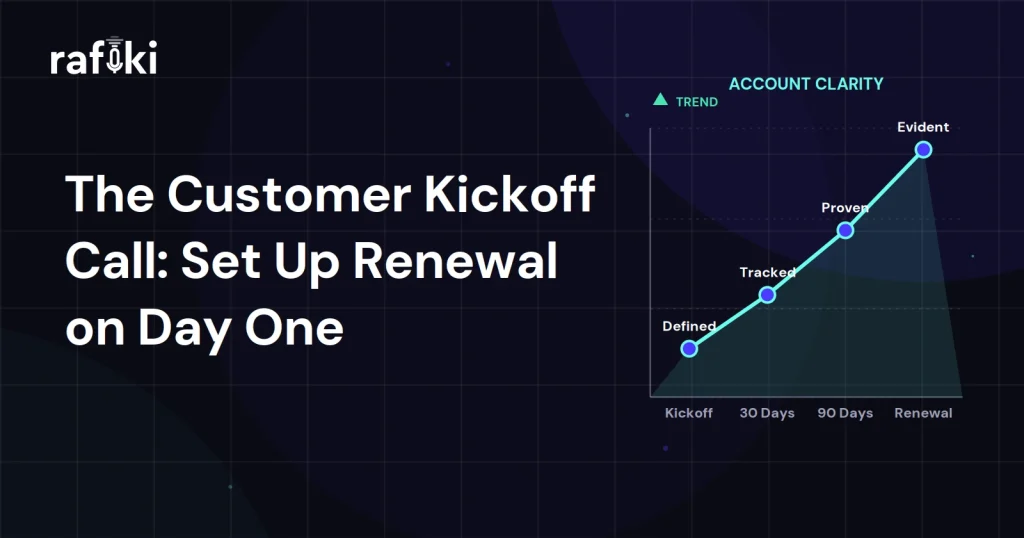
The customer signed the contract on Friday, and on Wednesday the implementation lead opens the customer kickoff call. Its first slide says "Welcome," and the next one shows a timeline: data import in week one, training in week two, go-live in week four.
Across the table, the customer's project manager nods and takes notes. Six weeks earlier, the customer's VP told the AE they bought after losing two renewals they never saw coming. Nobody on the vendor side brings that up, and no one asks what success looks like.
So the call ends with a project plan but no agreed outcome for the project to deliver. Eleven months later, the renewal conversation opens with "remind me what we were trying to accomplish here?"
Few meetings in the customer lifecycle carry more weight, yet most teams run the kickoff as a logistics session. Over weeks of sales conversations, the customer formed clear expectations about the purchase. At kickoff, the vendor either restates and owns those expectations or quietly swaps them for a project plan.
The sales team knows what the customer bought, and so does the customer. Implementation and success teams should learn it at kickoff, yet that meeting is usually where the vendor loses it.
This article treats the customer kickoff call as the renewal's opening exhibit. It covers what the kickoff is for, why it slides into logistics, and how to build the agenda from sales calls. Later sections cover getting the success definition in the customer's own words and setting the stakeholder map and first-ninety-days commitments. The last part shows how a well-run kickoff becomes the evidence the customer weighs when deciding the renewal.
A customer kickoff call is the first structured meeting between a new customer and the team that will support them. The two sides meet after the customer signs the contract and before implementation begins. On paper, the meeting exists to align on plan, roles, and timeline. Its real purpose is to agree on what the engagement should achieve and how everyone will know it did.
This matters because the customer's reasons for buying are still fresh at kickoff, and the post-sale team is finally in the room. What the customer told sales about their problem, trigger, internal politics, and idea of a win is clearest on kickoff day and fades from there.
When the kickoff captures that context, the relationship gets a standard to measure against. If the team skips it, everyone falls back on usage, a proxy the customer never agreed to.
Seen that way, the customer kickoff call starts the renewal clock on day one. Plan it as the first renewal conversation, and give the implementation plan one slot on the agenda.
Why does a meeting this important so reliably turn into a timeline review? Each cause traces back to how companies staff and brief post-sale teams, so each one is fixable.
The implementation ships on time, and then the renewal arrives with no shared account of what the customer achieved. One theme runs through Salesforce's State of Service research: customers expect the companies they buy from to know and understand them. As the first post-sale interaction, the kickoff is where vendors most easily fall short of that expectation.
When a kickoff sets a plan but no outcome, the team completes every task and proves nothing. The costs arrive months later, in places nobody traces back to the first meeting.
First, the relationship loses its standard, so later conversations measure the product against usage the customer never said mattered. Second, the champion's story never reaches the people who need it. The executive who bought to stop losing renewals never hears whether it worked, because nobody wrote their terms down.
Third, the renewal turns into a price negotiation, since the vendor has no results to show in a form the customer recognizes. Our guide to the sales-to-CS handoff covers the internal half of this problem, and the kickoff decides the customer-facing half.
A Harvard Business Review piece on agentic AI in successful sales teams describes teams using it to equip their people instead of replacing them. Handing the post-sale team the full sales context on kickoff day applies the same idea to customer success.
The fix starts before the call, with an agenda drawn from what the customer said during the sale. If a conversation intelligence platform captured the sales calls, the team already has the full record to work from. The agenda then has five parts, and each one draws on the customer's own words.
Open by quoting the problem and trigger the customer described on the sales calls. You might say, "When you spoke with Marcus in July, you said you bought this so a renewal would never surprise you again."
The project manager may be hearing their executive's reasoning for the first time, and the vendor has shown it listened.
Ask the customer what will be true in ninety days, and in a year, if this works. Push past "adoption" to the business outcome, and write down the answer in the customer's phrasing. The customer will judge the renewal against this sentence, so it needs to exist on day one.
Sales conversations name the people who feel the problem, who approved the purchase, and who will use the product. At kickoff, the team confirms that map and adds the implementation contacts. Above all, it names the customer-side owner of the outcome, who is rarely the project manager on the call.
During the sale, buyers mention their fears, such as the last tool that failed or the integration that always breaks. Raising those fears at kickoff, before they materialize, turns the vendor from a supplier into a partner who was paying attention.
Only now does the timeline come in, with each milestone written as a commitment toward the success definition. For every milestone, the team answers one question: "What will the customer be able to say is true by this date?"
The most useful thing a kickoff produces is a success definition that the customer stated and would recognize later. It deserves a large share of the meeting, and a few practices help the team get it right.
A kickoff that produces this one sentence does more for retention than one that produces a flawless project plan. Any team can fix a weak plan in month two, but nobody can recover a standard the customer never stated.
The post-sale team missed the sales calls, and Rafiki AI fills in that context before the kickoff starts. It also keeps the kickoff itself on file as the account's first piece of evidence. Rafiki AI records, transcribes, and structures every sales and CS conversation on video and phone, across 60+ languages. That record lets the team build the kickoff agenda from what the customer actually said.
Before the call, the implementation lead can ask Gen AI Search questions across all the sales conversations. Why did the customer say they were buying, whom did they name, what worried them, and what did they expect from the first ninety days? Each answer cites the point in the sales call where the customer said it. For the closing calls, Smart Call Summary gives the team the trigger and the stakeholders, so nobody has to relisten.
During the kickoff, Rafiki AI captures the success definition in the customer's words, and Smart Follow Up drafts a same-day recap that puts it in writing. Smart CRM Sync then writes the definition, stakeholder map, and ninety-day commitments into the account record for every later touchpoint.
For customer success leaders, Gen AI Reports can report in plain language across recent kickoff conversations. A leader can see the success definitions customers stated, whom they named as the outcome owner, and which risks came up. Rafiki AI's agents carry that context forward on their own, so the kickoff team starts where the sale ended.
| Dimension | Logistics kickoff | Outcome kickoff |
|---|---|---|
| Opening | "Welcome, here's the timeline" | "When you spoke with Marcus, you said..." |
| Preparation | Contract and product list | Quotes from the sales conversations |
| Success definition | Pushed to the QBR | The customer states it on day one |
| Stakeholders | Whoever joined the call | The map from the sale, plus a named outcome owner |
| Risks | The team finds them when they hit | The team raises what the buyer already said |
| Milestones | Implementation tasks | Commitments tied to the success definition |
| Renewal conversation | "Remind me what this was for?" | "Here is what you said, and here is what happened" |
Run this way, the kickoff produces the two things a renewal conversation needs a year later. One is the customer's own statement of what they wanted, and the other is a dated record of vendor commitments.
Every QBR in between becomes a progress report against that statement, and so does each executive sponsor call. At renewal, the CSM can skip the usage charts and open with the customer's words from kickoff day, plus what happened since.
The last week of September is a good time to start, because the deals that close at quarter-end turn into October's kickoffs. Those kickoffs will shape the renewals that land next fall. For a CS team, running each of them as an outcome kickoff is one of the cheapest retention investments available.
No later meeting decides as much about the renewal as the customer kickoff call does. On that call, the customer's reasons for buying either become the relationship's standard or disappear behind a project plan.
For the next kickoff on your calendar, put the customer's stated problem, trigger, and named risks on the opening slide. Give the executive sponsor agenda time to state the success definition, and have the CSM tie the first milestone to it.
Rafiki AI does that preparation automatically, since its agents carry every sales conversation into the kickoff and record the kickoff as the account's first exhibit.
It is the first structured meeting between a newly signed customer and the vendor team that will implement and support them. The meeting happens between contract signature and implementation, and on paper it exists to align on plan, roles, and timeline.
Its bigger job is to capture, in the customer's words, what the engagement should achieve and what success looks like. Those reasons for buying are freshest on kickoff day, when the post-sale team meets the customer for the first time. That is why the kickoff decides whether those reasons become the relationship's standard or disappear behind a project plan.
A strong agenda covers five things in a set order. It opens by restating why the customer bought, using quotes from the sales conversations to show the vendor listened. Next, the team asks for the success definition as a story about ninety days and a year from now. It records the answer in the customer's phrasing.
After that, the team confirms the stakeholder map from the sale and names the customer-side outcome owner. It then raises the risks the buyer mentioned during the sale, before they materialize. The agenda closes with the first-ninety-days commitments, each tied to what the customer can say is true by then.
Start by asking for a story about the moment the customer will know this worked, since it holds the measure and meaning. The outcome owner should tell it, and that is often the executive sponsor, not the project manager on the call. If the sponsor misses the kickoff, schedule fifteen minutes with them.
Then read the definition back in their words and confirm it with them. Record it in the call record and the account so the CSM can quote it at the first QBR and again at renewal. Finally, tie the first milestone to the earliest progress you can demonstrate toward it.
The renewal conversation needs the customer's statement of what they wanted and a record of what the vendor committed to and delivered. A well-run kickoff produces both, while a logistics-only kickoff produces neither.
With a stated success definition, every QBR becomes a progress report, and the executive sponsor has something specific to review. At renewal, the CSM can open with the customer's words from day one and the evidence of what happened since. Without that definition, the renewal opens with usage charts the customer never asked for and a question about what the purchase was for.
Rafiki AI's conversation intelligence platform gives your kickoff team the sales calls it missed, starting at $19 per seat per month. Start a free trial before your next kickoff, or book a demo if you want to see it first.
Start for free — no credit card, no seat minimums, no long contracts. Just better sales intelligence.