Every CRM feels permanent until the day it isn't. A new CRO arrives with strong opinions, an acquisition drops a second platform into the stack, or procurement decides the renewal quote no longer matches the value delivered. When that day comes, revenue teams discover an uncomfortable truth: their customer conversations — the richest record of every deal they have ever worked — are trapped inside tooling that was bolted to the old CRM. That is exactly the problem CRM-agnostic revenue intelligence exists to solve.
The stakes are higher in 2026 than ever before. Modern conversation intelligence platforms capture every call, extract deal signals, and push structured data into the system of record. However, many of these platforms were architected around a single CRM's object model. As a result, the intelligence layer becomes inseparable from the database beneath it, and switching costs quietly compound with every recorded call.
This article makes the case for portability. Specifically, we will examine why intelligence bolted to one CRM becomes a migration hostage, how a sync-layer architecture differs from a storage-layer one, why multi-CRM stacks are now normal rather than exceptional, and what an evaluation checklist for portability should actually include.
Intelligence that lives inside one CRM inherits every constraint of that CRM — including its exit costs. The moment your organization considers changing platforms, the tool that was supposed to make you smarter becomes the loudest argument against moving. Vendors know this, and some depend on it.
Consider what actually happens when a team tries to leave. Years of call recordings, transcripts, deal summaries, and coaching moments sit in a system that only speaks one CRM's language. Meanwhile, the scoring history that told you which reps were improving is keyed to field IDs that will not exist in the new platform. In practice, three things break at once:
Consequently, the migration conversation stops being about which CRM serves the business best. Instead, it becomes a hostage negotiation over data you already own. That inversion — where the intelligence tool dictates the CRM decision rather than the other way around — is the clearest symptom of lock-in.
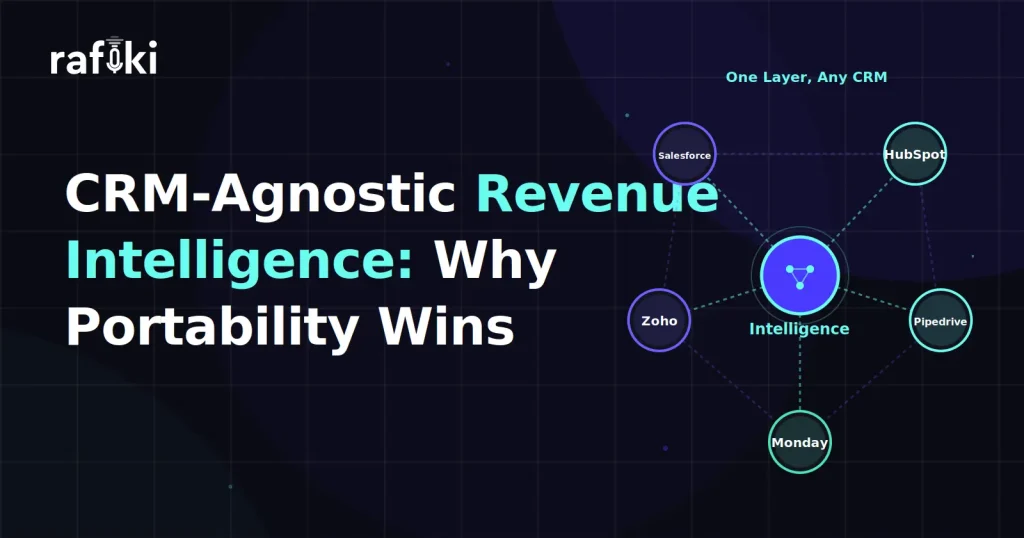
CRM-agnostic revenue intelligence is an architecture in which conversation data, deal signals, and analytics live in an independent intelligence layer that syncs to any CRM, rather than inside one CRM's database. The intelligence platform owns the conversation record; the CRM receives structured updates from it. Because the two layers are decoupled, changing the CRM changes a destination, not a foundation.
Think of it the way finance teams think about a general ledger and reporting tools. The ledger is the durable record, while the reporting layer on top can be swapped without rewriting history. Similarly, your calls, emails, and meetings form the durable behavioral record of your revenue engine. The CRM is where a snapshot of that record gets operationalized for pipeline management.
Three properties define a genuinely CRM-agnostic platform. First, it stores conversations and insights natively, independent of any CRM object. Second, it maintains native, first-class integrations with multiple CRMs — not one deep integration and several shallow ones. Third, it can sync the same intelligence to more than one CRM at the same time, which matters more than most buyers realize.
The portability question comes down to a single architectural choice: does the platform treat your CRM as a sync destination or as its storage backend? A sync-layer platform keeps the canonical conversation record in its own system and writes structured outputs — summaries, methodology fields, next steps, risk flags — into whichever CRM you point it at. A storage-layer platform, by contrast, reads and writes against one CRM's objects as its source of truth.
The difference is invisible during a demo. Both approaches populate CRM fields, both render dashboards, and both look identical in week one. However, the difference becomes decisive the moment anything about your stack changes. With a sync layer, repointing to a new CRM means remapping fields — an afternoon of configuration. With a storage layer, it means a data migration project with all the loss and cost that implies.
A useful mental formula: Durable conversation record + swappable sync targets = portable intelligence. In contrast, when the conversation record and the CRM are fused, every CRM decision becomes an intelligence decision too. That coupling is precisely what RevOps leaders should refuse to accept in 2026, because the pace of stack change keeps accelerating.
Buyers often evaluate tooling as if their company will run exactly one CRM forever. Reality is messier. Sales stacks keep expanding and recombining, a dynamic that research such as Salesforce's State of Sales series has tracked across multiple editions as teams layer new channels, tools, and AI capabilities onto their core systems. Three patterns make multi-CRM stacks the quiet norm:
Finance leaders increasingly plan for this fluidity rather than against it. For example, Deloitte's guidance for CFOs on technology trends emphasizes composable architectures and optionality precisely because rigid, tightly coupled systems age badly. If the CFO's office is planning for swappable components, revenue leaders should demand the same from their intelligence layer. Otherwise, the conversation record fragments along whatever lines the CRM estate happens to fracture.
Lock-in is usually priced as a switching cost, but the deeper damage shows up earlier and more quietly. Long before any migration, a CRM-locked intelligence tool distorts decisions. Renewal negotiations tilt against you because the vendor knows leaving means losing history. Stack decisions get made to protect the tool rather than to serve the go-to-market motion.
Moreover, the organizational costs accumulate in places procurement rarely audits. Teams on the "other" CRM — the acquired company, the regional office, the PLG pod — get second-class intelligence or none at all. Coaching becomes inconsistent because managers can only review calls from one part of the business. Forecast reviews mix conversation-informed judgment on one side of the house with gut feel on the other.
There is also a talent dimension. RevOps professionals build careers on portable skills and portable data models, and nobody wants to inherit a stack where the analytics history evaporates the moment leadership changes CRM direction. In short, lock-in taxes the present, not just the hypothetical migration. Portability, on the other hand, keeps every future decision cheap.
The two architectures answer every operational question differently. The following comparison summarizes what changes when the intelligence layer stands on its own:
| Dimension | CRM-Locked Intelligence | CRM-Agnostic Intelligence |
|---|---|---|
| Source of truth | CRM objects and fields | Independent conversation record |
| CRM migration | Data migration project, history at risk | Remap sync targets, history intact |
| Multi-CRM stacks | One CRM served well, others poorly or not at all | Native sync to several CRMs at once |
| Post-acquisition | Acquired team waits for consolidation | Both teams get intelligence on day one |
| Renewal leverage | Vendor holds your history hostage | You negotiate from freedom to move |
| Analytics continuity | Resets when the CRM changes | Unbroken across stack changes |
| Coaching library | Tied to old CRM links | Lives with the platform, always findable |
| Procurement posture | Locked into bundled decisions | Each layer evaluated on merit |
Notice that most rows have nothing to do with a migration itself. Rather, they describe everyday operating conditions — coaching, analytics, negotiation posture. That is the core argument for portability: it improves the years you stay, not just the week you leave.
Rafiki AI was built on the sync-layer model from day one. The platform captures and analyzes every customer conversation — meetings, calls, and follow-ups — in its own AI-native intelligence layer, then syncs structured outputs natively into Salesforce, HubSpot, Zoho, Pipedrive, Freshworks, and Monday.com. Each of those integrations is first-class, which means field mapping, custom objects, and methodology fields work the same way regardless of which CRM sits underneath.
Because the conversation record lives in Rafiki AI rather than in any single CRM, the platform functions as the intelligence layer between your conversations and your revenue decisions. Autonomous AI agents transcribe, score, and summarize every call, extract methodology-specific facts, and keep the CRM current without a rep typing a field. The product overview walks through how those capabilities fit together across the deal lifecycle.
For a RevOps leader, the practical consequence is simple: the CRM becomes a choice you revisit on the CRM's merits. Pricing changes? Governance requirements shift? An acquisition lands? The intelligence layer stays put, and only the sync destination moves. That is what CRM-agnostic revenue intelligence looks like when it is an architectural fact rather than a slide-deck claim.
Smart CRM Sync is the capability that turns the architecture into daily workflow. After every call, Rafiki AI extracts the facts that matter — budget signals, decision criteria, competition mentions, timeline shifts, named stakeholders — and writes them to the corresponding fields in your CRM. The extraction is methodology-aware, so MEDDIC, BANT, SPIN, SPICED, GAP, and custom field sets all populate from the same underlying conversation record.
Crucially, the mapping is configuration, not code. Point Smart CRM Sync at a Salesforce opportunity layout today and a HubSpot deal pipeline next quarter, and the same extracted facts flow into both. We covered the mechanics of field-level extraction and human oversight in depth in Inside the Rafiki CRM Sync Agent, including how suggested updates stay reviewable before they land.
The oversight model matters for portability too. Since every synced value traces back to a specific moment in a specific call, an admin can audit why a field says what it says — in any CRM. In contrast, storage-layer tools scatter that provenance across CRM activity logs that will not survive a migration. With Rafiki AI, the evidence trail travels with the conversation record, wherever the CRM goes.
A migration is where the sync-layer model pays off most visibly. Picture a team moving from one CRM to another over a quarter. On day one of the transition, Rafiki AI keeps syncing to the legacy CRM so active deals stay current. Meanwhile, admins map the same fields to the new platform in a sandbox, validate the output, and flip production sync when the cutover date arrives.
Nothing about the intelligence layer pauses during that window. Calls keep getting recorded and scored, coaching reviews continue, and forecast conversations still reference the full deal history. More importantly, the day after cutover, the new CRM is not empty — Smart CRM Sync populates it with current, conversation-verified deal facts rather than whatever stale values survived the export.
Compare that with the locked alternative, where the migration plan needs a separate workstream just to decide what happens to years of call data. Teams mid-migration can test this decoupling directly on live calls before committing to anything. Start your free trial today and run it against your sandbox CRM while the migration plan is still on the whiteboard.
Multi-CRM operation is the scenario that exposes shallow "integrations" fastest. Suppose your PLG motion runs on Pipedrive while the enterprise team works in Salesforce, or a newly acquired subsidiary lives in Zoho while headquarters runs HubSpot. Rafiki AI treats each CRM as a peer sync target, so every team gets native field updates in the system it actually uses.
The intelligence, however, stays unified. Leadership sees win patterns, talk tracks, and pipeline risk across both motions in one place, because the analysis happens on the shared conversation record rather than inside either CRM. As a result, coaching standards stay consistent across regions and segments, and the QBR deck stops needing an asterisk explaining why half the data is missing.
Data quality benefits compound in this setup as well. Automated capture removes the per-CRM hygiene burden that usually makes dual stacks decay, a dynamic we explored in Agentic CRM Hygiene and in our piece on CRM data quality through auto-capture. When agents populate fields from conversations, both CRMs stay clean without doubling the admin headcount.
Portability claims are easy to make and cheap to print on a website. Therefore, evaluate them the way an IT or procurement team would — with specific, testable questions. Before signing, ask every vendor to demonstrate the following:
Score candidates honestly against these eight questions. Furthermore, run the exercise even if you have no migration planned — the answers reveal how much leverage you will hold at every future renewal.
CRMs change. Leadership changes them, acquisitions multiply them, and pricing reviews challenge them — often on timelines nobody predicted at purchase. Your conversation record, by contrast, is the compounding asset: every call your team has ever taken, scored, and learned from. Architecture decides whether that asset survives stack changes or gets held hostage by them.
CRM-agnostic revenue intelligence keeps the durable record in an independent layer and treats every CRM — Salesforce, HubSpot, Zoho, Pipedrive, Freshworks, or Monday.com — as a swappable destination. Consequently, migrations become configuration work, multi-CRM stacks get unified intelligence, and renewal negotiations happen from a position of freedom. Choose the intelligence layer as if your CRM will change, because eventually it will.
CRM-agnostic revenue intelligence means the platform that analyzes your customer conversations stores its data independently of any CRM and syncs structured outputs to whichever CRM you use. The intelligence layer owns the canonical record — recordings, transcripts, scores, extracted deal facts — while the CRM receives field updates from it. Because the two layers are decoupled, you can change CRMs, add a second one, or run different CRMs by region without losing history or re-implementing analytics. In practice, the test is architectural rather than rhetorical: ask where the conversation record lives and whether the platform can sync to more than one CRM at the same time. Rafiki AI, for example, maintains native integrations with Salesforce, HubSpot, Zoho, Pipedrive, Freshworks, and Monday.com from a single shared conversation record.
With a sync-layer platform, no. Recordings, transcripts, call scores, analytics history, and coaching libraries live in the intelligence platform itself, so a CRM switch only changes where synced fields land. Your team keeps its full behavioral record, and the new CRM starts populated with current, conversation-verified deal facts instead of an empty pipeline. With a storage-layer tool, however, the answer is usually some version of "it depends" — which in migration planning means risk. History may export as flat files stripped of deal context, scores may be keyed to field IDs that no longer exist, and curated coaching clips may lose their links. That difference is why the "what survives a switch" question belongs in writing during procurement, not as a surprise during cutover.
Yes, provided the platform was architected as a sync layer. Simultaneous multi-CRM operation is common in post-acquisition periods, in companies with regional CRM standards, and in businesses running a PLG motion alongside an enterprise motion. A genuinely CRM-agnostic platform treats each CRM as a peer destination: the enterprise team gets native field updates in its platform, the velocity team gets them in its lighter CRM, and leadership analyzes one unified conversation record across both. In contrast, CRM-locked tools force a choice — one team gets intelligence and the other gets spreadsheets. If dual-CRM operation is even a possibility for your business, make simultaneous sync a demonstrated requirement in the evaluation, not a roadmap promise.
Treat portability as a testable property, not a marketing claim. Start with the architectural question: where does the conversation record live, and what happens to it if the CRM changes? Then verify breadth by watching the vendor configure field mapping in at least two CRMs live, including methodology fields such as MEDDIC or custom scoring criteria. Next, run the acid test — simultaneous sync to two CRMs — because bolt-on architectures typically fail it. Additionally, get written answers on what survives a switch, how long repointing takes, and how data export works at exit. Finally, weigh the everyday benefits too: provenance for every synced value, unified analytics across stacks, and negotiating leverage at renewal all flow from the same portable architecture.
Rafiki AI's conversation intelligence platform starts at $19 per seat per month with no minimums and no annual commitment — and native sync for Salesforce, HubSpot, Zoho, Pipedrive, Freshworks, and Monday.com is included from day one. Start your free trial today or book a demo to see how a portable intelligence layer transforms your revenue operations.
Start for free — no credit card, no seat minimums, no long contracts. Just better sales intelligence.