Your CRM is a fiction co-written by tired reps at 6pm on Fridays, and your forecast is built on it.
Nobody planned it that way. The CRM was supposed to be the system of record; instead it became the system of recollection — fields filled from memory, days late, under quota pressure, by the one person in the deal with an incentive to be optimistic. Every revenue process downstream inherits the damage: pipeline reviews argue about stale stages, forecasts aggregate wishful thinking, and RevOps spends its life chasing reps to "update Salesforce."
This article is the fourth installment in our per-agent transparency series, after the deep dives on the Coaching Agent, the Revenue Agent, and the Follow-Up Agent. The premise stands: buyers deserve to know what a specific agent mechanically does before trusting it. Today, the agent with the least glamorous job and arguably the largest blast radius — the Rafiki CRM Sync Agent, the capability surfaced as Smart CRM Sync. What it populates, what grounds it, where your control sits, and what it refuses to invent.
An AI writing to your CRM is performing surgery on the data your company runs on. Get it right and the chronic disease of B2B revenue — the gap between what happened in deals and what the system says happened — finally closes. Get it wrong and you have automated the corruption of your own forecast, at scale, with confidence.
That asymmetry is why this deep dive leads with the grounding rule rather than the feature list. We wrote the general case in AI hallucination guardrails for sales: an AI that fills a field it cannot evidence is worse than an empty field, because empty fields announce their ignorance and wrong fields lie with a straight face. The CRM Sync Agent is that essay shipped as engineering. Every value it writes traces to something said in a conversation — and where the conversation is silent, so is the agent.
The stakes are not hypothetical. As Harvard Business Review's analysis of the gen AI myths holding sales teams back argues, the failure mode for AI in revenue organizations is rarely the technology's ambition — it is deploying generation where grounding was required. CRM data is the purest case of grounding-required work in the entire stack.
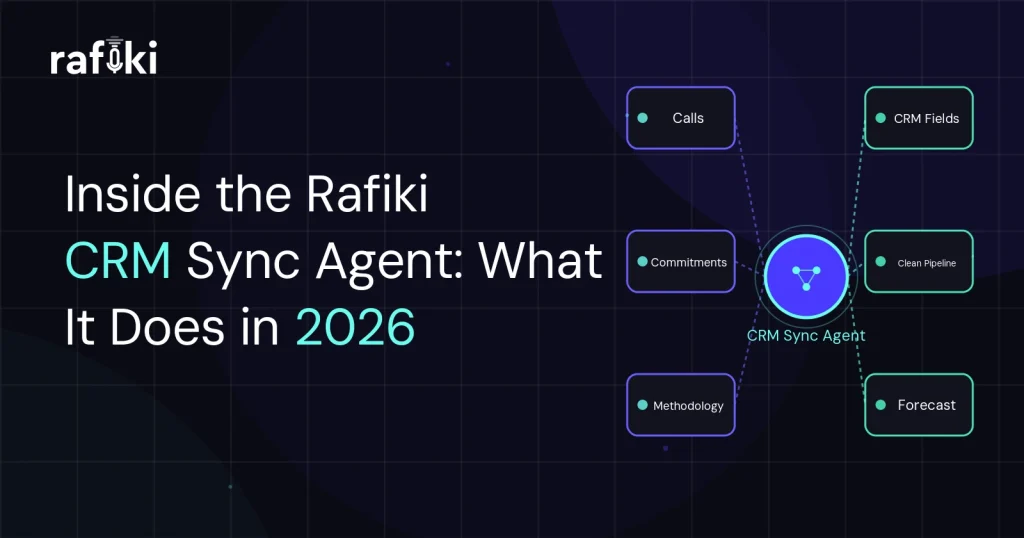
The CRM Sync Agent is the autonomous capability inside Rafiki AI that turns what was said in your sales and customer success conversations into structured, accurate CRM data — methodology fields, custom fields, contacts, and activity context — without the rep typing it. It consumes the same conversational source of truth as the rest of the platform and writes to the CRM your team already runs: Salesforce, HubSpot, Zoho, Pipedrive, or Freshworks.
And the negative space, which matters as much:
In the agent lineup, CRM Sync is the infrastructure layer: the Coaching Agent develops reps, the Revenue Agent reads the pipeline, the Follow-Up Agent writes to buyers — and all of them work better because this one keeps the record true.
Mechanically, the agent extracts and writes several classes of CRM data, each grounded in call content:
The agent auto-populates methodology-specific fields for MEDDIC, BANT, SPIN, SPICED, GAP, Challenger, and Sandler. When the economic buyer finally states the decision process on a call, the MEDDIC "Decision Process" field fills with what was actually said — not with a rep's Friday-evening paraphrase of what they remember being said. Teams running hybrid or homegrown qualification get the same treatment: the extraction maps to whatever framework your fields encode.
Most CRMs accumulate custom fields that encode the company's real process — "Integration Requirements," "Compliance Deadline," "Champion's Success Criteria." The agent populates custom fields from conversation content the same way, which is what makes it useful beyond the standard playbooks. Your schema is the contract; the conversations supply the values.
The promises and agreed actions that the Follow-Up Agent surfaces for the buyer-facing email land in the CRM as deal context — so the system of record knows what both sides owe, not just when the next meeting is.
Who actually attends calls, who speaks, who has gone quiet — participation data that turns the CRM's contact roles from an org-chart guess into an engagement record. When the economic buyer has never been on a call, the CRM should know that; now it does.
Here is the design decision that defines the agent, stated as plainly as we can: no conversational evidence, no field value. The agent would rather leave a field empty than populate it plausibly.
In practice, the rule produces behavior that surprises teams used to generative tools:
This is the difference between automation and fabrication, and it is why the agent can be given write access to the data your forecast runs on. The full argument for evidence-linked CRM data — and what we built before this agent existed — is in our earlier piece on CRM data quality through auto-captured conversation context.
Human oversight in the CRM Sync Agent is structural, not a checkbox:
The result is a division of labor that mirrors the rest of the series: the agent does the recall and the typing; humans keep the judgment and the accountability.
CRM sync is infrastructure, so its value shows up in everything built on top:
The clean case — buyer states budget, field fills — is easy. The agent's credibility is earned on the messy ones:
In April the buyer said the decision lands in Q3; in June they said the project is paused. Conversations supersede each other, and the field reflects the most recent grounded statement — with the history preserved, so the trajectory ("confirmed, then paused") is visible rather than silently overwritten. Deals are stories, and the record keeps the plot.
The same economic buyer appears across two opportunities with different scopes. Extraction is deal-scoped: what was said in the expansion conversation populates the expansion opportunity, not its sibling. Cross-contamination between opportunities is the kind of subtle corruption manual updates introduce constantly and grounded extraction is specifically built to avoid.
Your custom field expects a date; the buyer said "sometime after our audit wraps." The agent does not coerce vagueness into false precision — the field carries the qualified statement or stays empty, and the vagueness itself surfaces as what it is: an unanswered qualification question for the next call.
A deal that runs in Portuguese populates the same English-schema fields as one that runs in English, because extraction operates on meaning rather than language. For global teams, this is the difference between one pipeline standard and three regional dialects of CRM hygiene.
The CRM Sync Agent shares one conversational source of truth with every other Rafiki capability, which is what makes the lineup a system rather than a bundle:
The architectural point repeats across this series because it is the actual product thesis: capture the conversation once, ground everything in it, and let each agent be a different consumer of the same truth.
| Dimension | Manual CRM updates | With the CRM Sync Agent |
|---|---|---|
| Source | Rep memory, days later | The conversation, as it happened |
| Coverage | The fields reps get to | Every mapped field, every call |
| Bias | Optimism under quota pressure | Grounded in what was said |
| Auditability | "Ask the rep" | Click through to the source moment |
| Empty fields mean | Nobody typed | The conversation hasn't established it |
| Judgment fields | Human | Still human — by design |
The last two rows carry the philosophy: emptiness becomes meaningful, and judgment stays where accountability lives.
Continuing the series' honesty convention:
For the account executive, the Friday CRM session disappears. Fields fill from the week's calls as they happen; the rep's remaining job is a quick verify-and-correct pass that takes minutes and produces better data than an hour of recollection ever did. The hours come back as selling time — and the rep stops being graded on typing discipline.
For the frontline manager, pipeline truth stops depending on interrogation. The Monday view shows what deals' conversations actually established — empty fields flagging real qualification gaps, not lazy data entry — so one-on-ones start at "what do we do about it?" instead of "is this even accurate?"
For the RevOps leader, the role shifts from data janitor to data architect. Instead of chasing compliance, RevOps designs the field contract, audits the mappings quarterly, and finally gets to answer the question the job was supposed to be about: what should we measure, now that measurement is free?
To evaluate it the way we would:
Setup takes about 15 minutes against Salesforce, HubSpot, Zoho, Pipedrive, or Freshworks, support is included on all plans, and with 60+ language transcription the same contract works across global teams.
The agent populates the fields it is configured to own, with values linked to conversational evidence. Judgment fields — stage, amount, commit — remain human-owned, and the configuration controls which fields the agent touches at all. The practical pattern teams settle into: evidence fields flow from calls automatically, judgment fields stay manual, and disputes get resolved by clicking through to the source.
Nothing — and that is the feature. A check-in call that established no new qualification facts produces no new field values, just its activity record and summary. Empty fields under the grounding rule are diagnostic: they show managers exactly what the deal's conversations have not yet established, which is often the most useful thing a pipeline view can say.
Natively: Salesforce, HubSpot, Zoho, Pipedrive, and Freshworks on the CRM side; Zoom, Teams, and Google Meet as conversation sources, with 60+ language transcription underneath. The multi-CRM stance is deliberate — growing teams switch CRMs more often than vendors like to admit, and a conversation-grounded record ports across that switch instead of being held hostage by it.
Native loggers record that activity happened — a call, its duration, maybe a transcript attachment. The CRM Sync Agent extracts what the conversation established and writes it into the structured fields your process actually reads: methodology qualification, custom field values, commitments, stakeholder engagement. Logging answers "did they talk?"; the agent answers "what is now true about this deal?" — with the evidence linked.
Nobody buys software because of CRM hygiene, and no demo of field population will ever go viral. But every promise in the modern revenue stack — accurate forecasts, evidence-based coaching, honest pipeline reviews, board narratives that survive scrutiny — quietly assumes the system of record tells the truth. For most teams, that assumption has been false for years, and everyone has learned to work around it.
The CRM Sync Agent exists to retire the workaround. Grounded extraction, human-owned judgment, auditable values: the record finally reflects the conversations, and everything built on the record gets sturdier at once. In a series about what our agents actually do, this one's answer is the simplest — it makes the truth cheap.
See the CRM Sync Agent alongside the rest of Rafiki AI's autonomous AI agents — plans start at $19 per seat per month with no seat minimums and no annual commitment. Start your free trial today or book a demo and run the twenty-deal baseline test on your own pipeline.
Start for free — no credit card, no seat minimums, no long contracts. Just better sales intelligence.