The follow-up email is the most consequential document in B2B sales, and most of them are written from memory, hours late, by the least objective witness in the room.
Every deal advances or stalls on what happens after the call ends. The recap that misstates a commitment, the action item that never gets written down, the three-day delay while a rep digs through notes — these small failures compound into slipped deals and confused buyers. Yet follow-up remains the part of the sales motion teams scrutinize least, precisely because it happens in the gaps between meetings where no manager is watching.
This article is the third installment in our per-agent transparency series, following the deep dives on the Rafiki Coaching Agent and the Revenue Agent. The premise of the series is simple: buyers deserve to know what a specific agent actually does, mechanically, before they trust it anywhere near their customers. So here is the Rafiki Follow-Up Agent — what it drafts, what it sends, where your control sits, and what it deliberately does not do.
Of all the work AI agents now do for revenue teams, drafting customer-facing communication is the most trust-sensitive. An AI that mis-scores a call wastes an analyst's time; an AI that sends a wrong email damages a relationship in front of the person you're trying to win. Consequently, the Follow-Up Agent carries a heavier design burden than any internal-facing capability.
That burden shapes everything in this article, and it explains the design choice that defines the agent: grounding. Every sentence the Follow-Up Agent drafts traces back to something that actually happened in the conversation. As Harvard Business Review's coverage of how sales teams use generative AI to discover what clients need argues, the value of generative AI in sales comes from working over real customer signals rather than generating plausible text — and nowhere is that distinction more visible than in an email your buyer will actually read.
It also explains the second defining choice: the human approval loop. The Follow-Up Agent drafts; you decide. That is not a temporary limitation to be engineered away — it is the line that keeps the rep accountable for what their customers receive. We made the broader case for this stance in 5 things AI can't do in a discovery call; the Follow-Up Agent is that philosophy shipped as a product.
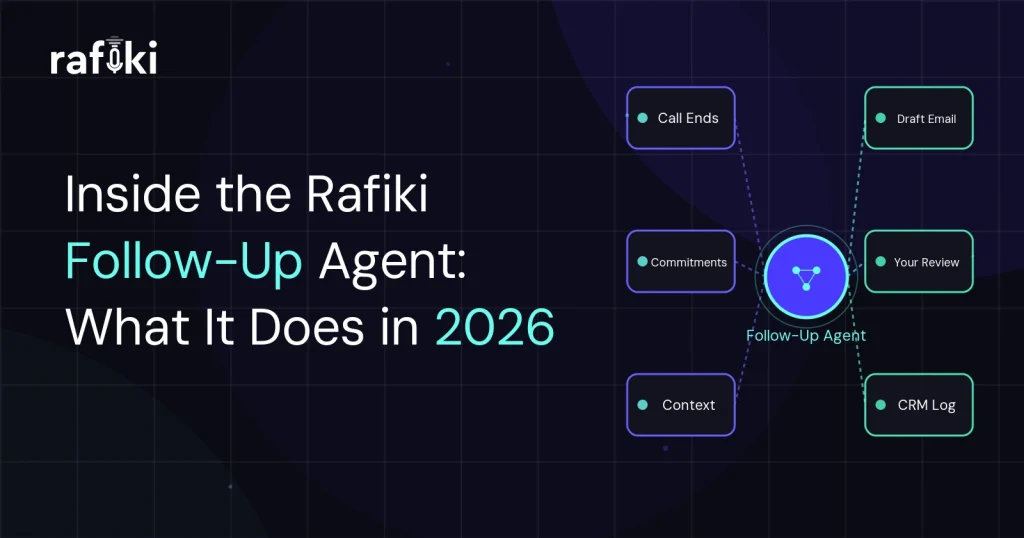
The Follow-Up Agent is the autonomous capability inside Rafiki AI — surfaced as Smart Follow Up — that turns a finished sales or customer success call into a ready-to-review follow-up draft, grounded in what was actually said. It works from the same conversational record as the rest of the platform: the transcript, the extracted commitments, the action items, and the stakeholder context from the meeting.
Equally important is what it is not:
In the agent lineup, the Follow-Up Agent sits immediately downstream of the conversation itself: the call ends, the record exists, and the follow-up work begins without anyone having to remember to start it.
The Follow-Up Agent's output is a draft email built from the conversation's actual substance. Mechanically, that means the draft assembles several grounded components:
Because the draft is grounded in the transcript, it inherits the conversation's specificity. The buyer who said "we need security sign-off before the 15th" gets an email that says exactly that — not a template paragraph about "next steps on the security front." Specificity is what makes a follow-up feel like attention rather than automation, and it is the thing reps writing from memory three hours later consistently lose.
For multi-stakeholder deals, the grounding extends to the room: the draft reflects who was in the conversation and what each party raised, which keeps follow-ups accurate even when the rep is juggling a dozen similar deals in parallel. And since Rafiki AI transcribes in 60+ languages, the same workflow holds for global teams whose calls do not happen in English.
Here is the workflow in full, because trust lives in the details:
The point of the loop is not bureaucracy; it is that the expensive part of follow-up was never the typing. It was the reconstruction — what did we agree to? who owed what? — and the delay that reconstruction causes. The agent eliminates the reconstruction and the delay while leaving the judgment, and the send decision, with the human being the buyer actually has a relationship with.
In practice, that converts follow-up from a memory task performed under deadline into an editing task performed with leverage. Editing a grounded draft takes a fraction of the effort of composing from recollection — and produces a more accurate email than even a diligent rep writes solo, because the source material is the call itself rather than what the rep retained of it.
A follow-up email is also an accountability instrument, and this is where the Follow-Up Agent quietly does its most valuable work. Conversations generate more commitments than anyone records. The buyer mentions they'll loop in their data team; the rep promises a pricing breakdown by Friday; someone agrees to "circle back after the board meeting." Individually small, these threads are precisely what deals slip on.
Because the agent works from the full conversational record, it surfaces:
Managers see the aggregate effect: deals where follow-ups consistently capture and close commitments move differently than deals where they don't. That signal feeds the rest of the platform — deal-health context the Revenue Agent weighs, and execution patterns the Coaching Agent can coach on.
There is a buyer-side effect too, and it is underrated. A follow-up that accurately restates the customer's own asks tells them they were heard — which is rarer than it should be in B2B buying. Over a multi-month evaluation, the team whose written record is consistently accurate accumulates a quiet credibility advantage that no amount of polished outreach can buy. Buyers may never mention it; they notice it.
The Follow-Up Agent is one stage of a pipeline that begins when the conversation does. Three integrations matter most in daily use:
This shared-record architecture is the practical meaning of "AI-native." The Follow-Up Agent is not an email tool bolted onto a recorder; it is one consumer of a single conversational source of truth that also powers scoring, coaching, syncing, and forecasting. Rafiki AI connects natively to Salesforce, HubSpot, Zoho, Pipedrive, and Freshworks, and captures calls across Zoom, Teams, and Google Meet — so the loop closes inside the systems your team already runs on.
Per-agent transparency cuts both ways, so here is the honest list. The Follow-Up Agent does not:
These boundaries are design decisions, not roadmap gaps. The reason is the one this article opened with: follow-up is where AI trust gets decided, and trust survives on knowing exactly where the machine stops and the human begins.
Any agent can handle the clean demo call. Trust is built on the messy ones, so it is worth being specific about how the Follow-Up Agent behaves when conversations are not tidy.
Some calls end ambiguously — the buyer is non-committal, the next step never gets stated. A grounded draft makes that ambiguity visible instead of papering over it: there is no confident "looking forward to our next conversation" when no next conversation was agreed. For reps, that visibility is itself a prompt — the draft missing a next step is the signal to go create one. Managers eventually learn to read the same signal across the pipeline.
When a deal runs across parallel conversations — a technical track, a commercial track, an executive track — follow-up accuracy depends on keeping the threads straight. Because every draft is grounded in its own call's record, the security-review recap does not bleed into the pricing recap. Meanwhile, the longitudinal view ("everything promised to this account, across all threads") stays one Ask Rafiki query away, so the rep who owns the relationship can keep the whole ledger in view.
Escalations, pricing pushback, a frustrated stakeholder — these are calls where a wrong word in writing costs real money. Here the review loop earns its keep most visibly. The draft gives the rep an accurate account of what was said to work from, and the human decides what belongs in writing, what gets a phone call instead, and what needs a manager's eyes first. The agent's job is fidelity; diplomacy stays human.
The day-to-day difference compresses into a simple contrast:
| Dimension | Manual follow-up | With the Follow-Up Agent |
|---|---|---|
| Source | Rep's memory and notes | The conversation record itself |
| Timing | Hours or days after the call | Draft ready while the call is fresh |
| Commitments | The ones somebody wrote down | Both sides' commitments, extracted |
| Coverage | The calls reps get to | Every recorded call |
| CRM agreement | Two separate manual updates | Same record feeds email and CRM |
| Send decision | Human | Still human — by design |
Notice what the last row preserves. The rows above it remove reconstruction work; the bottom row is the line that does not move.
For the account executive, the follow-up goes from a dreaded evening task to a two-minute review. The practical gain is speed and accuracy on the deal-advancing email — recaps land while the conversation is fresh, commitments are stated precisely, and nothing from minute 43 gets lost. Multiplied across a full calendar of calls, that is hours returned to actual selling every week — which is why account executives tend to be the agent's fastest adopters.
For the customer success manager, every QBR and renewal call produces a written record both sides agree on. The follow-up becomes the running ledger of the relationship — what was promised, what was delivered, what's outstanding — which is exactly the evidence trail that renewal conversations and churn post-mortems later depend on.
For the frontline manager, follow-up quality stops being invisible. Because drafts are grounded in the same record the platform scores, managers can finally see execution in the gaps between meetings: which commitments are being made, kept, and followed through — without riding along on every call.
If you want to evaluate the agent the way we'd suggest, run this two-week loop with a handful of reps:
Setup takes about 15 minutes, support is included on all plans, and the agent works from your first recorded call — there is no training period where it needs to learn your team before being useful.
No. The agent drafts; a human reviews and sends. This is the product's central design decision, not a configurable shortcut. Customer-facing communication carries relationship and legal weight that belongs with the person accountable for the account — the agent removes the reconstruction work, never the decision.
A grounded recap of the conversation, commitments from both sides, action items with owners, and the agreed next step — each traceable to the call itself. If something was not said in the conversation, it does not appear in the draft. Reps then edit for tone, strategy, and relationship context before sending.
Generic AI writers compose from prompts and templates; sequencers send scheduled campaigns to prospects you have not spoken with. The Follow-Up Agent does neither. It exists strictly downstream of a real conversation, which is what makes its output specific rather than plausible — and it shares its source of truth with conversation intelligence capabilities like scoring and CRM sync, rather than operating as a disconnected writing tool.
Both. Any recorded conversation — discovery, demo, QBR, renewal, escalation — produces the same grounded draft workflow. CS teams tend to value the running written ledger of commitments most, since renewals and expansion conversations depend on exactly that history.
A meeting source and, optionally, a CRM. Rafiki AI captures calls from Zoom, Teams, and Google Meet, transcribes in 60+ languages, and syncs with Salesforce, HubSpot, Zoho, Pipedrive, and Freshworks. Setup takes about 15 minutes, and the Follow-Up Agent is useful from the first recorded call — there is no training period, no minimum seat count, and support is included on every plan.
The Follow-Up Agent exists because the moments after a call are where good conversations go to die — where commitments evaporate, recaps drift from reality, and momentum waits on a rep's memory and calendar. Grounding the follow-up in the conversation itself, and keeping the send decision human, fixes the failure without creating the new one everybody fears: an AI speaking to your customers unsupervised.
That is the pattern across this whole series. The Coaching Agent multiplies a manager's attention; the Revenue Agent multiplies a leader's visibility; the Follow-Up Agent multiplies a rep's reliability. None of them replace the judgment they serve — and in 2026, that division of labor is what separates AI revenue teams that compound from AI experiments that stall.
See the Follow-Up Agent alongside the rest of Rafiki AI's autonomous AI agents — plans start at $19 per seat per month with no seat minimums and no annual commitment. Start your free trial today or book a demo and watch your next call turn into a follow-up your buyer actually reads.
Start for free — no credit card, no seat minimums, no long contracts. Just better sales intelligence.