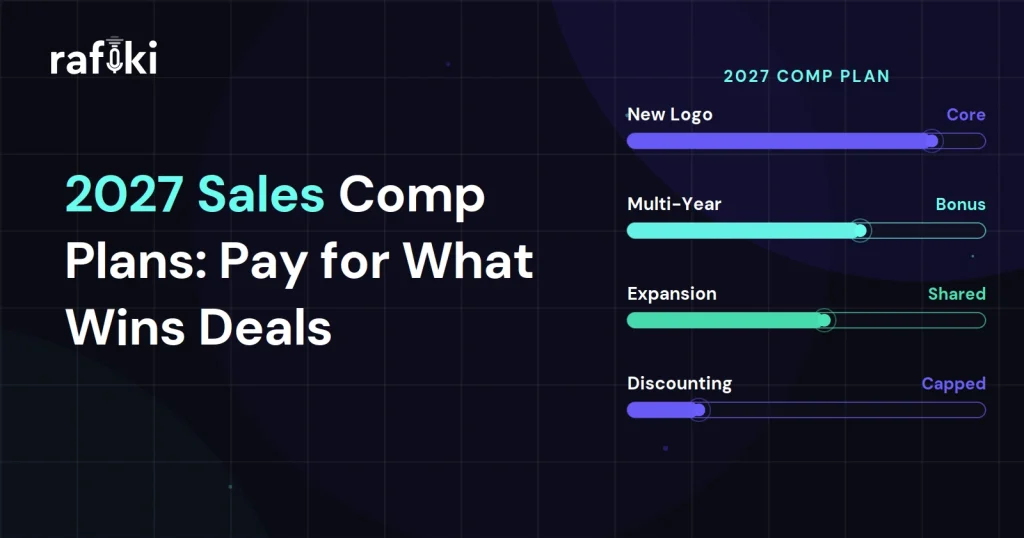
In late October, a RevOps lead drops this year's plan and a bookings export by rep into the comp committee folder. The CFO wants the 2027 sales comp plan signed before Thanksgiving, because HR has to send plan documents in December. Then the VP of Sales pulls up the top earner as proof that the multi-year kicker works. She closed more three-year contracts in Q3 than anyone on the team.
Nobody in the room has heard how those contracts came together. On the final call for two of them, the buyer asked what the rep could do on price for a September signature. The rep offered a longer term at a lower annual rate, the buyer said yes, and both deals now sit in the export as multi-year wins. Each buyer wanted a discount, and the kicker paid out as if each one had asked for a three-year partnership.
Most comp committees build next year's plan exactly like this, from bookings totals and whatever last year's rules said. You also have a year of call recordings that show what actually won deals, and October still leaves time to listen to them. This guide walks RevOps and sales leaders through checking each plan rule against those calls. It also covers the discounting habits the old plan paid for and how to test changes in Q1.
A sales comp plan is the set of written rules that decides how a company pays its sellers for results. In practice, it covers on-target earnings (OTE), the split between base salary and variable pay, quota, commission rates, and accelerators above quota. Most plans also carry a kicker or two for new logos or multi-year terms, plus a clawback when a customer cancels early.
Whatever the kickoff deck says about values, reps read the plan to learn what the company wants from them. Pay one rate for renewals and new logos, and reps will treat a renewal and a cold enterprise deal as equal work. Add a multi-year kicker, and by February every proposal offers a three-year option. That includes proposals for buyers who only ever asked about price.
The rewrite happens once a year, and it lands in Q4 whether anyone is ready or not. RevOps builds the model and finance checks the cost. After that, the CRO signs off so HR can send documents before the fiscal year turns over.
Quota and headcount come out of the same model, and we covered that half in our piece on 2027 revenue planning. What follows picks up after the targets exist, when the committee has to decide what the plan actually pays for.
Finance wants revenue to outgrow the cost of selling it, so a plan that pays for the wrong deals hurts more. Gartner's CFO research puts a number on how widely finance leaders hold that view.
In an October 2025 press release, Gartner shared results from a survey of 142 CFOs that it ran in August and September 2025. According to the survey, 64% of CFOs planned to grow SG&A budgets more slowly than revenue in 2026. Commissions and sales salaries sit inside SG&A at most companies, so that pressure lands on the variable pay pool directly.
If the same thinking carries into 2027 budgets, the pool for variable pay won't keep pace with bookings targets. Every commission dollar has to buy a deal the company actually wanted. Paying full rate on a steeply discounted quarter-end deal means paying commission on margin the company already gave away.
Expect the CFO to ask, rule by rule, what behavior each one pays for and whether that behavior wins good deals. Bookings reports show what closed and when. They can't show why the buyer signed or what the rep traded to get the signature.
A bookings export tells you the deal closed and says almost nothing about how. Comp design needs the how, because every rule you write will shape the behavior that produces next year's outcomes.
Four facts matter for plan design, and you will almost never find them in a bookings export:
The CRM holds a couple of these as fields, like a close reason picked from a dropdown. Reps fill in that dropdown after the deal closes, often when finance needs it to release the commission payment, and they pick whatever sounds defensible. The recording kept what the buyer said at the time, and that makes it the better source.
If your team records calls with a conversation intelligence platform, you already have that record for most of this year's deals. Comp committees rarely open it, since plan design has always run on finance data and nobody thinks to ask. Even a dozen calls per deal type gives the committee something real to test each rule against.
Pull this year's closed-won deals, sort them by deal type, and listen to the final calls in each group. You want to learn why each type closed, so the plan can pay more for deals that closed for good reasons.
Most B2B teams can use five groups: new logos, expansions, renewals with an upsell, multi-year contracts, and deals discounted past normal approval. A deal can land in more than one group, and the overlaps tell you the most. When the same deal shows up as both multi-year and heavily discounted, the kicker probably paid for a price cut.
For each group, the RevOps analyst pulls the last two calls from a sample of deals. A dozen deals per group is usually enough to hear the pattern. One analyst can get through it in a few days. While listening, the analyst answers the same short set of questions for every deal:
If you sell with MEDDIC or something like it, your scorecards already cover part of this. They show whether the rep found the economic buyer and the decision criteria. The pricing and term questions are the new part, and most scorecards skip them entirely.
What you'll hear is that each group splits in two. Some deals closed because the buyer had a real problem with a date on it, and the rep got to the budget owner. The rest closed because the rep gave up something at the end, usually price, to pull the date into the quarter. Your plan should pay noticeably less for that second kind.
Most comp plans pay the same rate for a discounted deal as a clean one, and reps notice within a quarter. A rep who needs one more deal to hit an accelerator will trade price for timing, and you can hear it on the calls.
Once a manager starts listening for it, the pattern is hard to miss, and some of it comes from the buyer. One buyer asks what the rep can offer for a signature this month, while another mentions that they waited for the quarter end last year, too. On other calls, the rep brings up a discount before the buyer has pushed back on price at all. You will also hear reps anchor the signature to "end of quarter" instead of any date that matters to the buyer.
Picture the week after the VP announces a SPIFF on the 20th. By the next Thursday forecast call, a few reps have moved deals from best case to commit. Each of those redlines, still sitting in legal, now carries a new discount line. Nobody broke a rule, because the plan told them exactly what to do.
We covered the buyer side of this in quarter-end discounting, where buyers learn to hold out for the last week. On the rep side, the comp plan usually explains the behavior better than any coaching gap does. If quarterly accelerators have no link to net price, the discount that saves the quarter is the rational move for the rep.
Two plan changes reduce that pull without punishing reps for ordinary negotiation. Paying commission on net price is the simplest fix, since the rep who gives a discount shares its cost. Some teams also move part of the accelerator to annual attainment, which makes one late deal matter less. Either change deserves a Q1 test before it goes into every rep's plan.
A sales comp plan should pay for outcomes, and the calls tell you which outcomes separated real wins from bought ones. Once the committee has heard that difference, it can pick measures that track it.
The right changes depend on what your calls show, but these five come up again and again in comp reviews:
Every year, somebody on the committee suggests paying reps on call scores directly. Don't, because reps figure out within weeks which phrases the scorecard listens for. The scores go up while the conversations stay the same, and managers lose a coaching signal they used to trust.
Keep behaviors like sharp discovery or early contact with the economic buyer in coaching and deal reviews. Let the plan pay for what those behaviors produce, like higher net price and customers who renew. With that split, reps have nothing to game, and finance can check every measure in the plan against the CRM.
Most plans start as last year's plan plus a bookings export. When you add call evidence, the inputs change at almost every decision the committee makes.
| Plan decision | Bookings-only design | Evidence-based design |
|---|---|---|
| Multi-year kicker | Pays on any contract over one year | Pays when the term came without an extra discount |
| Commission base | Gross bookings | Net contract value after discounts |
| New logo vs. renewal rates | Copied from last year | Set from the effort calls show for each type |
| Accelerators | Quarterly thresholds | Partly annual, based on discount patterns |
| Top-earner review | Total bookings and attainment | Final calls from their largest deals |
| Plan changes | Rolled out to every rep on January 1 | Tested with one team in Q1 first |
Never roll a new rule out to the whole floor on January 1 without trying it on one team first. One team running the change in Q1 gives the committee real evidence by the end of March.
Before anything starts, RevOps should confirm with HR and legal that the plan documents allow this kind of change. Many teams run it as a SPIFF or plan addendum, so the base plan survives if the change flops.
Start with the change that has the clearest evidence behind it, which for most teams is paying commission on net price. You want a team with a stable manager and enough deal volume to show a pattern inside one quarter. A second team stays on the old rule for comparison.
Before the quarter opens, the RevOps lead and the team's manager write down what should change on calls. With a net-price rule, reps should raise discounts later and less often, and buyers should hear a reason attached to any concession. Put it in writing first, because otherwise the review bends toward whatever result shows up.
Every other week, the manager listens to the pricing moments from a handful of late-stage calls on both teams. The hour it takes catches ugly side effects early, like a rep who holds a signed order form until April for a fresh accelerator. When the manager hears a real problem, the committee can adjust the rule mid-quarter without waiting for the numbers.
In the last two weeks of March, RevOps puts net price and deal count for both teams next to the call review notes. The committee then decides whether to extend the change to every team or drop it. Either way, reps on the test team should hear the reasons from their own manager before the revised plan document reaches their inbox.
A plan document full of formulas has never convinced a rep of anything. Reps accept a new rule when they can see the deals behind it, which means managers need real calls to point at.
Frontline managers can walk each rep through two anonymized deals from this year in the first January one-on-one. In one, a rep holds price and closes on the buyer's date. The second closes on a late discount and, under the new rule, costs the rep real commission. Seeing the two side by side makes the gap concrete in situations the rep will face again next year.
Talk to your top earners privately before the plan goes out. Some of them made a big share of their pay on deals the new plan pays less for. If they first learn that from a slide at kickoff, you will spend February handling the fallout in DMs and skip-levels. A sales leader who plays them the calls and walks through the new math has a harder December and an easier kickoff.
Account executives also need to know exactly how the company will measure them, especially if the plan now pays on net price. When reps can check their own deals against the rule during the quarter, fewer commission statements turn into disputes later.
A comp review built on call evidence needs a transcript for each disputed deal, and Rafiki AI keeps that record. It transcribes sales calls in more than 60 languages, whether the rep met over video or called through Aircall or OpenPhone. When someone asks how the top earner's multi-year deals closed, RevOps leaders can answer from the final calls.
For the deal-type review, Smart Call Scoring scores every call against MEDDIC, BANT, SPICED, or custom criteria. A RevOps analyst can build a custom scorecard that includes the pricing and term questions from the review. Smart Call Summary summarizes each of the final calls, so the analyst can read the pricing discussion before opening the recording.
With Gen AI Search, a sales leader can search this year's calls for moments where a buyer asked for a discount. The analyst can then use Gen AI Reports to build a written report from the call data for the comp committee.
During the Q1 test, Smart CRM Sync fills in the CRM fields the team chooses after each call, including custom ones. RevOps can then compare the test team and the control team in the same reports it already runs.
This week, ask your RevOps analyst for the Q3 closed-won deals that carried a discount above the normal approval level. Next to that list, add an equal number of Q3 wins that closed at or near list price. Running the final two calls of each deal through the five questions above takes the analyst a few days.
Bring a one-page summary to the first comp committee meeting in November. It should show who proposed each multi-year term, when pricing came up, and whether the rep tied the signature to the quarter end. From there, pick the one change the evidence supports best and name the team that will test it in Q1. Get the biweekly review dates on everyone's calendar before the holidays eat December.
Rafiki AI's conversation intelligence platform starts at $19 per seat per month. You can buy a single seat for the analyst running the comp review. Open a trial account at no cost and run the pricing questions against your own Q3 calls. For a guided look first, book a demo and bring the deal your committee argued about longest.
A sales comp plan should reward outcomes that came from good selling, such as new logos at healthy net prices. The fastest way to find those outcomes is to listen to the final calls on this year's wins. Any rule that paid for late discounts or rep-driven term extensions deserves a hard second look.
Call recordings show how each deal closed, which bookings data cannot. RevOps can hear who proposed a multi-year term, when pricing came up, and whether the rep offered a discount before the buyer asked. Those details tell the comp committee which rules paid for the behavior it wants.
Keep call scores out of pay, because reps quickly learn which phrases a scorecard checks and start saying them. The scores rise while the calls stay the same, so use scores for coaching and let the plan pay for results like net price and retention.
Run the change with one team for a quarter as a SPIFF or plan addendum, and keep a second team on the old rule. Write down what should change on calls before the quarter starts. Then review pricing moments every two weeks and decide by the end of the quarter.
Start for free — no credit card, no seat minimums, no long contracts. Just better sales intelligence.