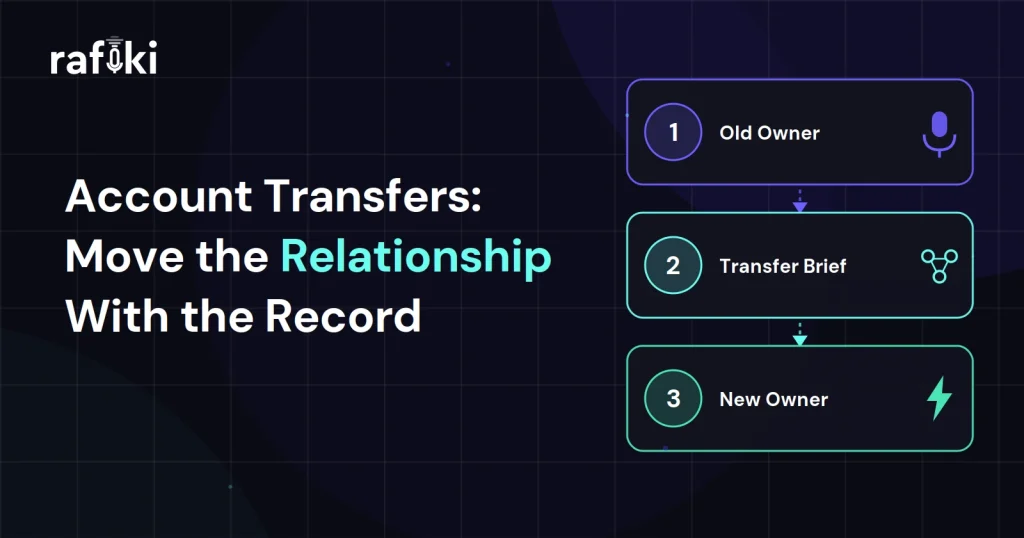
In the second week of January, an account executive emails every contact in the book she picked up through the year's account transfers. An operations director at one customer replies within the hour with a question the new rep cannot answer. Last fall, she spent three calls walking the previous rep through a vendor consolidation project. Now she wants to know if the pricing review he promised before renewal is still on.
The CRM record says only "renewal Q2, healthy," so the new rep has no idea which review she means. RevOps ran the transfer by the book, changing the owner on the planned date with the deal history intact. What stayed behind was the context the old rep carried in his calls. That context includes who the real champion was, what he promised, why the director distrusted her last vendor, and which budget funds the renewal.
Many RevOps teams finish their 2027 territory maps this fall, and a lot of accounts will change owners by late January. This article lays out a process to put in place before those accounts move, starting with a one-page transfer brief built from each account's call history. After that come a joint handoff call, a way to order transfers around renewal dates, and a 30-day check on whether the customer noticed.
An account transfer is the planned move of a customer or prospect account from one owner to another. Transfers usually follow a territory redesign, a promotion, a rep departure, or a change in segment rules. In most companies RevOps runs the mechanics, which cover the owner field, open opportunities, tasks, and renewal dates.
A complete transfer moves two things. Contract dates, products, open deals, and logged activity make up the record, and a CRM stores that part well. The relationship is what the customer believes about your company and its people. Most of it lives in conversations the previous owner had over months or years.
You can tell which one moved the first time the new owner talks to the customer. When the new rep knows the champion, her project, and the open promise, the customer barely registers the change. A rep who starts from a blank page forces the customer to decide whether to invest in the relationship again. Some customers use that moment to look at other vendors.
RevOps teams usually build transfer processes around the CRM, so the checklist covers only what a system can verify. The departing owner rarely gets a template or protected time to hand over the rest. A few common habits make the gap wider.
We covered how to draw the map in our piece on territory design for 2027 from deal evidence. This article starts where that one ends, with each account waiting for an owner who can keep the relationship intact. For wider reading on how B2B customers judge vendors, McKinsey keeps its growth, marketing and sales research in one library.
From the customer's side, a new account owner raises one question: does this company remember us? Customers judge the answer from the first email and the first call. A champion who explained their procurement process for an hour will notice when the new rep asks how procurement works.
Salesforce's State of the Connected Customer research tracks how strongly customers expect companies to keep context across departments. An account transfer tests that expectation, because the customer did nothing to cause the change. They simply open their inbox one morning and find a new contact.
In practice, a customer notices when the new rep asks them to explain their goals again, or when a promise from the old rep goes quiet. A pitch for a product they turned down last year stands out too, and so does a monthly meeting that drops off the calendar with no explanation.
Few customers complain about any of this out loud, so the damage is easy to miss. The champion answers emails a little slower, and the executive sponsor skips the next business review. By the time the new owner spots the pattern, the renewal may be only a quarter away.
The table below compares a typical record-only transfer with one that also moves the relationship. Its left column shows common practice today, and the right column shows what the new owner needs on day one.
| Account context | Record-only transfer | Relationship transfer |
|---|---|---|
| Champion and power map | Contact list with job titles | Named champion, skeptic, and signer, taken from calls |
| Open commitments | Open tasks, if the rep logged them | Every promise the old rep made, with the call it came from |
| Sensitive topics | Missing | Past incidents, pricing history, and subjects to avoid |
| Customer goals | A generic use-case field | The goal in the customer's own words |
| Introduction | Automated email from the CRM | Joint call with the old and new owner |
| Follow-up | Nothing scheduled | A 30-day check on engagement and tone |
Most of the right column comes from conversations, which is why notes alone rarely fill it. A rep writes down what seemed important on the day of the call. The customer's exact words about a failed rollout or a nervous CFO rarely reach the CRM, and the new owner needs those words most.
A transfer brief is a one-page document the new owner reads before first contact. The best source for it is the account's recorded calls. If your team captures calls with a conversation intelligence platform, the old owner can build the brief from recent quarters. A recording keeps the customer's own words, which a rep's memory of the call usually loses.
Keep the brief to five sections so the old owner can finish it in one sitting. Each section should point to its source call, so the new owner can listen to the moment itself.
Start with who holds the relationship on the customer's side. List the champion, the signer, anyone who raised doubts on a call, and anyone who went quiet this year. Many accounts depend on one person, and the new owner needs to know that before the first email.
Go through the calls and pull out every commitment the old rep made that the company has not kept yet. That might be a pricing review, a feature request, a training session, or a reference call. An open promise loses trust fastest after a transfer, because the customer assumes the new owner knows about it.
Every long relationship has a few subjects that need care. A support outage last spring belongs here, along with a discount the customer fought for. So does a stakeholder who resents the purchase or a feature the old rep hinted at but never confirmed. The new owner should learn about these from the brief before an irritated customer raises them.
Write down the customer's goals in their own words, copied from the calls. "Cut the number of vendors our ops team manages" tells the new owner more than "efficiency" in a dropdown. The new rep can use that sentence on the first call, and the customer will recognize it as their own.
Close the brief with the next event on the customer's calendar that affects your business. It could be a renewal, a budget meeting, a board review, or the end of a pilot. The new owner plans the first 30 days backward from that date, so it should be easy to find at the bottom of the page.
In a typical failed transfer, RevOps assumed the old rep would pass on the context, and the old rep assumed the CRM already held it. RevOps leaders should own the account list and the brief template, and they decide which accounts get joint calls. The departing owner drafts each brief, because they know which calls to check first.
The receiving rep reads every brief before first contact and writes down a few questions for the joint call. Account executives who inherit a book in January often skip this step, so their manager should protect time for it. Treat the briefs as part of the ramp plan for the new territory, with a due date.
Frontline managers review briefs for their largest accounts and join joint calls where one champion holds the relationship. For current customers, the customer success manager should read the brief too. In many accounts the CSM has the steadiest relationship, and the new rep can lean on that during month one.
For your most important accounts, schedule a short call with the customer, the old owner, and the new owner. Twenty to thirty minutes is enough, and the old owner should send the invite from a name the customer trusts. Keep any sales agenda off this call so the customer can focus on the people.
Send the recap even when the call went smoothly. Written under the new owner's name, it tells the customer that the goals and promises survived the change. The new rep can also point back to it at the 30-day check.
Some transfers happen because a rep resigned, so no joint call is possible. In that case the recorded calls are the only full account of the relationship. A manager or RevOps analyst builds the brief from those calls, which takes longer when nobody can confirm the promises.
On the first call, the new rep should acknowledge the change directly. A good opening says the previous owner has moved on and that the new rep listened to recent calls. Then the rep asks to confirm a few things before anything else, starting with a specific goal or promise. That opening tells the customer the history did not leave with the old rep, which is the thing they are most likely worried about.
For accounts with a large renewal coming up, the manager should join that first call too. Their presence signals that the company treats the account as a priority, and it gives the new rep backup.
The territory plan sets one cutover date, but customers each run on their own calendar. An account in a renewal negotiation or late-stage expansion deal should usually stay with its owner until the deal closes. Moving it mid-negotiation forces the customer to rebuild trust just as they decide whether to spend more.
A simple way to plan the order is to sort every moving account by two factors. One is how soon the next renewal or decision date arrives. The other is how many people at the customer have a working relationship with your team. Accounts with a near date and a single champion carry the most risk, so they get the first briefs and the first joint calls.
Compensation rules should support that order. When the old owner keeps credit on deals they finish after cutover, they have reason to make a good introduction. Our guide to the sales-to-CS handoff makes a similar point about closed deals moving to the post-sale team.
Rafiki AI is the intelligence layer between your conversations and your revenue decisions. It records and transcribes the calls your team has with each account, so the history is searchable on the new owner's first day. That shortens the work of writing a brief and lets the new rep check details on their own.
With Ask Rafiki Anything, the new owner can ask "What did we promise this customer about pricing?" The answer comes from the account's own calls. Smart Call Summary writes a summary of each past call, so the brief's author opens full recordings only when needed.
Smart CRM Sync fills in methodology fields like the MEDDIC champion and economic buyer, plus custom CRM fields. As a result, the record the new owner inherits already holds more of the relationship than manual notes would. Rafiki AI works with Salesforce, HubSpot, Zoho, Pipedrive, Freshworks, and Monday.com. It also transcribes calls in 60+ languages, which helps teams that move accounts between regions.
Smart Call Scoring scores calls against any methodology or against your own criteria. RevOps can build a short handoff scorecard that checks whether the old owner restated goals and set a next meeting. After the joint call, Smart Follow Up drafts the recap email for the new owner to review and send.
For the whole transferred book, RevOps can use Gen AI Reports to see which accounts met their new owner in month one and where customer sentiment dropped after the change. Because Rafiki AI connects to Aircall and OpenPhone, phone calls count toward that picture along with video meetings.
Thirty days after each high-risk transfer, the new owner and their manager should review the account together. They want to know whether the customer experienced a continuation or a restart. The first few calls with the new owner usually answer that clearly.
Listen to those calls for four signals, and note what you hear.
If the answers look bad, act before the next renewal conversation. The manager can call the champion, or the old owner, if still around, can send a personal note. Customer success leaders should see the results too, because a cooling account often shows up in their renewal forecast a quarter later.
This month, ask RevOps for the full list of accounts that change owners under the 2027 plan. Sort it by next renewal date and by engaged contacts, then flag accounts with a near date and one champion. Write briefs for those accounts by the end of November, and book joint calls for early December before the holidays.
Pick one measure to review in February: the share of high-risk accounts that met their new owner within 30 days. That number tells you whether the relationships moved, and it gives you a baseline for the next territory change.
Rafiki AI's conversation intelligence platform records and summarizes your customer calls, so every account's next owner inherits the full history. Plans start at $19 per seat per month, and you can buy as few seats as your team needs. Start a free trial and build a transfer brief from real calls, or book a demo to see one of your own accounts.
Start about six to eight weeks before the cutover date. That window lets departing owners write briefs while they still hold the accounts, with room left for joint calls. For a January cutover, planning starts in November.
A transfer brief names the champion and the people around them, then lists every open promise and sensitive topic. It also quotes the customer's goals and marks the next date that matters. Each item links to its source call, and the whole brief fits on one page.
Most teams can't run a joint call for every account in a large transfer. Save them for accounts with a decision date in the next two quarters or a single champion. Smaller accounts can get a personal email from the old owner that introduces the new one by name.
The clearest sign is that the customer did not have to start over. Check whether the new owner met the customer within 30 days and whether the champion stayed engaged. If the first calls sound like a continuation of earlier conversations, the relationship moved with the record.
Start for free — no credit card, no seat minimums, no long contracts. Just better sales intelligence.