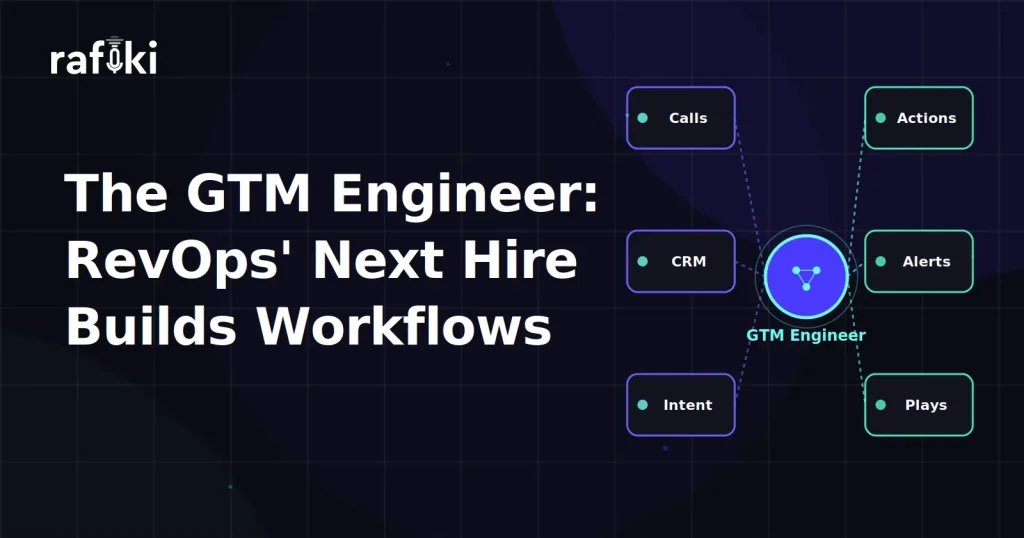
Every RevOps job description used to read the same way: build dashboards, clean the CRM, report on pipeline. In 2026, a different posting keeps showing up — the GTM engineer. Instead of asking for reporting chops, it asks for workflow design, signal routing, and experience supervising AI agents. That shift is not cosmetic. It reflects a deep change in what revenue teams need from their operations function.
For a decade, RevOps hired analysts to explain the past. Dashboards told you what happened last quarter, and attribution models told you why. Meanwhile, the deals themselves kept moving. By the time an insight reached the Monday pipeline review, the buyer had gone quiet, the champion had changed jobs, or a competitor had made the shortlist.
The GTM engineer exists to close that gap. Rather than explaining the past, this role builds systems that act on the present. Its workflows catch a signal in a sales conversation and trigger the right response within minutes, not weeks. This guide breaks down the role's scope and how it differs from adjacent ops roles. It also covers when your team needs one and which skills to screen for.
A GTM engineer is an operations professional who designs, builds, and maintains the automated workflows that run a company's go-to-market motion. In practice, that means routing signals to the right people, orchestrating actions across the revenue stack, and supervising AI agents. The role sits at the intersection of revenue operations, software engineering, and systems design. Where an analyst produces reports, a GTM engineer produces running systems.
Think of the difference between a weather forecaster and a civil engineer. The forecaster tells you rain is coming; the engineer builds the drainage system that handles it automatically. Similarly, a RevOps analyst tells you which deals look risky. A GTM engineer builds the workflow that flags risk the moment it appears in a call, then routes it to the owner with context.
Importantly, the title says "engineer" for a reason. These practitioners treat the GTM motion like a product. They version their workflows, test changes before shipping, monitor for failures, and iterate on what the system produces. That engineering mindset — not any single tool — is what defines the role.
Speed is the short answer. Buying committees move faster than quarterly reporting cycles, and revenue teams that respond to signals in hours consistently outperform teams that respond in weeks. Harvard Business Review makes this case in its analysis of how companies use AI to make faster decisions in sales and marketing. The competitive edge has shifted from having better data to acting on data sooner.
The longer answer involves a capability gap. AI can now transcribe calls, extract signals, score deals, and draft follow-ups. Yet most RevOps teams lack someone who can wire those capabilities into coherent, end-to-end workflows. As McKinsey's State of AI research explores, organizations capture value from AI not by adopting individual tools but by redesigning the workflows around them. Someone has to do that redesign. In revenue organizations, that someone is increasingly a GTM engineer.
There is also a headcount logic at work. Rather than adding another analyst to produce more retrospective reporting, CROs are converting that budget into a builder who multiplies the output of the existing team. One well-built workflow saves every rep hours per week — leverage no additional dashboard can match.
Strip away the tooling debates, and the role reduces to three core responsibilities. Each one converts raw signal into revenue action.
Revenue signals appear constantly: a buyer mentions a competitor on a call, a champion stops responding, a prospect asks about pricing three times in one demo. Signal routing means detecting those moments and delivering them to the right person — with context — while they still matter. In practice, the GTM engineer defines what counts as a signal, sets the thresholds, and builds the pipes that carry each signal from source to owner.
Routing a signal is only half the job; something has to happen next. Workflow design covers the "then what" — the sequence of automated and human steps a signal triggers. For example: a call reveals a security objection, so the workflow updates the CRM, notifies the solutions engineer, attaches the relevant clip, and schedules a follow-up task. Good workflow design also specifies the failure paths, because every automation eventually meets an edge case it cannot handle.
Autonomous AI agents now execute much of the repetitive work — summarizing calls, updating fields, drafting follow-ups, scoring deals against a methodology. Consequently, someone must define their guardrails, review their outputs, and tune their behavior over time. The GTM engineer plays that supervisory role: less like a user of software, more like a manager of a tireless digital team. When an agent drifts or a workflow misfires, the GTM engineer is the one who diagnoses and corrects it.
Titles blur in operations, so it helps to see the three roles side by side. Each answers a different question, operates on a different time horizon, and produces a different kind of output.
| Dimension | GTM Engineer | RevOps Analyst | Sales Ops |
|---|---|---|---|
| Core question | What should happen automatically, right now? | What happened, and why? | How do we keep the sales engine running? |
| Time horizon | Present — minutes to hours | Past — weeks to quarters | Ongoing — the current cycle |
| Primary output | Running workflows and supervised agents | Reports, dashboards, analyses | Territories, quotas, comp plans, process docs |
| Relationship to AI | Builds with it and supervises it | Uses it for analysis | Administers tools that include it |
| Success metric | Signal-to-action time, workflow reliability | Insight quality, forecast accuracy | Process adherence, rep productivity |
| Failure mode | Automation that misfires silently | Insight that arrives too late | Process that reps route around |
Notice the pattern: the analyst explains, sales ops administers, and the GTM engineer builds. All three matter. However, most teams already have the first two and lack the third — which is exactly why the hiring conversation has shifted.
Every workflow needs an input, and the richest input in any revenue organization is what buyers actually say. CRM fields capture what reps remember to type; conversation intelligence captures what actually happened — objections, competitor mentions, pricing questions, hesitation, enthusiasm, silence. For a GTM engineer, that stream of structured conversation data is the raw material everything else gets built on.
Consider the difference in trigger quality. A workflow built on CRM stage changes fires days after reality shifted, because stages update when reps get around to it. In contrast, a workflow built on conversation signals fires the moment a buyer says "we're also evaluating another vendor" or "our budget got cut." The trigger arrives at the source of truth, not at a lagging proxy of it.
This is also why modern revenue intelligence platforms matter so much to the role. They convert unstructured talk into structured, machine-readable events — topics, sentiment, blockers, methodology fields — that workflows can act on. We covered a related shift in The MQL Is Dead: when conversation signals replace form-fill proxies, the entire handoff between marketing and sales gets rebuilt. The GTM engineer is the person doing that rebuilding.
Not every team should rush to open a requisition. The role pays off when specific conditions hold, and it is premature when they do not.
Hire a GTM engineer when:
Conversely, hold off when your team is small, your motion is simple, and your conversations are few. In that situation, a builder would spend most of the week waiting for something to build.
Here is the twist in the 2026 hiring conversation: for many teams, the first "GTM engineer" is not a person at all. Autonomous AI agents now handle the foundational layer of the job out of the box. They capture calls, extract signals, score deals against methodologies like MEDDIC or SPICED, sync CRM fields, and draft follow-ups. As we explored in Agentic AI Revenue Operations, agentic systems increasingly execute the workflows that ops teams used to assemble by hand.
For lean teams, that changes the math entirely. A two-person RevOps function cannot justify a dedicated builder, yet it can deploy agents that deliver the same signal-to-action loop for the price of a software subscription. We made the fuller case in Lean Revenue Orchestration: small teams win by orchestrating intelligent systems rather than by adding headcount.
The honest framing is a spectrum, not a binary. Agents cover the standard workflows: call capture, field sync, follow-up, scoring. By contrast, a human becomes necessary when your motion demands custom logic across many systems, unusual routing rules, or deep integration work. Start with agents, and hire the human when your workflow backlog outgrows what configuration can express.
Whether you are hiring for the role or growing into it, screen against these six skills. Each H3 below states what good looks like.
Strong candidates see the GTM motion as one connected system rather than a pile of tools. Ask them to map a signal's journey from a customer call to a closed task, and listen for how they handle feedback loops and failure paths. Weak candidates describe features; strong ones describe flows.
The role demands comfort with data models, APIs, and transformation logic — knowing how a conversation event becomes a CRM field becomes a routed alert. Full software-engineering depth is optional; however, the candidate must read a payload without flinching and reason about where data gets lost or duplicated.
Look for evidence of shipped automations that survived contact with reality. Anyone can demo a happy path. The craft shows in error handling, idempotency, rate limits, and the discipline to document what was built so it outlives its builder.
This is the newest skill and the hardest to fake. Good candidates can explain how they would set guardrails for an agent, evaluate its outputs, and decide which decisions stay human. Ask how they would detect an agent drifting off-policy — the quality of that answer reveals real experience.
Workflows built by someone who has never watched a deal die are dangerous. Candidates need working fluency in pipeline mechanics, qualification frameworks like MEDDIC and BANT, handoff points, and the incentives that shape rep behavior. Otherwise they automate the wrong things beautifully.
Finally, the best GTM engineers treat internal workflows as products with users. They interview reps before building, measure adoption after shipping, and kill automations that nobody trusts. That instinct separates a builder who creates leverage from one who creates ticket queues.
Tooling determines how much of this role goes to building versus babysitting. On a legacy stack, GTM engineers burn most of their week on plumbing: exporting transcripts, patching brittle integrations, and reconciling fields across systems. An AI-native platform inverts that ratio by handling the plumbing natively, which frees the engineer to design workflows instead of maintaining them.
This is where Rafiki AI enters the picture. Rafiki AI acts as the intelligence layer between your conversations and your revenue decisions. It captures every call, then extracts topics, blockers, sentiment, and competitive signals in 60+ languages. Those become structured events a GTM engineer can route anywhere. Its autonomous AI agents work around the clock, so the standard workflows arrive pre-built rather than hand-assembled.
Take CRM hygiene, the workflow every GTM engineer gets asked to fix first. Smart CRM Sync auto-populates methodology-specific fields — MEDDIC, BANT, SPIN, SPICED, or custom — straight from what was said on the call. It works across Salesforce, HubSpot, Zoho, Pipedrive, Freshworks, and Monday.com. As a result, the engineer skips months of field-mapping work and starts building on clean, current data from day one. Curious how that feels in practice? Start your free trial today and wire your first conversation-triggered workflow this week.
For RevOps leaders, the planning question is sequencing, not either/or. First, deploy an AI-native sales automation foundation so the standard signal-to-action workflows run without custom engineering. Next, watch where configuration runs out — the custom routing rules, the odd integrations, the workflows unique to your motion. That backlog is your business case for the human hire.
For ops ICs eyeing the role, the path is equally concrete. Volunteer for every automation project, learn to read API documentation, and build a portfolio of workflows that shipped and survived. Meanwhile, get hands-on with agent supervision, because that skill is scarce and compounding. Analysts who can build are being promoted into these roles from the inside far more often than companies are hiring them from outside.
Either way, the direction is settled. Operations work is shifting from explaining revenue to engineering it, and the teams that make the shift early will set the pace for everyone else.
RevOps spent a decade perfecting hindsight. Dashboards got sharper, attribution got smarter, and deals kept dying in the gap between insight and action. The GTM engineer closes that gap. Signals get routed the moment they surface, and workflows act instead of waiting for a meeting. Meanwhile, autonomous AI agents handle the repetitive work at machine speed.
The hiring decision, therefore, is really a sequencing decision. Let AI agents cover the standard workflows first, then bring in a human builder when your backlog of custom logic demands one. Teams that get the sequence right turn conversation data into pipeline while their competitors are still formatting last quarter's slides.
A typical week mixes building, monitoring, and tuning. The GTM engineer designs new workflows — for example, routing competitor mentions from calls to deal owners — and ships them with proper error handling. In addition, they monitor existing automations for silent failures and review AI agent outputs against quality guardrails. Thresholds get adjusted when signals fire too often or too rarely. Stakeholder work fills a meaningful slice too: interviewing reps about broken handoffs, prioritizing the workflow backlog, and documenting systems so they outlive any single person. The common thread is that outputs are running systems, not reports. If a week produced only slides, something went wrong.
The two roles answer different questions on different time horizons. An analyst looks backward and explains: what happened to win rates, why the forecast slipped, which segment converts best. A GTM engineer looks at the present and acts: building the workflow that catches a stalled deal today and routes it to the owner with context attached. Their outputs differ accordingly — the analyst ships dashboards and analyses, while the engineer ships automations and supervised agents. Success metrics diverge too: insight quality for the analyst, signal-to-action time and workflow reliability for the engineer. Most mature RevOps teams eventually need both, because explanation and action reinforce each other.
Start with autonomous AI agents, and hire the human when configuration runs out. Agents now cover the standard signal-to-action workflows — call capture, signal extraction, methodology scoring, CRM field sync, follow-up drafting — at a fraction of a salary. Consequently, a dedicated builder only earns their keep once your motion demands what off-the-shelf agents cannot express. Think custom routing logic across many systems, unusual integrations, or workflows unique to your business model. A practical signal is your backlog. When you have a quarter's worth of custom workflow requests that no amount of configuration can satisfy, the business case for the hire writes itself.
Screen against six areas: systems thinking, data fluency, workflow craft, AI agent supervision, GTM domain knowledge, and product mindset. In practice, two exercises reveal most of them. First, ask the candidate to whiteboard a signal's full journey, from buyer comment to completed CRM action. Then probe for failure paths and edge cases. Second, ask how they would supervise an AI agent that drafts follow-ups: what guardrails they would set, how they would evaluate outputs, and how they would detect drift. Strong candidates answer with specifics from systems they have actually run, and they can show the artifacts to prove it. Weak candidates describe tools they have merely used.
Rafiki AI's conversation intelligence platform gives GTM engineers — human or otherwise — the structured conversation data every workflow needs. Plans start at $19 per seat per month with no minimums and no annual commitment. Start your free trial today or book a demo to see how autonomous AI agents turn your calls into pipeline.
Start for free — no credit card, no seat minimums, no long contracts. Just better sales intelligence.